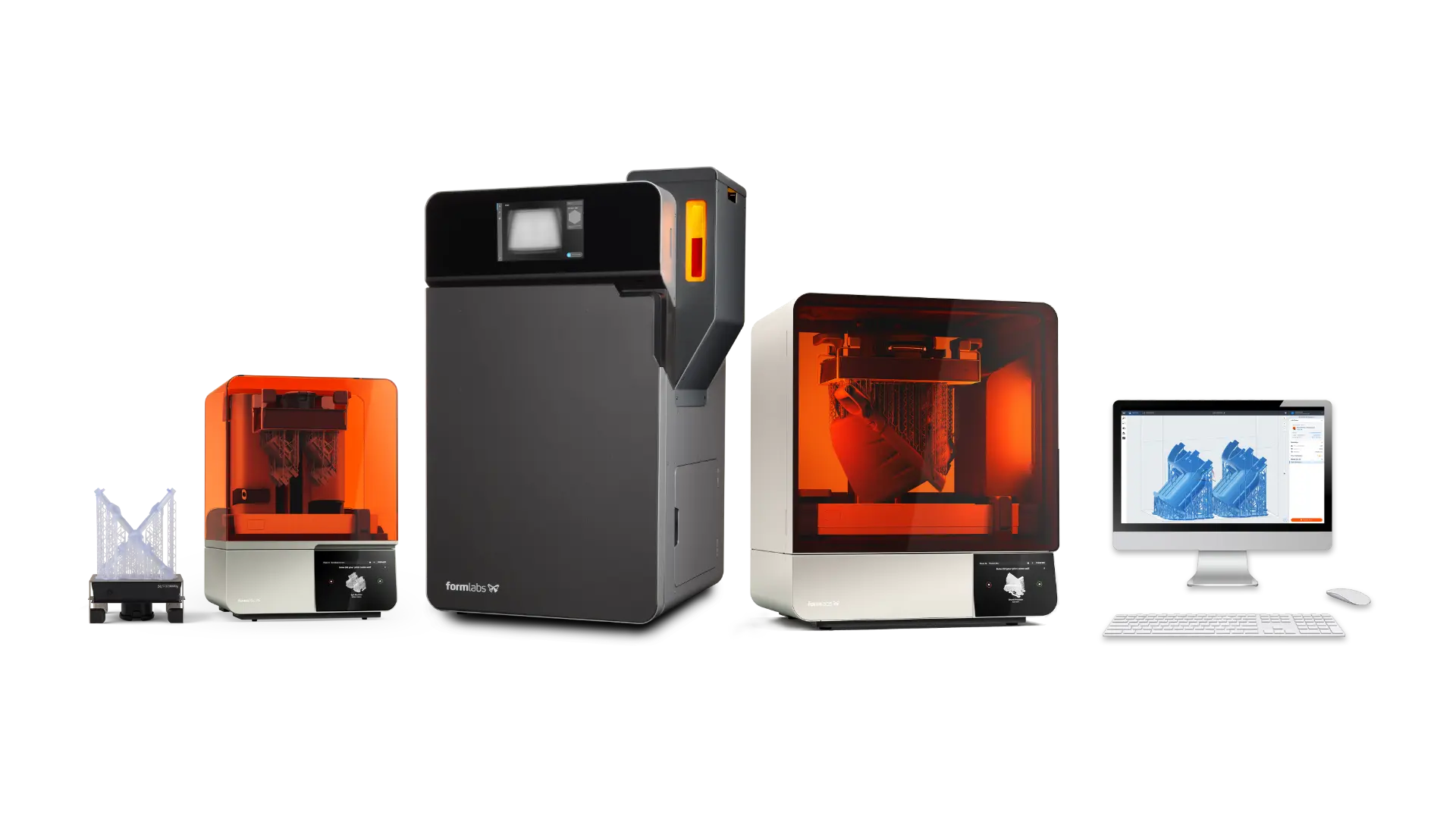
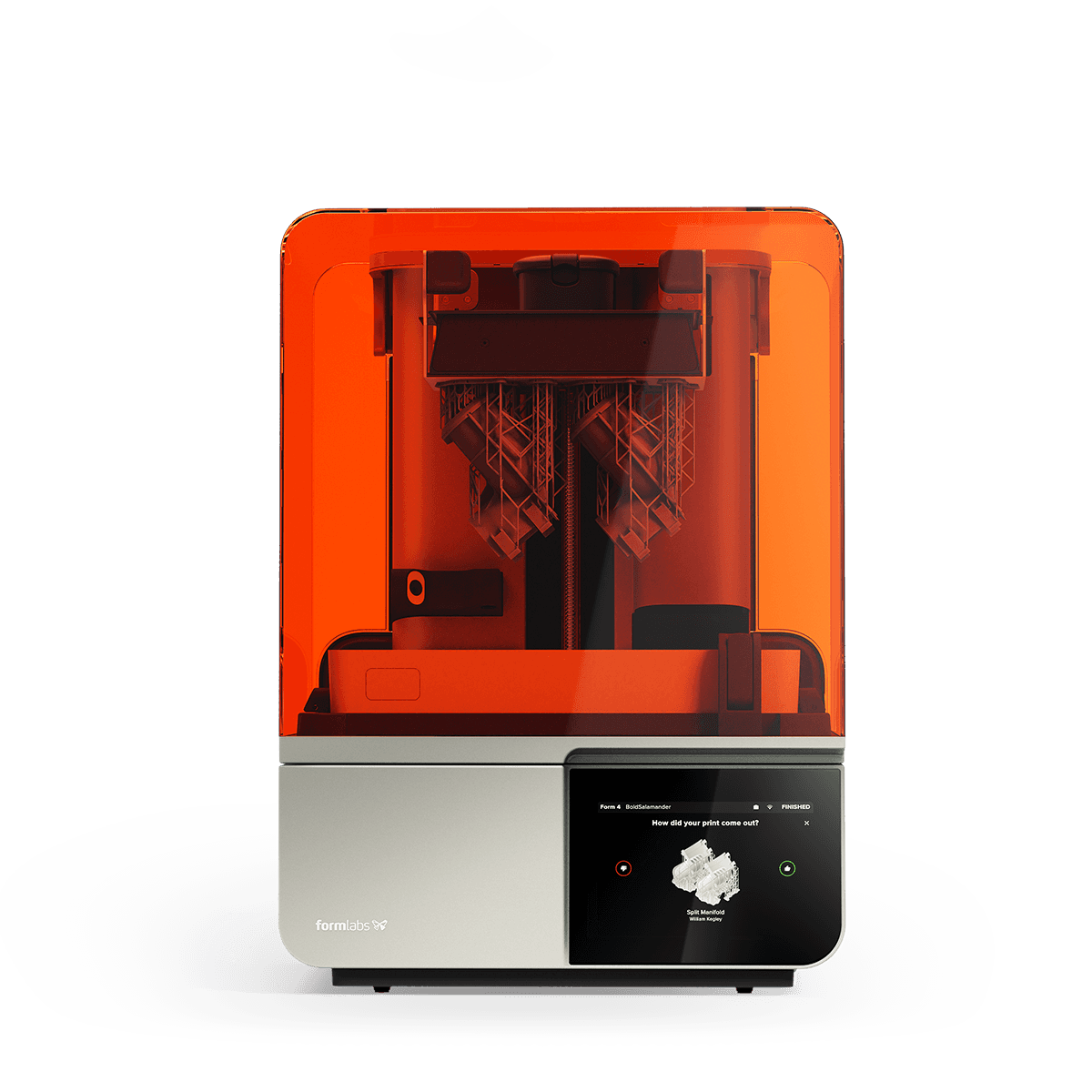
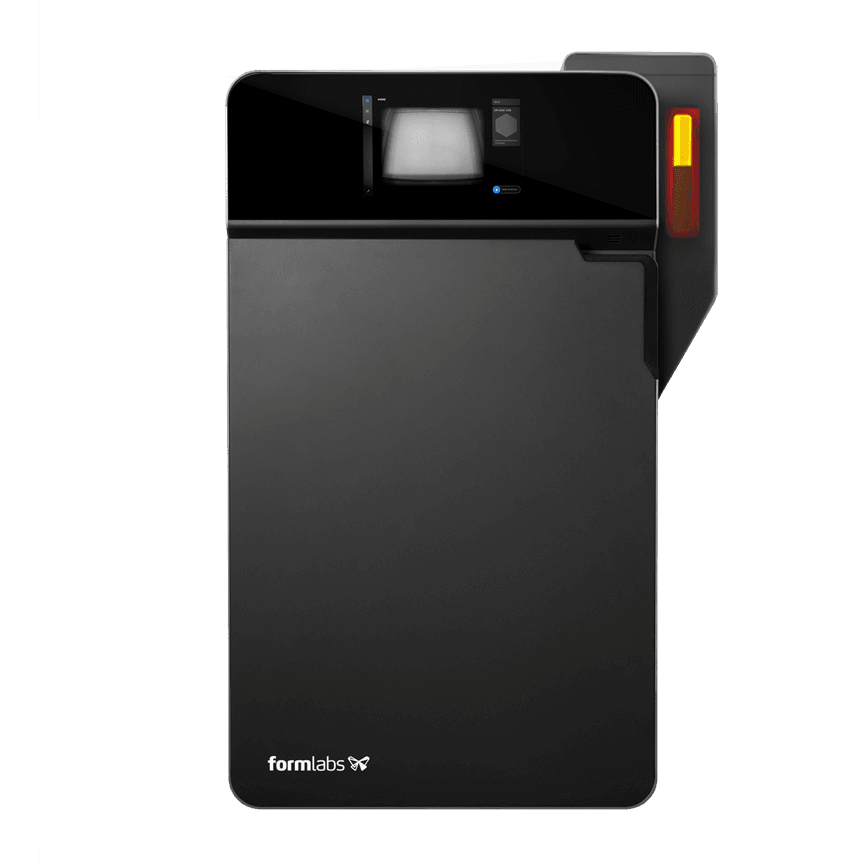
Form 4 is a blazing fast masked SLA 3D printer that combines an industry-leading materials library with a reliable, accurate print engine. Turn your ideas into reality faster than ever with easy workflows, leading reliability, and stunning part quality using the Form 4 ecosystem.
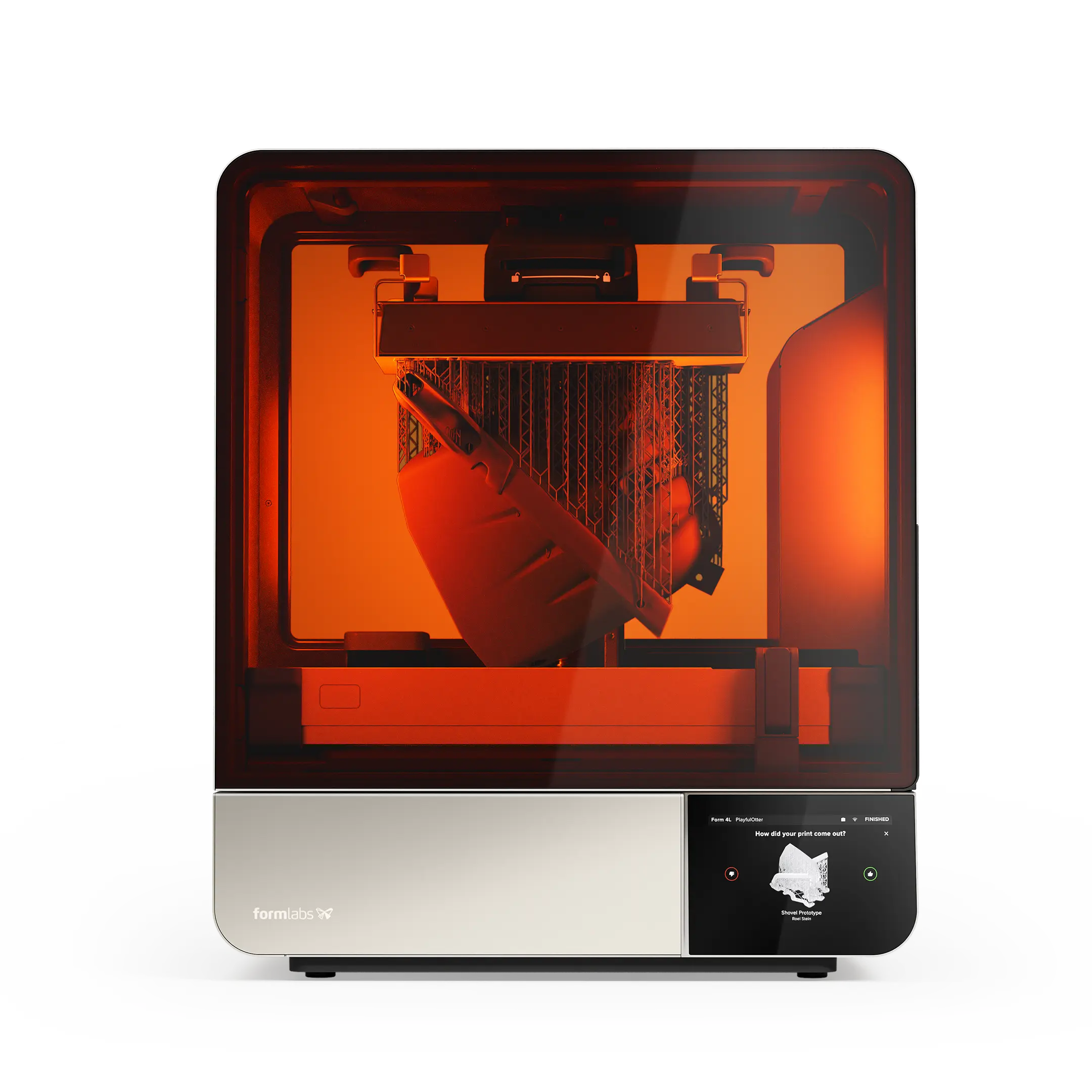
Form 4L is a blazing fast, large-format masked SLA 3D printer that combines an industry-leading materials library with a reliable, accurate print engine. Turn your biggest ideas into reality faster than ever with easy workflows, leading reliability, and stunning part quality using the Form 4L ecosystem.
Masked Stereolithography (MSLA)
Masked Stereolithography (MSLA)
Low Force Display™ (LFD)
Low Force Display™ (LFD)
20.0 × 12.5 × 21.0 cm
7.9 × 4.9 × 8.3 in
5.25 liters
35.3 × 19.6 × 35.0 cm
13.9 x 7.7 x 13.8 in
24.2 liters
Backlight Unit
Light Processing Unit 4 (LPU 4)
Release Texture
Flexible Film Resin Tank
Intelligent Control Systems
High-Speed Automatic Resin Handling
Backlight Unit
Light Processing Unit 4 (LPU 4)
Release Texture
Flexible Film Resin Tank
Intelligent Control Systems
Automatic Resin Handling
25–200 µm
0.001–0.008 in
25–200 µm
0.001–0.008 in
Backlight Unit: 60 uniform-wavelength LEDs, a plano-convex lens array, and integrated air cooling
405 nm optical wavelength
16 mW/cm² optical power intensity delivered to the cure plane
50 µm pixel size
Backlight Unit: 145 uniform-wavelength LEDs, a plano-convex lens array, and integrated air cooling
405 nm optical wavelength
16 mW/cm² optical power intensity delivered to the cure plane
46 µm pixel size
100 mm/hour
3.9 in/hour
80 mm/hour
3.1 in/hour
Average: 40 mm/hour (1.6 in/hour) across all materials
Range: 16-50 mm/hour (0.6-2.0 in/hour) depending on the material
Average: 24 mm/hour (0.9 in/hour) across all materials Range: 20-35 mm/hour (0.8-1.4 in/hour) depending on the material
1-30 mm features: ±0.15% (lower limit: ±0.02 mm)
31-80 mm features: ±0.2% (lower limit: ±0.06 mm)
81-150 mm features: ±0.3% (lower limit: ±0.15 mm)
1-30 mm features: ±0.15% (lower limit: ±0.02 mm) 31-80 mm features: ±0.2% (lower limit: ±0.06 mm) 81-150 mm features: ±0.3% (lower limit: ±0.15 mm)
On average with Precision Model Resin:
99.7% of surfaces within 100 μm of CAD model
95% of surfaces within 50 μm of CAD model
69% of surfaces within 25 μm of CAD model
On average with Precision Model Resin:
99.9% of surfaces within 100 μm of CAD model
96.7% of surfaces within 50 μm of CAD model
71.4% of surfaces within 25 μm of CAD model
98.7%, measured by an independent third-party lab in a series of comprehensive performance tests.
Testing in progress.
23 industry-leading Formlabs materials or third-party materials using Open Material Mode. More exciting new materials are currently in development.
Explore Materials
19 industry-leading Formlabs materials or third-party materials using Open Material Mode. More exciting new materials are currently in development.
Explore Materials
Auto-generated
Light-touch removal
Auto-generated
Light-touch removal
No (available on Form 4B)
No (available on Form 4BL)
40.7 × 47.8 × 84.4 cm
16.0 × 18.8 × 33.2 in
88.9 x 116.9 x 81.3 cm
35 x 46 x 32 in
39.8 × 36.7 × 55.4 cm
15.7 × 14.5 × 21.9 in
66.4 x 52.8 x 79.4 cm
26.1 x 20.8 x 31.3 in
250 cm²
8.8 in²
692 cm²
107 in²
27.3 cm
10.7 in
Not measured.
50 µm with pre-tuned anti-aliasing for subpixel resolution
Superior fine feature performance and sharp features compared to the
Form 3 Series
46 µm with pre-tuned anti-aliasing for subpixel resolution
Superior fine feature performance and sharp features compared to the
Form 3L Series
18–28 °C
64–82 °F
18–28 °C
64–82 °F
Auto-heats resin to 25–45 °C (77–113 °F), depending on material
Auto-heats resin to 25–45 °C (77–113 °F), depending on material
1
2
Next-generation resin cartridge
5-10x faster filling
63% less waste
30% less shelf space
Next-generation resin cartridge
5-10x faster filling
63% less waste
30% less shelf space
High speed conduction resin heating with infrared temperature sensing
High speed conduction resin heating with infrared temperature sensing
100–240 VAC
4.8 A
50/60 Hz
480 W
100-240 VAC
9 A
50/60 Hz
900 W
Z-Axis Force Sensor: automatically optimizes print quality and print speed based on part geometry and selected material.
Z-Axis Force Sensor: automatically optimizes print quality and print speed based on part geometry and selected material.
Wi-Fi (2.4 and 5 GHz; IEEE 802.11 b/g/n/ac, WPA/WPA2)
Ethernet (1000 Mbit)
USB-C 2.0
Wi-Fi (2.4 and 5 GHz; IEEE 802.11 b/g/n/ac, WPA/WPA2)
Ethernet (1000 Mbit)
USB-C 2.0
7" interactive touchscreen
1280 × 800 resolution
Languages: English, German, French, Spanish, Italian, Japanese, Simplified Chinese
7" interactive touchscreen
1280 × 800 resolution
Languages: English, German, French, Spanish, Italian, Japanese, Simplified Chinese
18.3 kg
40.4 lb
58.5 kg
129 lb
Touchscreen alerts
SMS/email via Dashboard
Speaker for audio alerts
Touchscreen alerts
SMS/email via Dashboard
Speaker for audio alerts
6 upgraded sensors that precisely control resin temperature, resin level, print forces, and print status:
High-speed conduction resin heating with infrared temperature sensing
Ultrasonic Resin Level Sense: controls resin in the tank
Z-Axis Force Sensor: controls and minimizes print forces
Resin Cartridge Load Cell: measures exact resin level in cartridge
Printer Leveling Sensor
Camera
6 upgraded sensors that precisely control resin temperature, resin level, print forces, and print status: High-speed conduction resin heating with infrared temperature sensing
Ultrasonic Resin Level Sense: controls resin in the tank Z-Axis Force Sensor: controls and minimizes print forces
Resin Cartridge Load Cell: measures exact resin level in cartridge
Printer Leveling Sensor
Camera
Integrated camera
2592 x 1944 resolution (5MP)
Remote monitoring, print history, and print timelapses
Can be easily disabled, covered, or removed
Integrated camera
2592 x 1944 resolution (5MP)
Remote monitoring, print history, and print timelapses
Can be easily disabled, covered, or removed
Windows 10 (64-bit only, ARM not supported) and up
macOS 13 or later
OpenGL 2.1
C++ runtime library from Microsoft (Windows only)
4 GB RAM (8 GB recommended)
Windows 10 (64-bit only, ARM not supported) and up macOS 13 or later
OpenGL 2.1
C++ runtime library from Microsoft (Windows only)
4 GB RAM (8 GB recommended)
STL, OBJ, and 3MF file input
FORM file output
STL, OBJ, and 3MF file input
FORM file output
One-Click Print
Adaptive layer thickness for faster printing with fine details
Remote Print
Auto-orient for optimal print position
Auto-mesh repair
Auto-generation of supports
Advanced tools for manually editing supports
Rotate, scale, duplicate, and mirror
Layer slicer for path inspection
Custom print settings
Available in multiple languages
One-Click Print
Adaptive layer thickness for faster printing with fine details
Remote Print
Auto-orient for optimal print position
Auto-mesh repair
Auto-generation of supports
Advanced tools for manually editing supports
Rotate, scale, duplicate, and mirror
Layer slicer for path inspection
Custom print settings
Available in multiple languages
Manage prints and printers via the cloud
Track resin and tank usage over time
SMS and email alerts
Create enterprise group accounts with admins to more easily share printers and control access
Manage prints and printers via the cloud
Track resin and tank usage over time
SMS and email alerts
Create enterprise group accounts with admins to more easily share printers and control access
75,000+ layers with any Formlabs material
For example: approximately 190 prints using average height model (39 mm tall), any resin, and 100 µm layer height
75,000+ layers with any Formlabs material
For example: approximately 190 prints using average height model (39 mm tall), any resin, and 100 µm layer height
Footnotes
¹ Using Fast Model Resin and 200 µm layer height on the Form 4 Series. Based on actual print times from a collection of test parts covering common engineering, product design, manufacturing, and dental applications. Using Draft v2 Resin and 200 µm layer height on the Form 3 Series. Based on the 75th percentile actual print speed from reported prints in 2023.
² Average across all materials printed at 100 µm layer height, weighted by material popularity. Print speed will vary depending on the material, layer height, and part geometry. The range is based on the materials with the slowest median print speed and highest median print speed.
³ Using Grey Resin V5 and 100 µm layer height, post-cured for 5 minutes at room temperature. One test model with various feature sizes 3D printed on three different printers.
⁴ Using 50 µm layer height. Tested using a full arch restorative model with dies, four models per print job, printed on three different printers, and post-processed according to the recommended settings.
⁵ Actual achievable part size may be slightly smaller than the build volume, accounting for minor shrinkage during printing and part orientation. If you are printing a job that is taller than 19.0 cm (7.5 in) on Form 4/B, taller than 30.5 cm (12 in) in) on Form 4L/4BL, or taller than 18.5 cm (7.2 in) on Form 3/B/+, you have to remove the resin tank while removing your print. PreForm will warn users when their job is above these limits.
⁶ Assuming a part printed on supports that resembles a rectangular prism with 12.5 cm depth and 1 cm height.
⁷ XY resolution describes how precisely the printer can cure the resin in the XY (horizontal) plane. It corresponds to the pixel size of the Light Processing Unit 4 and Light Processing Unit 4L.
⁸ Layer thickness availability varies by material. View our materials compatibility table to confirm availability.
⁹ Languages beyond English will come in future firmware releases on the Form 4 Series.
¹⁰ The exact lifetime of an individual resin tank depends on layers printed, physical wear, and accidental damage.
Start Scaling Your Prototyping and Production Today
Contact a Formlabs 3D printing expert for a 1-1 consultation.