Note:
Starting with PreForm 3.5, all parts printed in Castable Wax Resin on the Form 3/Form 3B have these redesigned light-touch supports.

Supports are essential to successful SLA 3D printing, but they require removal and often leave marks behind. Formlabs' new Low Force Stereolithography (LFS) technology works in combination with a smaller laser spot size to print parts with a finer support structure to produce a smooth surface finish. The general term for this feature is light-touch supports.
This technology also allows for additional changes to the support structure of individual Formlabs resins. Starting with PreForm 3.5, parts printed in Castable Wax Resin on Formlabs LFS printers have redesigned supports that terminate in a fine point. These light-touch supports provide all the stability of regular supports without the imperfections that typically mar highly-detailed surfaces. This is particularly beneficial for resins used for casting, such as Castable Wax Resin, because a pit left behind by a support touchpoint is difficult to repair once a part is cast.
Note:
Starting with PreForm 3.5, all parts printed in Castable Wax Resin on the Form 3/Form 3B have these redesigned light-touch supports.
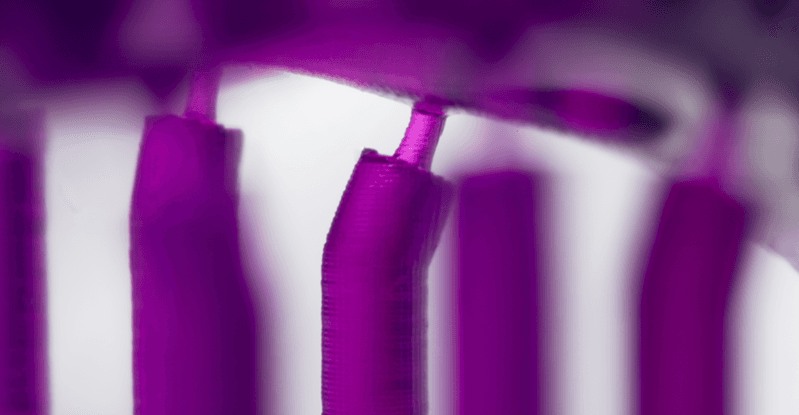
A magnified look at the new light-touch support touchpoints for Castable Wax Resin on the Form 3/Form 3B.
A redesigned support structure
As each layer in a part prints, the newly-cured resin adheres to the previous layer as well as the bottom of the resin tank. The layer must be peeled away from the surface of the resin tank before the next layer begins printing. The peel forces of the Form 3/Form 3B are significantly lower than those of the Form 2, so supports do not need to be as robust. As a result, supports can be thinner and exclusively vertical.
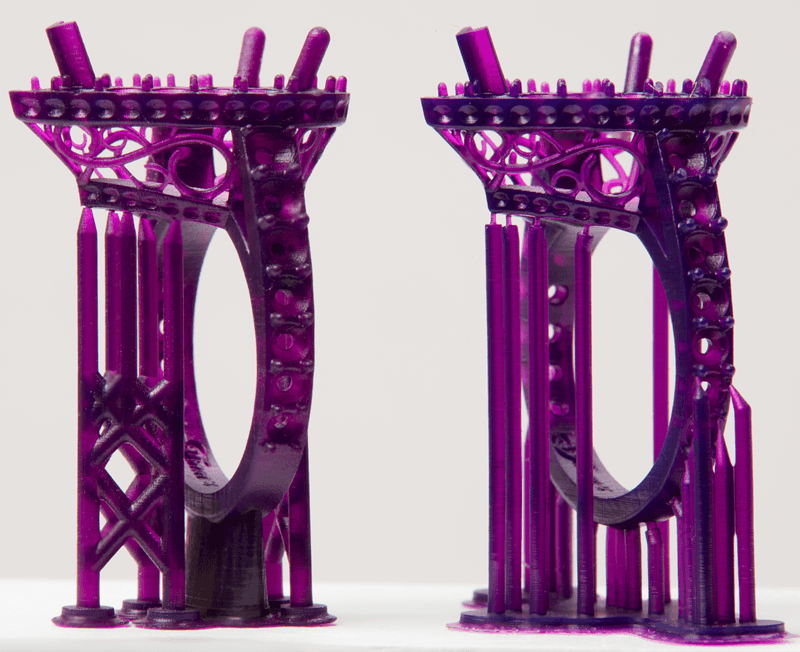
Comparison of the different support structure for each printer. On the left, a Form 2 support structure has larger touchpoints and more scaffolding. On the right, a Form 3 support structure showcases the smaller touchpoints and absence of trussing.
Smaller touchpoint size
The redesigned support structure takes full advantage of these lower forces to decrease the touchpoint size. Just before the point of contact, the support transitions to a fine hair that touches the part's surface.

Side-by-side comparison of touchpoint sizes. Left: Form 2 touchpoints are larger and cone-shaped. Right: Form 3 touchpoints shift to fine wires just before contacting the part.
Decreased trussing
Trusses link individual supports together to create a scaffolding effect, and were a necessity on the Form 2. With the reduced peel forces on the Form 3/Form 3B, the added strength is no longer needed. These trusses are now confined close to the raft at the bottom of the support structure to allow easy access to the part and prevent removal tools from becoming blocked.
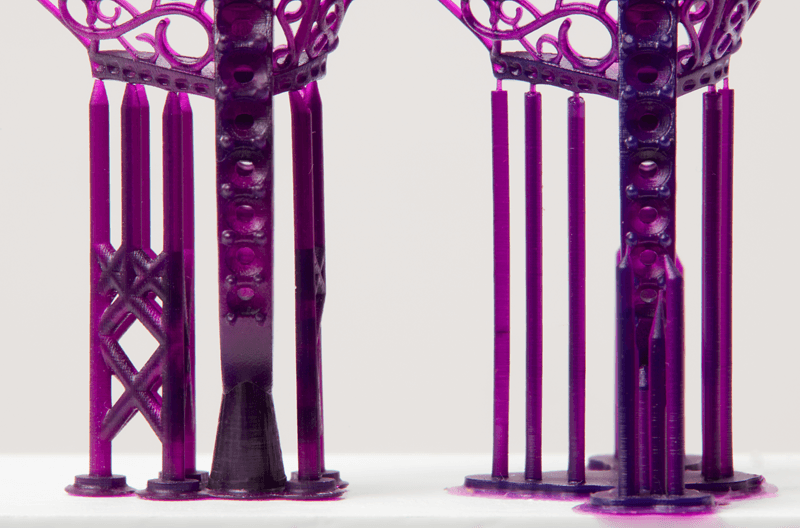
Side-by-side comparison of the vertical scaffolding generated by each printer. On the left, the Form 2 supports are thicker and have more trussing between the vertical supports. On the right, the Form 3 supports are thinner and lack trussing.
A comparison of support marks
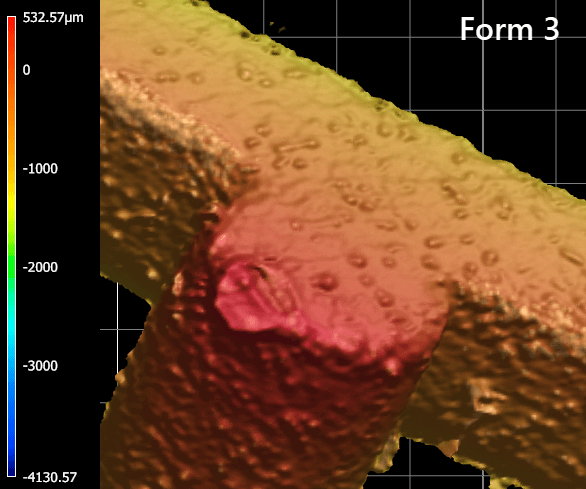
These light-touch supports are specifically designed with casting in mind. When they are removed, they leave a tiny amount of excess material on the surface of the part instead of creating a divot or hole that may lead to pitting on the cast part. Bumps and ridges can then be sanded during post-processing.
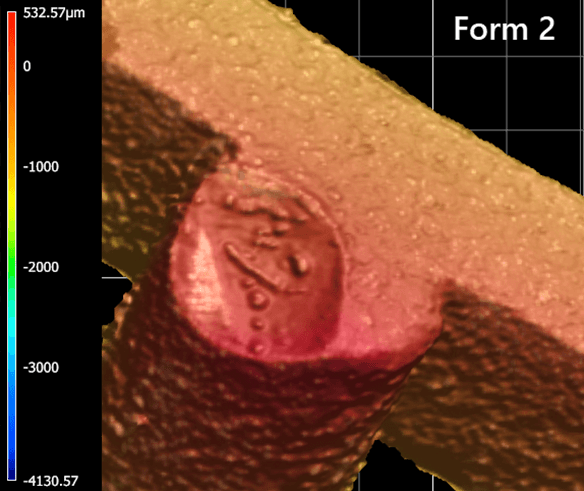
Left: Profilometer scan of Form 2 part surfaces after support removal.
Right: Profilometer scan of Form 3 part surfaces after support removal.