
Blow molding
Blow molding
Blow molding is a rapid mass production method for high-quality, thin walled plastic parts. Blow molding has very short cycle times, typically between one and two minutes, and is extremely cost-effective for high-volume production. It is usually employed for producing millions of identical parts at low unit costs.
Blow molding works by inflating a heated plastic tube, called parison or injected preform, inside a mold until it forms into the desired shape. There are three types of blow molding processes: extrusion blow molding (EBM), injection blow molding (IBM), and stretch blow molding (SBM). SBM is commonly used to produce high-quality glass clear PET containers such as water bottles.
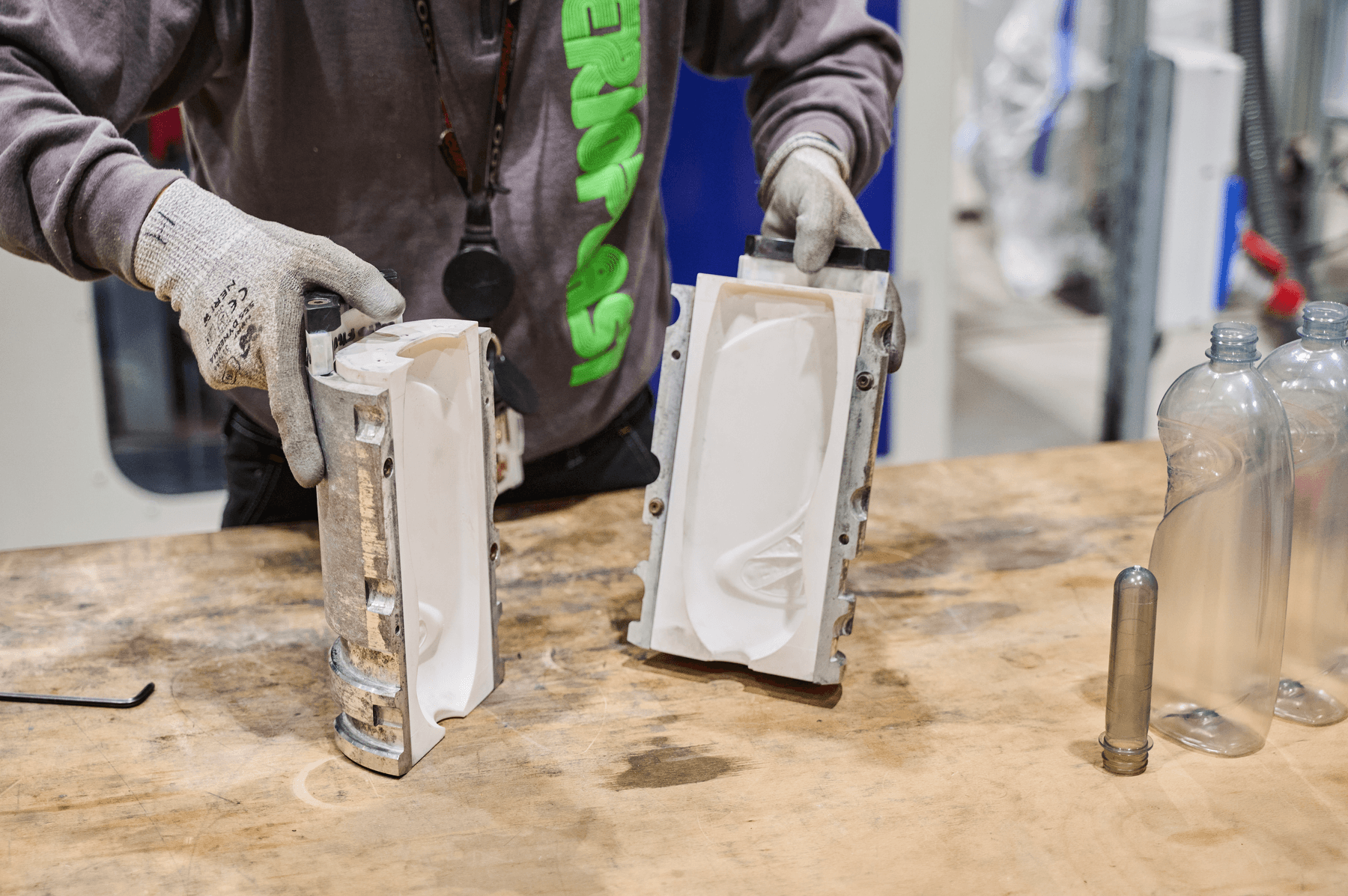
SBM molds are traditionally made out of metal by CNC machining, which requires specialized equipment, CAM software, and skilled labor. Outsourced production of metal tooling is both lengthy and expensive. With in-house 3D printing, manufacturers and product designers can rapidly fabricate tools at a low cost to validate design and manufacturing steps before transitioning to mass production.
Formlabs recommended materials
Formlabs recommends using Rigid 10K Resin for creating molds for blow molding. Rigid 10K Resin combines strength, stiffness, and thermal resistance. It is an industrial-grade, highly glass-filled material with an HDT of 218 °C @ 0.45 MPa and a tensile modulus of 10,000 MPa. Tooling printed with Rigid 10K Resin has good dimensional stability and is suitable for hundreds of blow molding cycles with high repeatability.
Rigid 10K Resin molds have been shown to perform reliably for 100–200 bottles per day, making them ideal for functional validation before committing to machined metal tooling.
Design considerations
When designing a printed part for blow molding, follow Formlabs’ best practices for additive manufacturing.
General guidelines:
- Design the mold to fit inside the shell holder that is placed in the blow molding machine.
- Rigid 10K supports fine features, including holes as small as 0.5 mm.
- Add surface textures to the mold in CAD for design realism.
Printing considerations
Follow Formlabs best practices for model orientation.
- Avoid printing supports on molding surfaces.
- Orient the mold halves to ensure flatness.
- Print thicker walls for durability under pressure.
- Print at 50 µm layer height for high detail fidelity and smooth surface finish.
Post-processing considerations
Follow Formlabs best practices for washing and post-curing prints. Refer to the material article for specific wash and cure instructions.
After post-curing, the surface of a part printed in Rigid 10K Resin may feel powdery. Rubbing mineral oil or water into the part surface and wiping away any excess will lead to a smoother, less powdery finish.
Formlabs recommends media blasting Rigid 10K Resin printed parts for improved mechanical properties, including tensile, flexural, and impact strength. Media blasting parts reduces surface defects that may cause part failures.
- Avoid damaging the sealing edges when removing supports.
- Validate the printed pattern to ensure it is dimensionally precise.
- Polish the mold to improve finish and expedite demolding.
- Assemble molds into a metal frame or standard shell holder to integrate with blow molding equipment.
End-use recommendations and limitations
Stereolithography (SLA) 3D printing is a great choice for blow molding. The 3D printed mold’s smooth surface finish and high precision transfers to the final part and facilitates demolding. It is particularly recommended for:
- Produce samples for consumer testing
- Validate the SBM process as well as the PET preform
- Pilot testing for the production line
Some limitations include:
- Mold lifespan is limited to around 1000 parts, depending on geometry, pressure, and thermal cycling.
- 3D printed molds are not suitable for high-volume production.
- Precise CAD design and careful post-processing are needed to match final tooling tolerances.
Additional resources