
100% Customer Satisfaction: Industrial Aerospace and Defense Manufacturing at American Additive With SLA and SLS
100% Customer Satisfaction: Industrial Aerospace and Defense Manufacturing at American Additive With SLA and SLS
"To sustain a market-leading position, American Additive prioritizes high-performance technology. Formlabs has fundamentally expanded our capabilities, capturing significant business that traditional FDM cannot support. For these applications with high volume, traditional FDM would not have been economical."
American Additive is an industrial manufacturing leader that leverages advanced additive manufacturing technologies to produce high-performance hardware for the aerospace and defense sectors. By utilizing Formlabs stereolithography (SLA) and selective laser sintering (SLS) 3D printers, the organization maintains an elite standard of production reflected in their 99%+ on-time delivery rate and 100% customer satisfaction. Every component is produced under a rigorous quality management system, typically with First Article Inspections (FAI) to ensure all parts strictly adhere to technical specifications.

Talk to Our Sales Team
Whether you need to prototype at speed, or are producing end-use parts, we’re here to help. The Formlabs Sales team is composed of dedicated specialists who know exactly how to support you and your company's needs.
Optimizing for Industrial Production With Formlabs 3D Printers
American Additive started 3D printing with Form 3L, which allowed them to deliver larger parts. They later upgraded to Form 4 and Form 4L where, “The finer features and surface finish of the 4 Series unlocked new markets for us,” says Matt White, Director of Engineering. This was followed by Fuse 1+ 30W, adding SLS 3D printing capabilities.
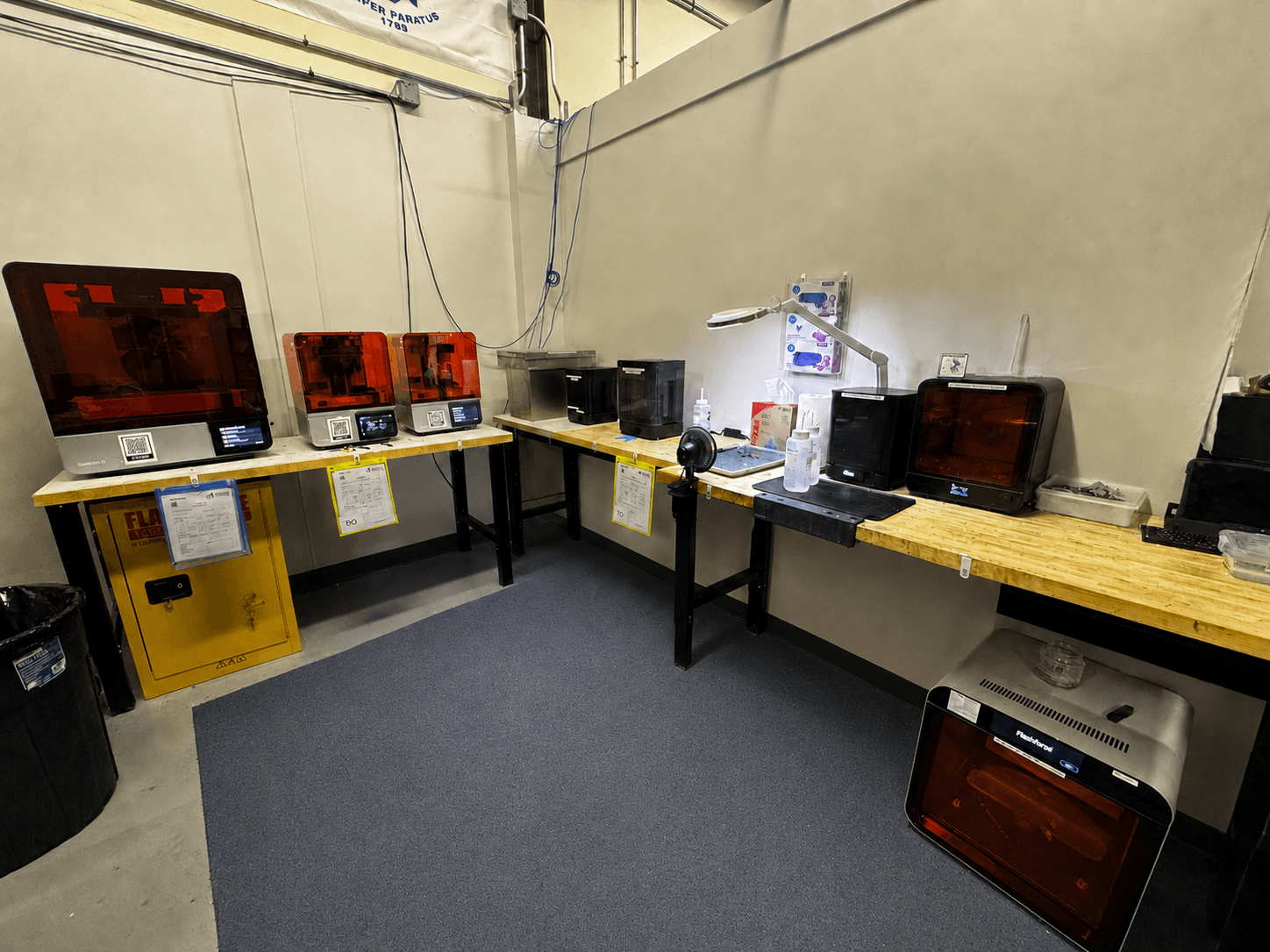
SLA 3D printing at American Additive, including Form 4L, Form 4, Form Wash, Form Cure, and Form Cure L.
In the beginning, SLA 3D printing was mostly used for prototyping and one-offs, but that has since shifted to industrial manufacturing of parts for repeat aerospace and defense orders, with 60-70% of current business being repeat production. A single family of parts may have a production run of up to 3,000 units, while part families produced on Fuse 1+ 30W SLS 3D printers have runs in the tens of thousands.
“Because the aerospace and defense sectors typically demand lower production volumes — where even 2,000 units is considered high — traditional injection molding often proves cost-prohibitive. The combination of these smaller quantities and the need for rapid turnaround makes 3D printing a more cost-effective and efficient alternative to conventional molding processes.”
Within these large part volumes are generally six-to-eight variations, making injection molding even less economical. If edits to the design are needed, there’s no additional cost when 3D printing, whereas edits to injection molding would cost months of work and tens of thousands of dollars.
White and the American Additive team bring their experience in additive manufacturing, aerospace, and automotive industrial manufacturing to their customers, making suggestions to ensure that the final design can be mass-produced via 3D printing. Primary considerations include, “Are there features that we can change to reduce costs, price, and lead time?”
White sees these early conversations not only as a value add, but also as education, helping American Additive’s customers work with the possibilities 3D printing offers, including geometric complexity.
Ensuring optimal printability is a foundational step in American Additive's workflow. According to White, the process begins by optimizing every design according to Formlabs guidelines. For SLA production, the team focuses on strategic part orientation to ensure superior surface finishes on critical features. When utilizing SLS technology, the priority shifts to maximizing packing density to improve cost-efficiency through batching. However, American Additive also carefully manages thermal distribution within the build chamber to ensure parts cool uniformly, effectively minimizing the risk of warping. This meticulous approach to printability is what allows the organization to maintain high throughput alongside consistent, repeatable quality.
SLA: Fiber Optics Cable Management Part
American Additive manufactures several versions of a certified production component designed for routing fiber optic cables within aircraft. This component must satisfy a rigorous set of technical requirements:
-
Electrostatic-Dissipative Properties: The material must be ESD-safe due to the proximity of sensitive electrical systems.
-
Superior Surface Finish: A smooth texture is vital to prevent abrasion or damage to the fiber optic cables.
-
High Feature Resolution: Precise detailing is necessary to accommodate small-diameter cables while minimizing overall part weight.
-
Structural Integrity: Thin-walled sections, some measuring only 0.03 inches, must remain stable and resist warping.
-
Precision Tolerances: Extremely tight clearances are mandatory to fit within the constrained spatial environments of an aircraft.
White says, “The tolerances were very tight and, given the part’s thin profile, it was a significant challenge to orient to ensure we could repeatedly meet those specifications.”
The requirement for a refined surface finish immediately eliminated FDM as a viable option for this cable management component. Instead, American Additive utilized Form 4 Generation 3D printers to achieve the intricate features, smooth finish, and exacting tolerances the client required. ESD Resin was selected as the build material to provide the necessary electrostatic-dissipative performance.
To streamline manufacturing, part orientation was optimized to minimize support touchpoints that might otherwise interfere with the fragile cables. Following an initial production run of approximately 2,000 units, follow-up orders exceeding 1,000 units are anticipated.
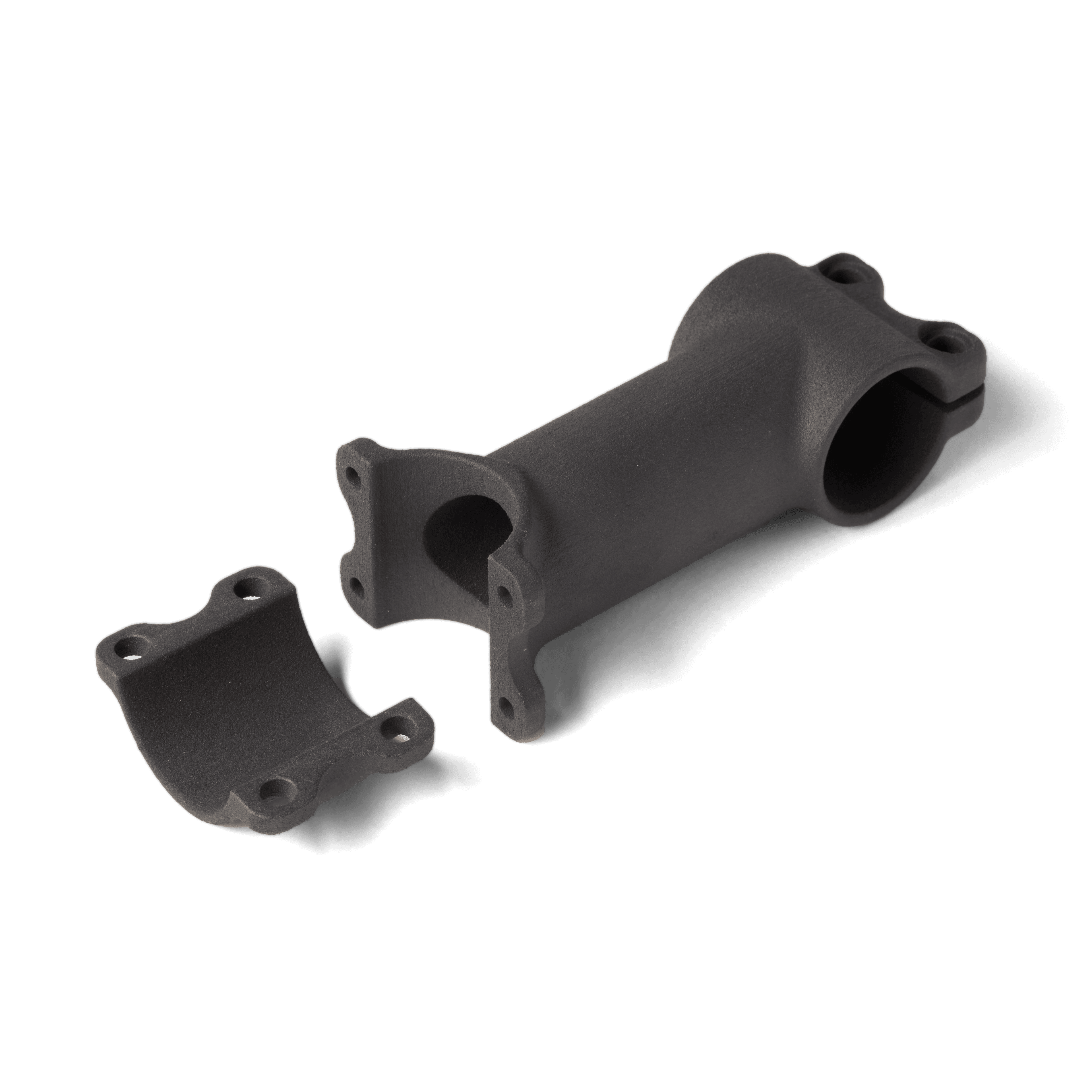
Request a Nylon Powder Sample Part
Formlabs offers seven SLS powders with a range of mechanical and visual properties. Choose a sample printed on the Fuse 1+30W to see them for yourself.
SLS: Drone Motor Components
For a drone motor component, the key part challenges were:
-
Maintaining a lightweight profile to maximize flight efficiency
-
Meeting high-volume production demands of 10,000 to 20,000 units
-
Integrating exceptionally thin walls and delicate structural features
-
Including numerous small slots within the part design
The team opted for Nylon 12 GF Powder to ensure structural integrity. According to White: "The rigidity of the glass fibers is attractive. There are very thin features on this part — less than 0.040 thousandths of an inch — that would be too weak for the application if we manufactured with standard Nylon 12."
While multi-jet fusion (MJF) 3D printing was considered, White notes that SLS offered a more cost-effective solution and a more repeatable manufacturing process. Additionally, the part's thin features and intricate slots would have required an injection mold with numerous slides, a path that would have delayed the project by over a year and likely resulted in high retooling costs to accommodate design changes.
AS9100D QMS & AS9102 First Article Inspections
American Additive’s Quality Management System (QMS) holds both AS9100D certification and ISO 9001:2015 certifications, ensuring full traceability from raw material procurement to part shipment. When a job order is placed, it’s processed through workflow management software that assigns a production manager to the project. Production routing cards then provide instructions for post-processing, such as washing and curing for SLA or sifting and blasting for SLS, as well as sanding, bonding, drilling, painting, placing inserts, etc. Each phase of the process requires a digital sign-off with a timestamp to maintain precise tracking.
For SLA, American Additive utilizes Form Wash and Form Cure post-processing solutions dedicated to specific materials. White highlights the benefit of this system, noting, “Having pre-programmed wash and cure profiles is a major advantage.” By using these presets, the team ensures batch-to-batch consistency from and significantly reduces the risk of operator error.
Fuse Blast has been transformative for SLS, delivering a full return on investment within a few months.
“Processing tens of thousands of drone motor parts used to be incredibly time-consuming with manual sifting and media blasting, making the investment in the Fuse Blast easy to justify. It has shaved days off our lead times. Thanks to the pre-programmed profiles, parts come out finished and ready for immediate inspection.”
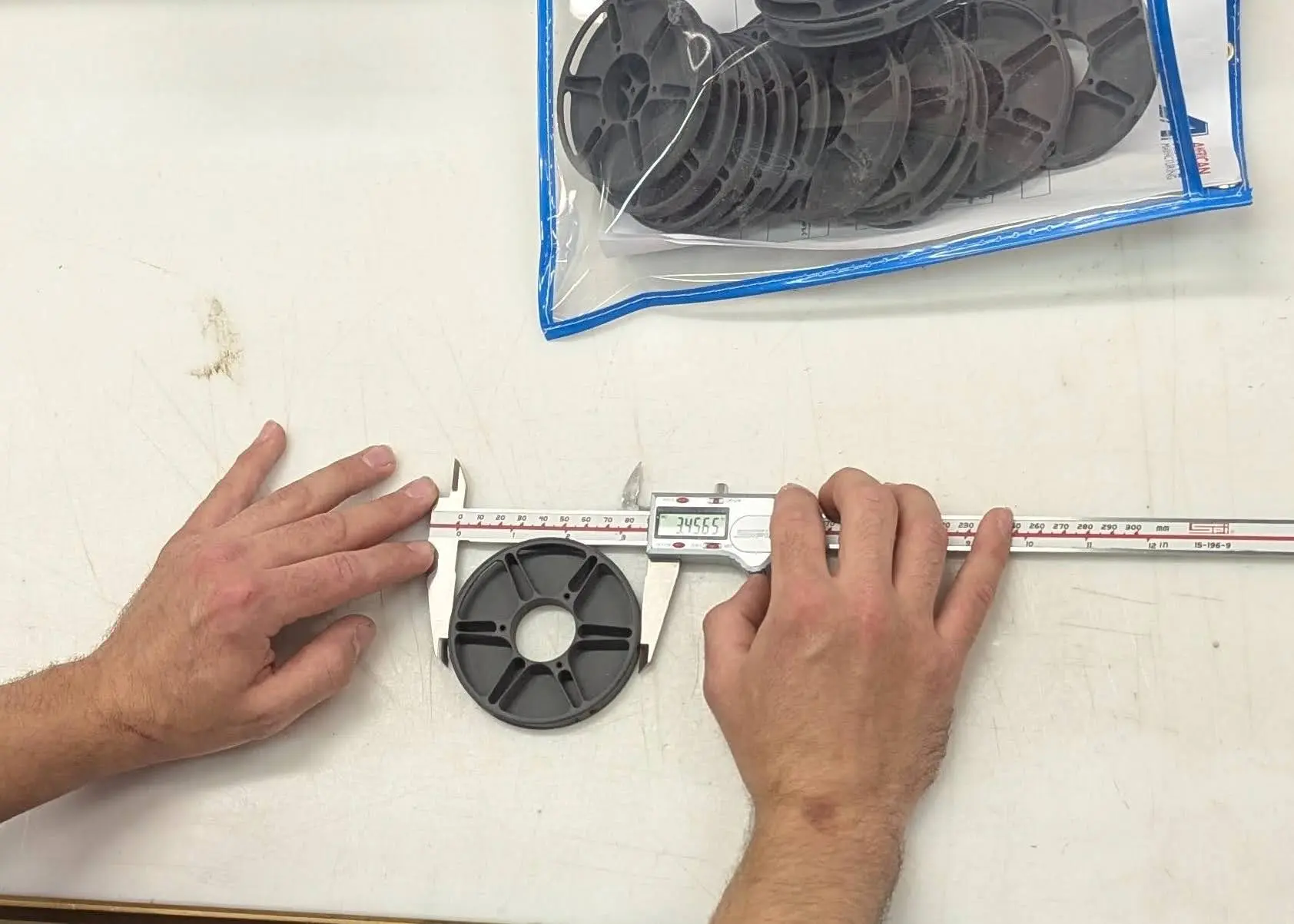
Once post-processing is complete, parts undergo inspection using 3D laser scanners or various manual metrology tools. Each part is verified against the engineering drawings, documented, and stored digitally.
White notes, “Many of our jobs require AS9102 first article inspections, which mandate that our team verifies the first part against the drawing. This process ensures any deviations are identified and corrected before high-volume production begins, ultimately minimizing waste and maximizing yield.” White explains, “Because of these benefits, we have integrated this first-part inspection methodology into every job we accept.”
3D Printed Tooling
In addition to end-use parts, American Additive 3D prints tooling, including drill fixtures, assembly fixtures, inspection fixtures, as well as composite layup molds and tooling for fiberglass and carbon fiber, both for laying up parts and for trimming parts after layup.
The most common tooling American Additive prints are composite layup molds in ULTEM 1010, and in High Temp Resin on Form 4 Generation 3D printers.
“High Temp Resin is very attractive because carbon fiber layup usually requires an autoclave, and the High Temp Resin can sustain the autoclave temperatures where not that many other additive materials can. The benefit of SLA is that it's already very smooth, so there's a lot less finishing that goes on for an SLA part in High Temp Resin versus an FDM part.”
A traditional alternative to 3D printing is machining an Invar steel composite layup tool, which would take several weeks at best, or, more likely, several months. With 3D printing, the tool can be designed and printed in one-to-two weeks. In addition to speed, 3D printed molds offer an ergonomic advantage. A big, two-foot steel mold requires machinery or multiple people to move, whereas a 3D printed one can be moved by a single person.
Plus, if a 3D printed tool design needs to be revised, it takes minutes to revise in CAD, then queue for 3D printing. If it’s dropped or cracked, it can easily be reprinted quickly, versus waiting months for the tool to be recut. In aerospace and defense, the stakes are also more than time. White says, “It's a quick and easy recovery for them and not a multiple month stop in production, which in the aerospace and defense world can cause significant penalties.”
In addition to High Temp Resin, American Additive also leverages Rigid 10K Resin for molds and Tough 1500 Resin for assembly fixtures. “It has enough give that if a fixture is dropped, it’s usually fine — making it a great fit for everyday jigs and fixtures without behaving like an elastomer,” says White.
This level of material versatility is made possible by the fast changeover capabilities of the Form 4 Generation printers. “The changeover process itself is maybe two or three minutes long,” White explains. “Some resins require a short heat-up period, but overall, you can move from one material to another and get back to printing very quickly.” Compared to SLS or FDM where material swaps can take hours or even a full day, SLA technology offers a far more agile workflow for manufacturers managing multiple applications.
The Results: 100% Customer Satisfaction
“So far this year, our on-time deliveries are in the 99% range, and customer satisfaction is currently at 100%.”
For customers in aerospace and defense, where tight tolerances and consistency are critical, that level of performance is especially significant. White credits additive manufacturing’s impact largely to its speed and iterative capabilities.
“I keep coming back to speed. From an aerospace customer's point of view, the ability to iterate is massive. There are advancements happening across the industry that likely wouldn’t occur if it wasn't for additive manufacturing, simply because teams can prototype, refine, and scale so much faster.”
The precision, accuracy, and reliability of Formlabs 3D printers empower the industrial throughput and high level of repeatability at American Additive, proving that reliable desktop and benchtop 3D printers can power American manufacturing.
To learn more about Formlabs 3D printers, explore our SLA and SLS offerings, or contact sales. To evaluate our materials for yourself, request a free sample part.