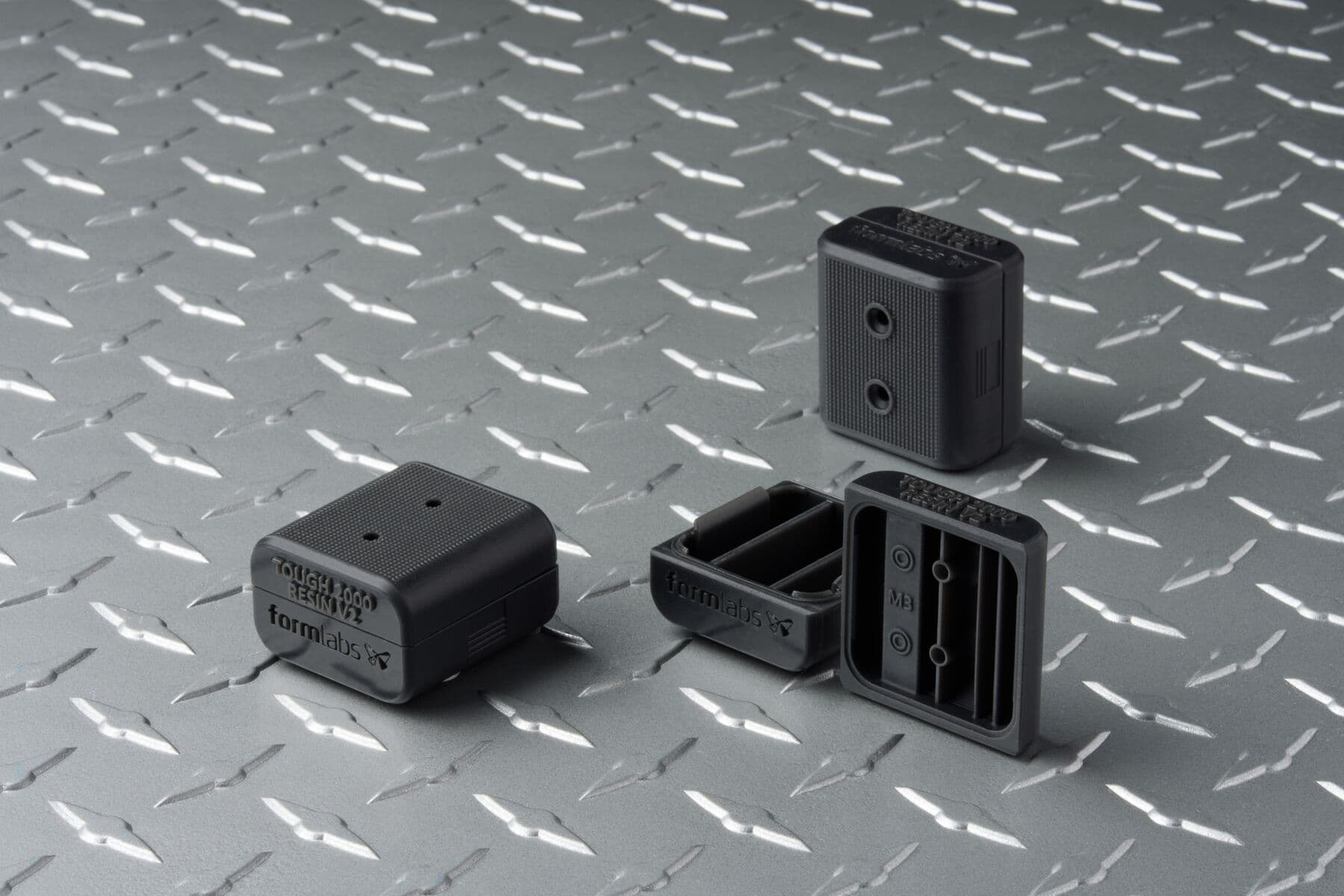
Tough 2000 Resin V2
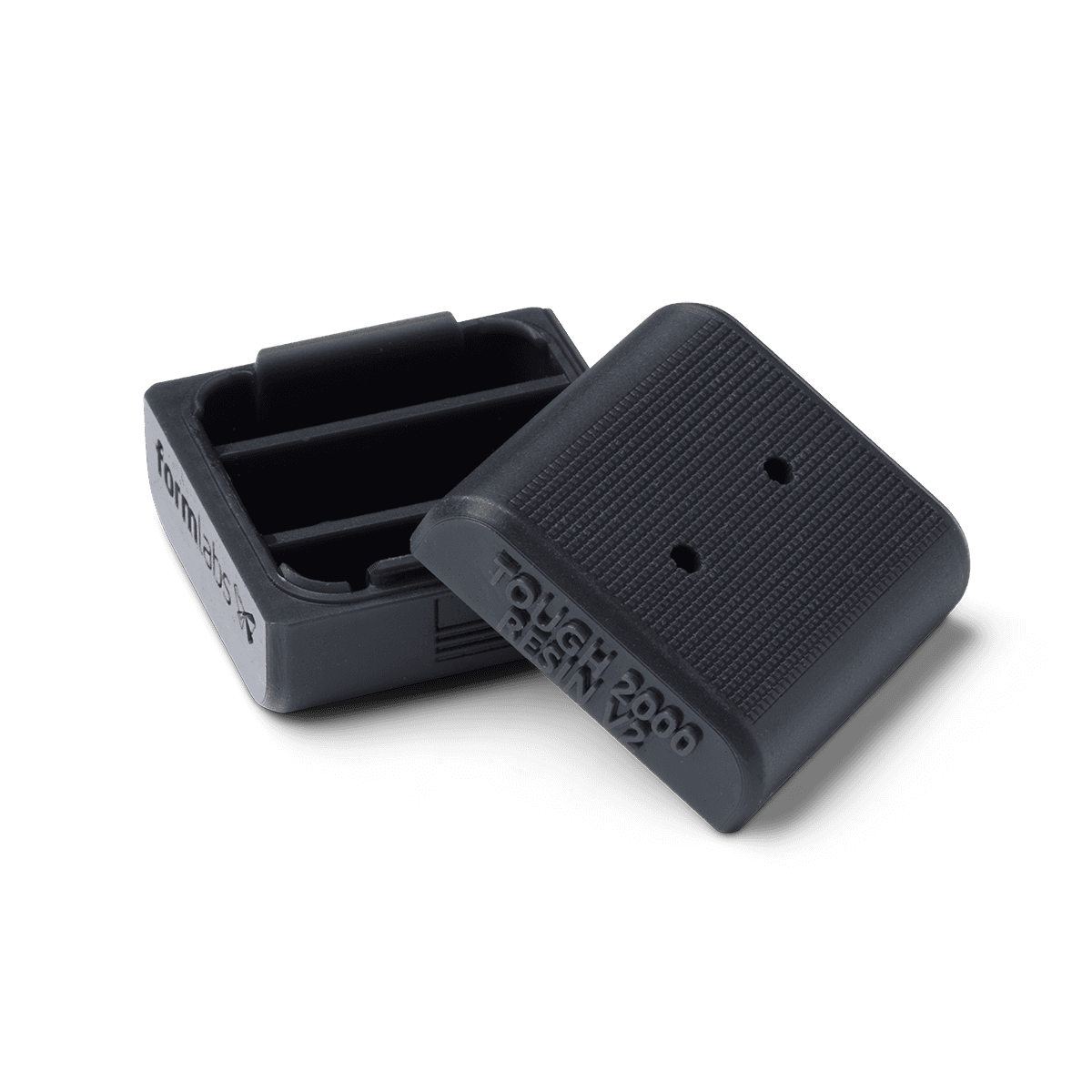
Tough 2000 Resin V2 is a rugged material with strength and stiffness comparable to ABS, combining toughness with high temperature and creep resistance.
Tough 2000 Resin V2 excels in heavy-duty applications and delivers highly functional prototypes and end-use parts that resist shattering, deformation, and long-term wear. With a 79% elongation at break and a heat deflection temperature (HDT) of 70 °C, parts maintain structural integrity under mechanical and environmental stress. The new formulation is darker with a matte finish, for presentation-ready parts with enhanced details and a smooth finish.
Tough 2000 Resin V2 is a new material formulation that leverages the technology of Form 4 Series printers to deliver 3x higher fracture toughness, improved temperature resistance, material longevity, and aesthetics compared to the previous version.
Tech specs
- Compatible Tank
- Form 4 Resin Tank, Form 4L Resin Tank, Form Studio Resin Tank Pro
- Compatible Build Platform
- Form 4 Build Platform, Form 4 Flex Build Platform, Form 4L Build Platform, Form 4L Flex Build Platform, Form Studio Standard Build Platform, Form Studio Flex Build Platform
- Compatible Printer
- Form 4, Form 4B, Form 4L, Form 4BL, Form Studio 1
- Print Technology
- SLA
- Colors
- Grey
- Categories
- Impact Resistant
- Applications
- Manufacturing Aids, End-Use Parts, Rapid Prototyping
- Ultimate Tensile Strength
- 40.4 MPa
- Tensile Modulus
- 1800.0 MPa
- Flexural Strength
- 67.0 MPa
- Flexural Modulus
- 1701.0 MPa
- Notched Izod
- 25.0 J/m
- Elongation at Break
- 79.0 %
- Heat Deflection Temp. @ 1.8 MPa
- 57.0 °C
- Heat Deflection Temp. @ 0.45 MPa
- 70.0 °C
- Thermal Expansion
- 134.2 μm/m/°C
- Unnotched Izod
- 325.0 J/m
- Gardner at 1/32" (0.97 mm) thickness
- 1.6 J
- Maximum Stress Intensity Factor (Kmax)
- 1.65 MPa-m1/2
- Work of Fracture (Wf)
- 305.0 J/m
Tough 2000 Resin V2 is a rugged material with strength and stiffness comparable to ABS, combining toughness with high temperature and creep resistance.
Tough 2000 Resin V2 excels in heavy-duty applications and delivers highly functional prototypes and end-use parts that resist shattering, deformation, and long-term wear. With a 79% elongation at break and a heat deflection temperature (HDT) of 70 °C, parts maintain structural integrity under mechanical and environmental stress. The new formulation is darker with a matte finish, for presentation-ready parts with enhanced details and a smooth finish.
Tough 2000 Resin V2 is a new material formulation that leverages the technology of Form 4 Series printers to deliver 3x higher fracture toughness, improved temperature resistance, material longevity, and aesthetics compared to the previous version.
Tech specs
- Compatible Tank
- Form 4 Resin Tank, Form 4L Resin Tank, Form Studio Resin Tank Pro
- Compatible Build Platform
- Form 4 Build Platform, Form 4 Flex Build Platform, Form 4L Build Platform, Form 4L Flex Build Platform, Form Studio Standard Build Platform, Form Studio Flex Build Platform
- Compatible Printer
- Form 4, Form 4B, Form 4L, Form 4BL, Form Studio 1
- Print Technology
- SLA
- Colors
- Grey
- Categories
- Impact Resistant
- Applications
- Manufacturing Aids, End-Use Parts, Rapid Prototyping
- Ultimate Tensile Strength
- 40.4 MPa
- Tensile Modulus
- 1800.0 MPa
- Flexural Strength
- 67.0 MPa
- Flexural Modulus
- 1701.0 MPa
- Notched Izod
- 25.0 J/m
- Elongation at Break
- 79.0 %
- Heat Deflection Temp. @ 1.8 MPa
- 57.0 °C
- Heat Deflection Temp. @ 0.45 MPa
- 70.0 °C
- Thermal Expansion
- 134.2 μm/m/°C
- Unnotched Izod
- 325.0 J/m
- Gardner at 1/32" (0.97 mm) thickness
- 1.6 J
- Maximum Stress Intensity Factor (Kmax)
- 1.65 MPa-m1/2
- Work of Fracture (Wf)
- 305.0 J/m
Bulk Order Discount
- 15%
- 30 L
- 20%
- 60 L
- 25%
- 120 L
- 30%
- 240 L
- 35%
- 1,000 L
- 40%
- 2,000 L
- 45%
- 3,000 L
Select Printer Series and Resin Volume
Why Choose Tough 2000 Resin V2?
Stiff and sturdy 3D printing material with toughness that rivals ABS.
Tougher Where It Matters
Create sturdy snap-fit assemblies and rugged parts with an elongation at break of 79% and a fracture toughness of 305 J/m2, 3x higher than the previous generation.
Production-Ready Surface Quality and Fine-Feature Performance
Darker, more matte finish and improved scratch resistance enhance contrast, ideal for prototypes and end-use parts with crisp features and smooth surfaces.
Exceptional Creep Resistance
Produce jigs, structural components, and load-bearing parts that resist long-term deformation with only 1.3% creep strain under 4 MPa load after two weeks.
High Environmental Stability for End-Use Applications
A heat deflection temperature (HDT) of 70 °C @ 0.45 MPa ensures reliable performance at elevated temperatures, so that functional parts hold their shape when other plastics may deform.
Applications
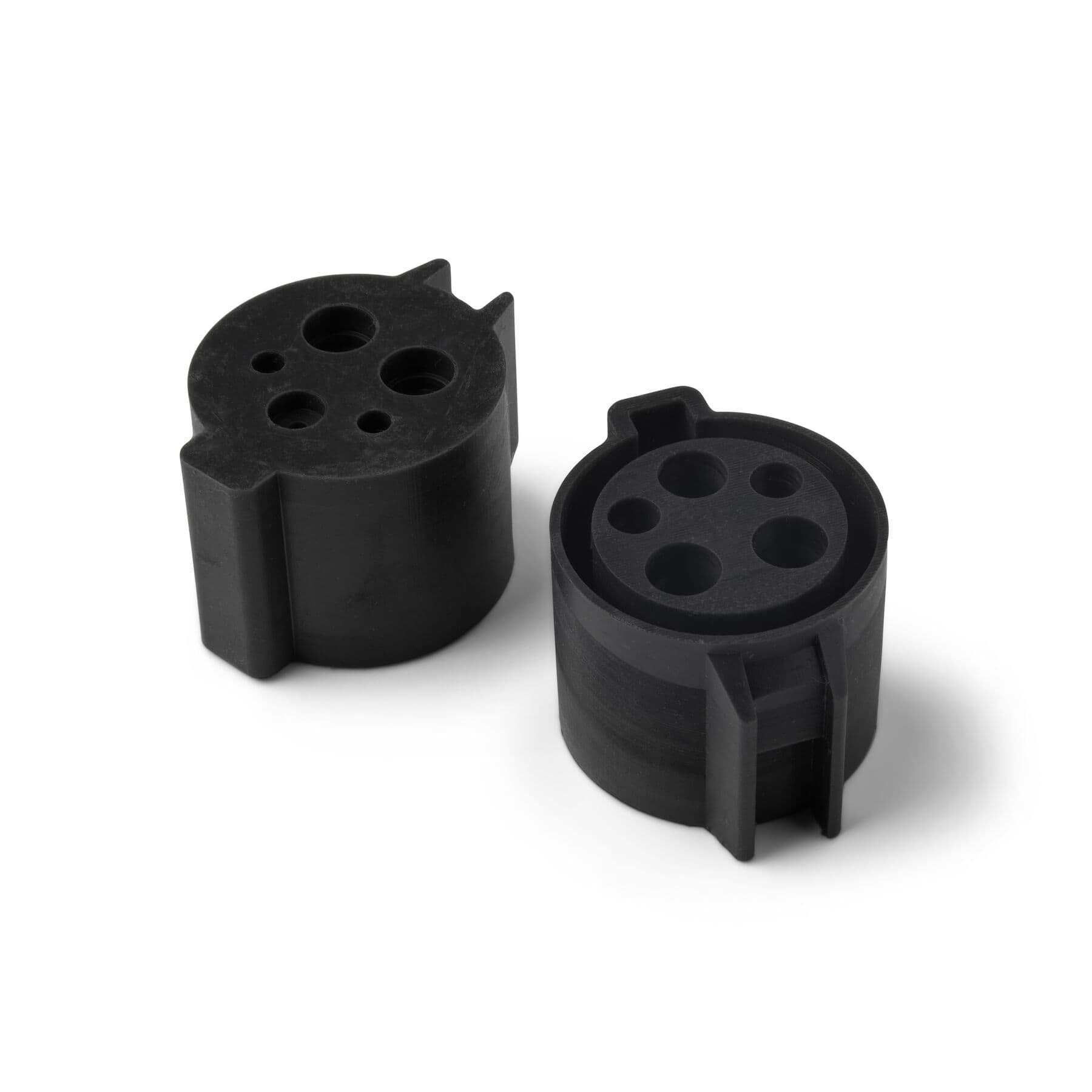
Parts requiring the strength and stiffness of ABS
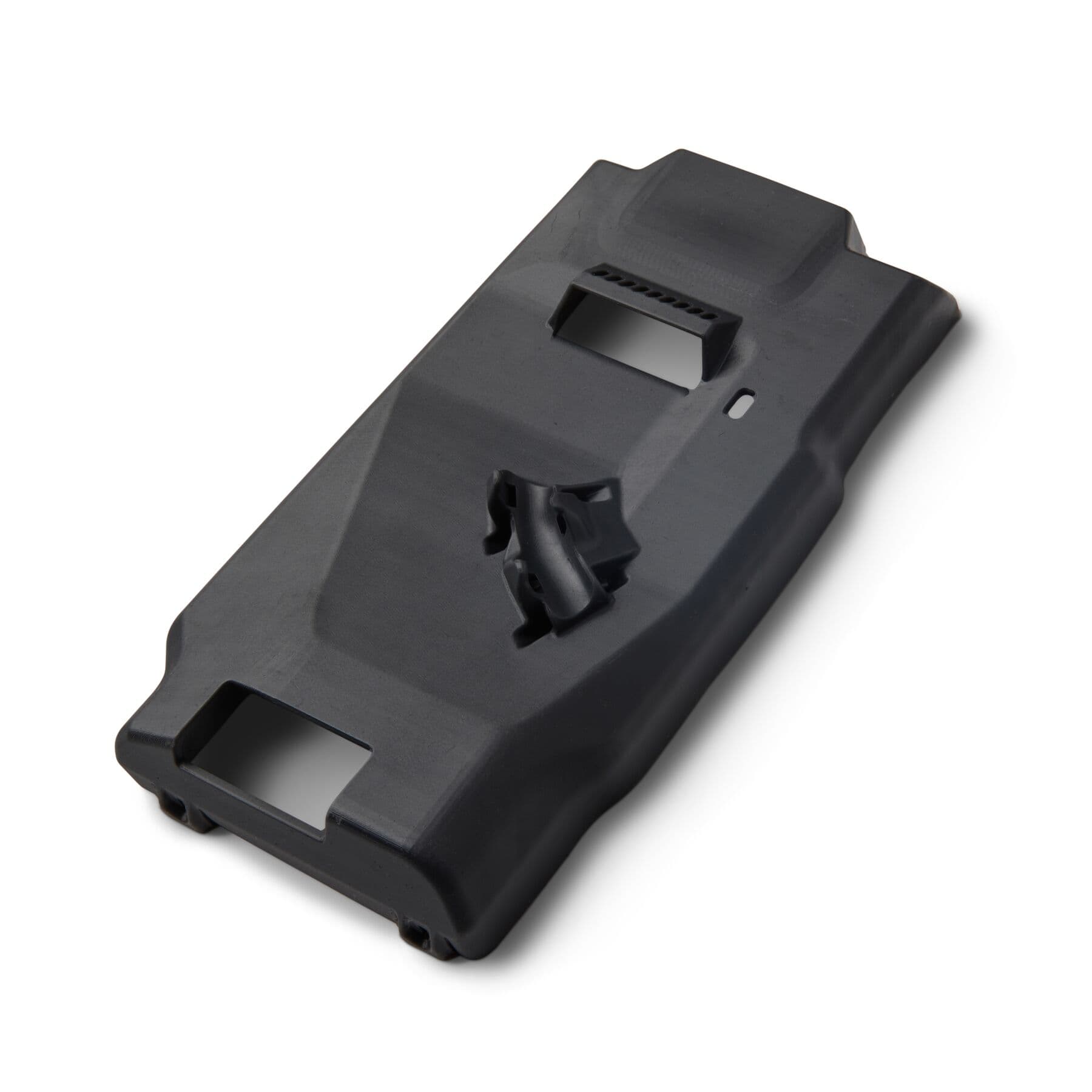
Jigs and fixtures to survive long-term use on the factory floor
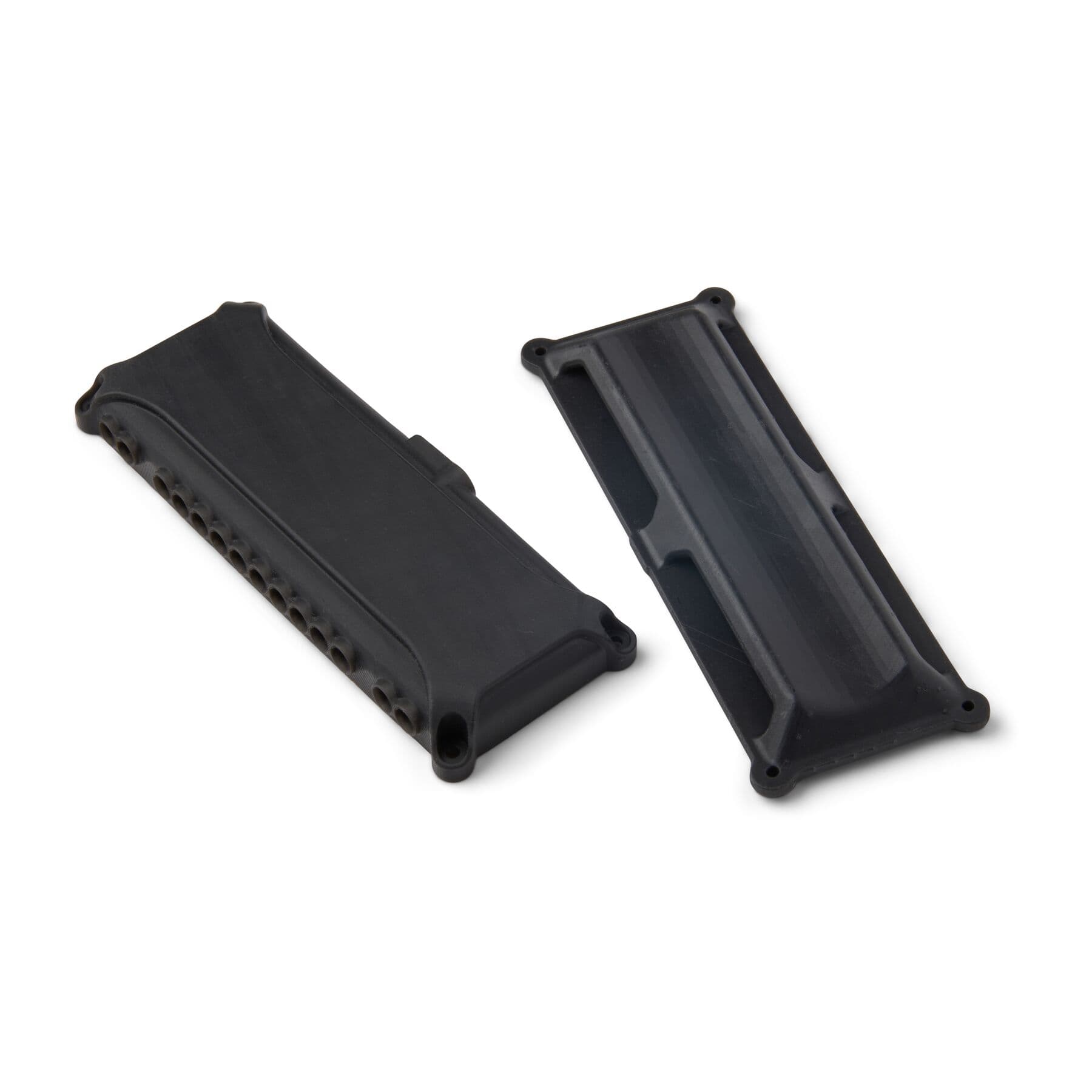
Robust enclosures with high temperature and creep resistance
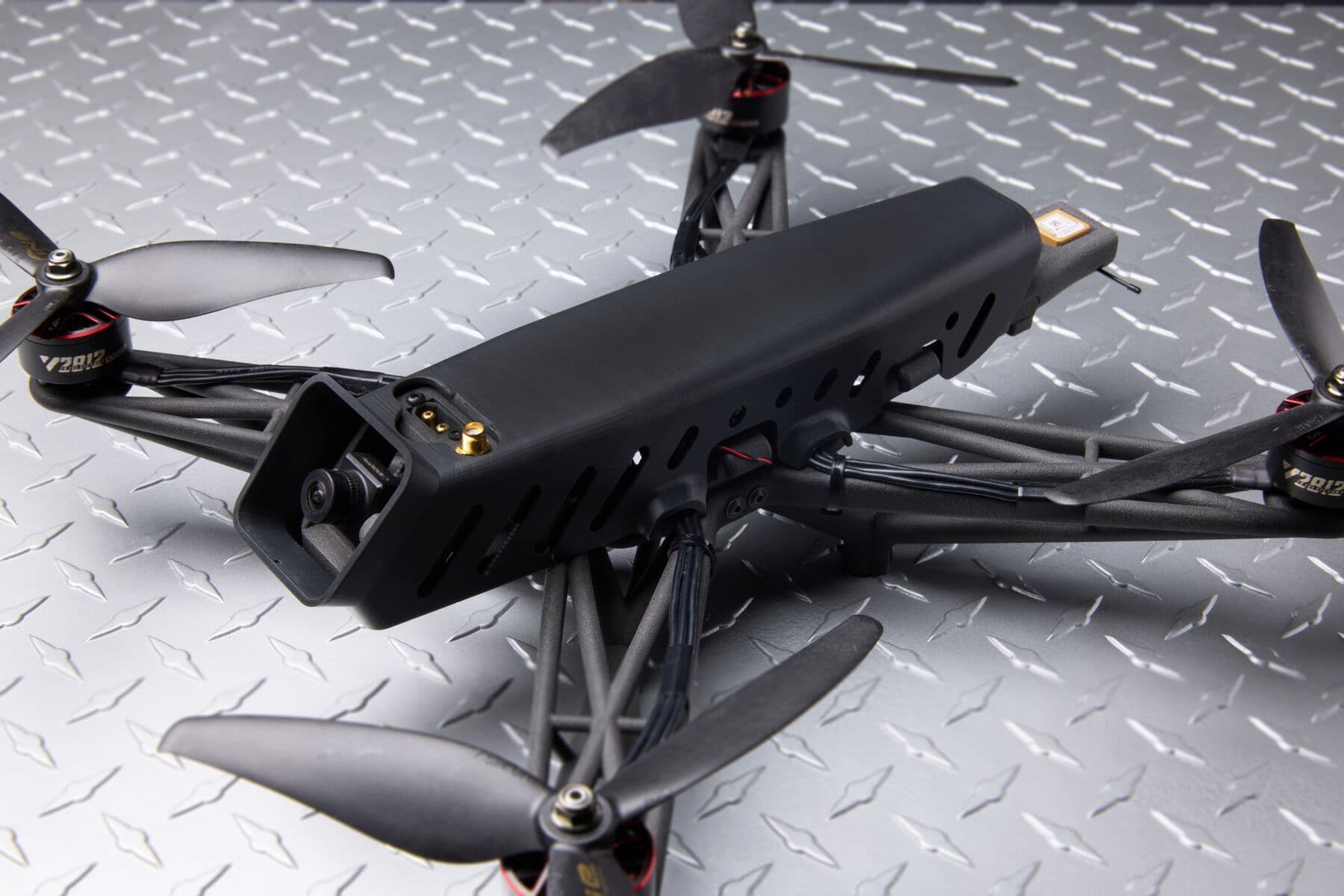
Production-ready parts with a dark, matte finish
Mechanical Properties*
| Parameter | Tough 2000 Resin V2 | ABS, Extruded Sheet, McMaster-Carr |
|---|---|---|
|
Ultimate Tensile Strength |
40.4 MPa | 5802 psi | 39 MPa | 4351 psi |
|
Tensile Modulus |
1800 MPa | 261 ksi |
1800 MPa | 261 ksi |
|
Elongation at Break |
79% |
8% |
|
Gardner Impact @ 1/32” (0.8 mm) |
1.6 J | 14 in-lb |
2.3 J | 20 in-lb |
|
Work of Fracture |
305 J/m2 | 20.87 ft-lb/ft2 | 2060 J/m2 | 141.15 ft-lb/ft2 |
|
Heat Deflection Temp @ 0.45 MPa |
70 °C | 158 °F |
Not tested. From literature, ~80-90 ºC | 176-194 °F |
* Material properties may vary based on part geometry, print orientation, print settings, and temperature. Data was obtained from parts printed using Form 4, 100 μm, Tough 2000 Resin V2 settings and post-cured with a Form Cure V2 for 12 minutes at 70 °C
See How Formlabs Customers Use Tough 2000 Resin
See all
Rowing 9,000 Miles Across the Pacific With 3D Printed Parts: The Journey of the Maclean Brothers

Making the Zerømouse Blade “Indestructible” With Tough 2000 Resin and Form 4L

Tough, Machineable, and Watertight: The Materials Behind Nudge Zero

How PSYONIC Uses Agile Manufacturing to Build the World’s Most Accessible Bionic Hands

What Formlabs Material Should I Use Instead of Injection Molded Plastics Like ABS or Polypropylene?

ABS-Like Resin vs. Real ABS: Properties & Comparisons

What Is the Strongest 3D Printing Material? A Complete Guide to Material Strength

Formlabs’ Next-Generation Tough Resins Rival Thermoplastics

Prosthetic Production Takes a Step Forward With the 3D Printed NOVA Foot

Rapid Prototyping Custom Hardware at Peak Design With Form 4
Post-Processing
Washing
The foundational step in any SLA post-processing workflow is to remove any excess resin on the surface of the parts through an alcohol or ether wash.
For the best surface finish, Formlabs recommends allowing parts printed in Tough 2000 Resin V2 to air dry for at least 10 minutes after washing, before handling.
SETTINGS
Curing
Post-curing Engineering and Specialty Resins is essential for parts to achieve their full strength and functionality. This step completes the chemical reaction initiated during printing, transforming the part from its green state into a fully finished component.
SETTINGS
Form Cure V1 | Form Cure V2 | Form Cure L V1 | Form Cure L V2
Formlabs Tough Resins
Next-Generation Tough Resins That Rival Thermoplastics
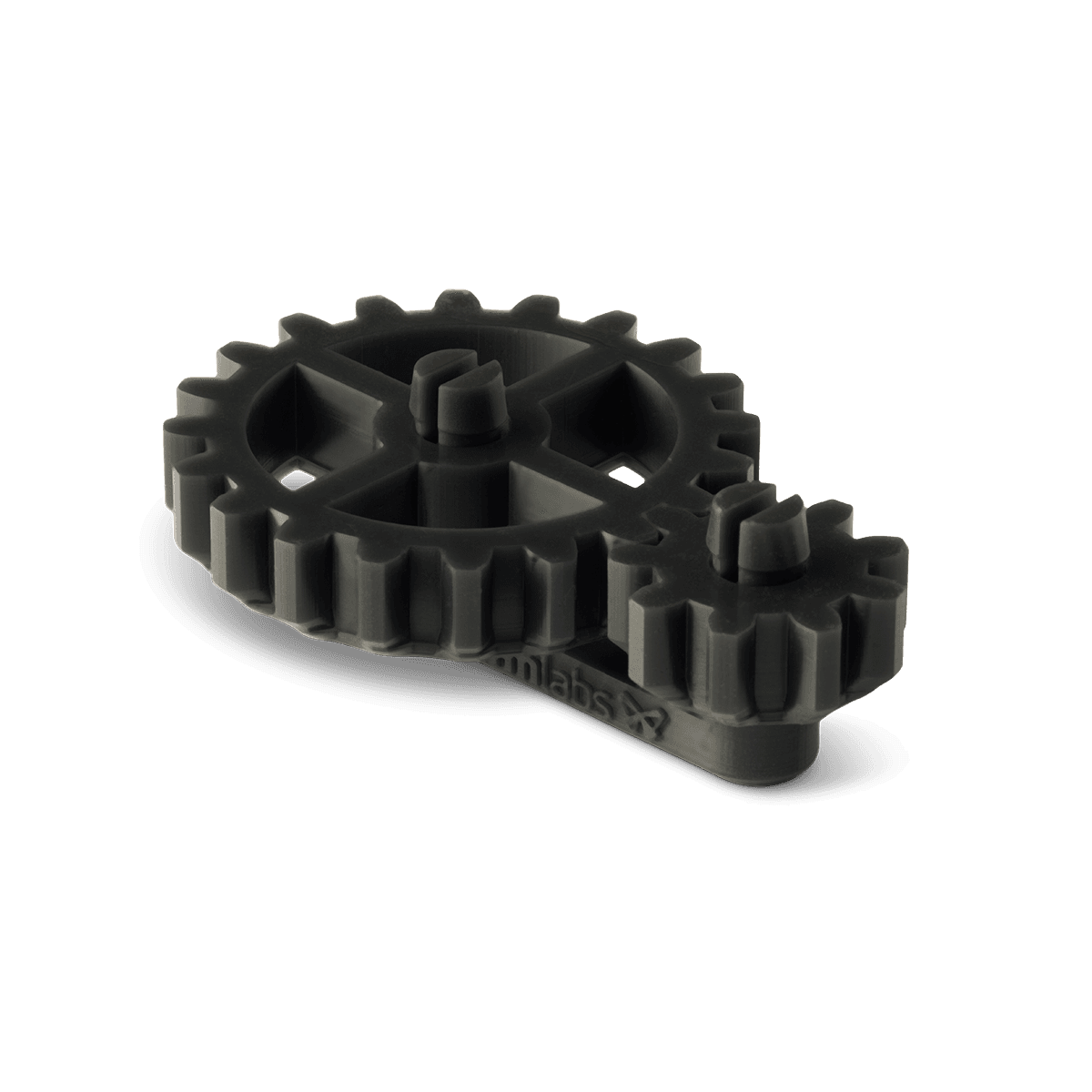
Tough 1000 Resin is a ductile, impact-resistant material with comparable strength, stiffness, and toughness to high-density polyethylene (HDPE), designed with exceptional wear and fatigue resistance for long-term toughness and utility.
The 180% elongation at break (EAB) and Gardner impact strength of 128 in-lb surpass HDPE, making it ideal for parts that bend, compress, or deform without cracking. Hinges and functional parts can handle repeated stress and wear with a work of fracture of 3,200 J/m2 and a Ross flex fatigue of >100,000 cycles (at 23 °C). With a matte, dark grey color, Tough 1000 Resin is engineered for applications that require smooth surfaces and low-friction finishes.
Tough 1000 Resin is a new material formulation that leverages the technology of Form 4 Series printers, with 5x higher fracture toughness, 2x higher EAB, and improved temperature, creep, and aging resistance compared to Durable Resin.
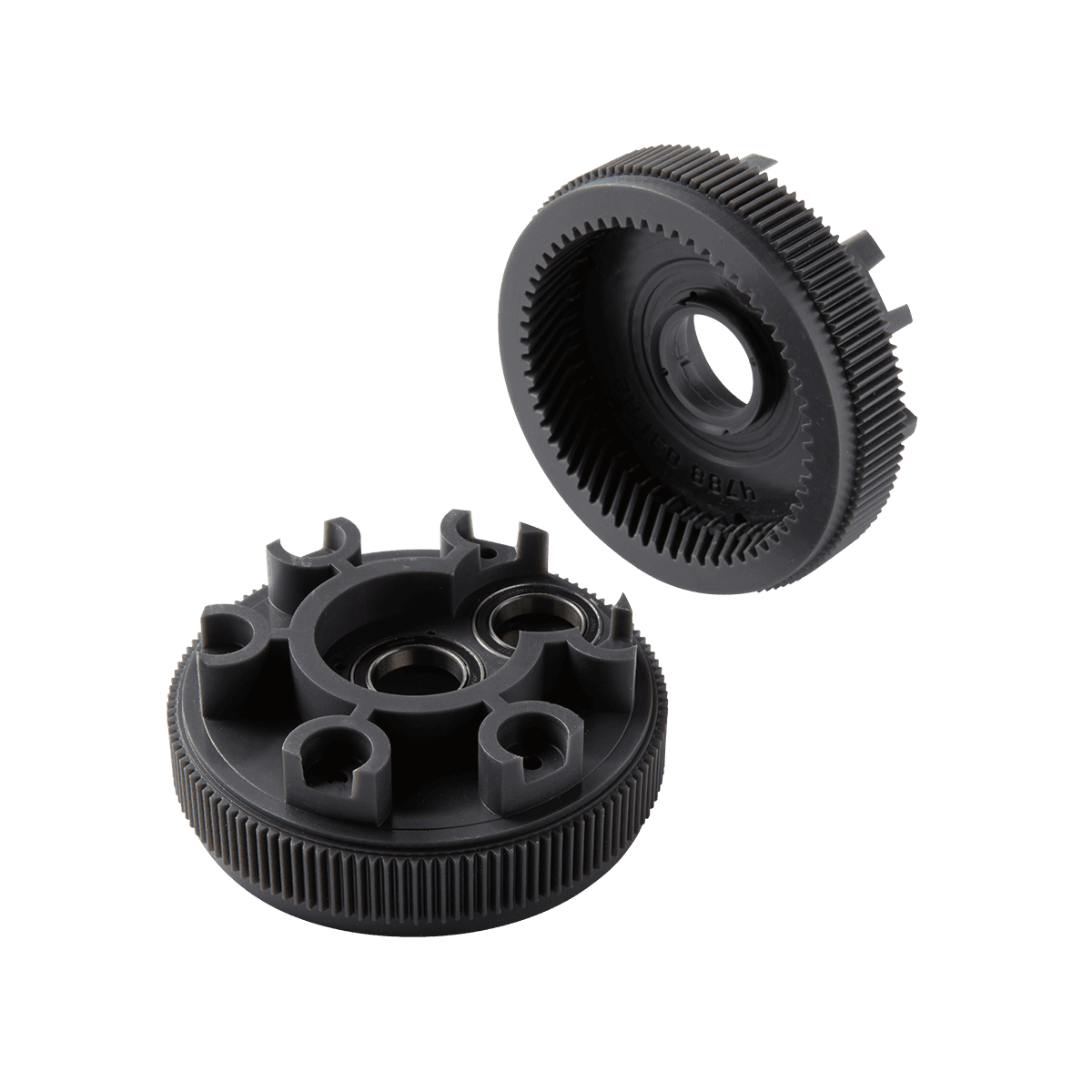
Tough 1500 Resin V2 is a resilient material with strength, stiffness, and toughness comparable to polypropylene (PP), offering exceptional resistance to fractures, impacts, and shattering.
Create parts that balance stiffness and ductility, whether for compliant mechanisms or rugged enclosures with self-tapping screws and snap fits. Tough 1500 Resin V2 enables a wide range of applications, from functional prototypes to end-use jigs and fixtures.
Tough 1500 Resin V2 is a new material formulation that leverages the Form 4 Series to deliver 10 times higher fracture toughness than the previous version.
This resin is for Form 4 Generation printers. For Form Studio 1 use Tough 1500 (Form Studio 1).
Toughest and most ductile
Balanced blend of stiffness and compliance
HDPE Delrin (POM)
PP
Impact-resistant jigs, fixtures, and parts, and squeezable prototypes
Low-friction assemblies, such as gears and ball joints
Parts that need a combination of stiffness and ductility to create compliant mechanisms like latches, flexures, and dampers
Clasps and buckles, self-tapping screw bosses, hinges
FAQ
Tough 2000 Resin V2 is a rugged SLA 3D printing material with strength and stiffness comparable to ABS. It combines toughness with high temperature and creep resistance, making it well suited for heavy-duty functional prototypes, end-use parts, jigs, fixtures, protective shells, and snap-fit enclosures that must resist shattering, deformation, and long-term wear.
The V2 formulation delivers 3x higher fracture toughness, improved temperature resistance, better material longevity, and enhanced aesthetics compared to the original Tough 2000 Resin. It also features a darker, more matte finish that improves contrast and scratch resistance for presentation-ready parts.
The material matches ABS closely in tensile modulus (both at 1800 MPa) and surpasses it in ultimate tensile strength (40.4 MPa vs. 39 MPa) and elongation at break (79% vs. 8%). Its heat deflection temperature of 70 °C at 0.45 MPa is somewhat lower than the typical ABS range of 80-90 °C noted in literature, so it is best evaluated against your specific application requirements. Download the Tough 2000 Resin V2 Technical Data Sheet for a full side-by-side comparison.
Each material in the Formlabs Tough Resin family is benchmarked against a different thermoplastic. Tough 1000 Resin is the most ductile, comparable to HDPE, with a 180% elongation at break and exceptional wear and fatigue resistance. Tough 1500 Resin V2 is balanced between stiffness and compliance, comparable to polypropylene, and is well suited for compliant mechanisms, latches, and self-tapping screw bosses. Tough 2000 Resin V2 is the strongest and stiffest of the three, comparable to ABS, and is the best choice when high temperature and creep resistance are priorities. Learn more on the Tough 1500 Resin V2 and Tough 1000 Resin pages.
Parts printed at 100 μm on a Form 4 and post-cured with a Form Cure V2 for 12 minutes at 70 °C exhibit the following properties: 40.4 MPa ultimate tensile strength, 1800 MPa tensile modulus, 79% elongation at break, 67 MPa flexural strength, 1701 MPa flexural modulus, 25 J/m notched Izod impact strength, and a heat deflection temperature of 70 °C at 0.45 MPa. Full specifications are available in the Technical Data Sheet.
The material offers exceptional creep resistance, showing only 1.3% creep strain under a 4 MPa load after two weeks. This makes it a reliable choice for structural jigs, load-bearing fixtures, and enclosures that must hold their shape under continuous stress.
Yes. Its 79% elongation at break and high fracture toughness of 305 J/m2 make it well suited for snap-fit assemblies and parts that undergo repeated flexing without breaking. The recommended applications include snap-fit enclosures and robust protective shells.
Post-processing involves two main steps. First, wash the part using isopropyl alcohol or an ether-based solution to remove uncured resin from the surface. Formlabs Form Wash or Form Wash L are both compatible. Second, post-cure the part using a Form Cure or Form Cure L unit. Post-curing is essential for parts to achieve their full strength and intended functional properties by completing the chemical reaction initiated during printing.
Wash time settings are available on the Formlabs support site for Form Wash and Form Wash L. Cure settings are available separately for Form Cure V1, Form Cure V2, Form Cure L V1, and Form Cure L V2.
Formlabs offers a 3D printed sample part that you can request to see and feel the material quality firsthand. You can also download the Technical Data Sheet to review full mechanical property data, or compare it against other Formlabs materials. For pricing information or bulk order options, visit the Tough 2000 Resin product page or contact the Formlabs sales team.
Request a Free Tough 2000 Resin Sample Part
See and feel Formlabs quality firsthand. We’ll ship a free Tough 2000 Resin 3D printed sample part to your office.