WHITE PAPER
Formlabs Logo

Preparing your workspace for the Fuse X1 ecosystem

Preparing your workspace for the Fuse X1 ecosystem

Before receiving your printer and accessory products, prepare a space to install and operate them. Read and understand the instruction manuals and their safety instructions before using the Fuse X1 printer or Fuse Sift X1.

If your product has any visible shipping damage upon delivery, add a note to the shipping receipt or bill of lading. Contact Formlabs Support or your certified service provider and provide photos of the damage, both to the unopened package and its contents.

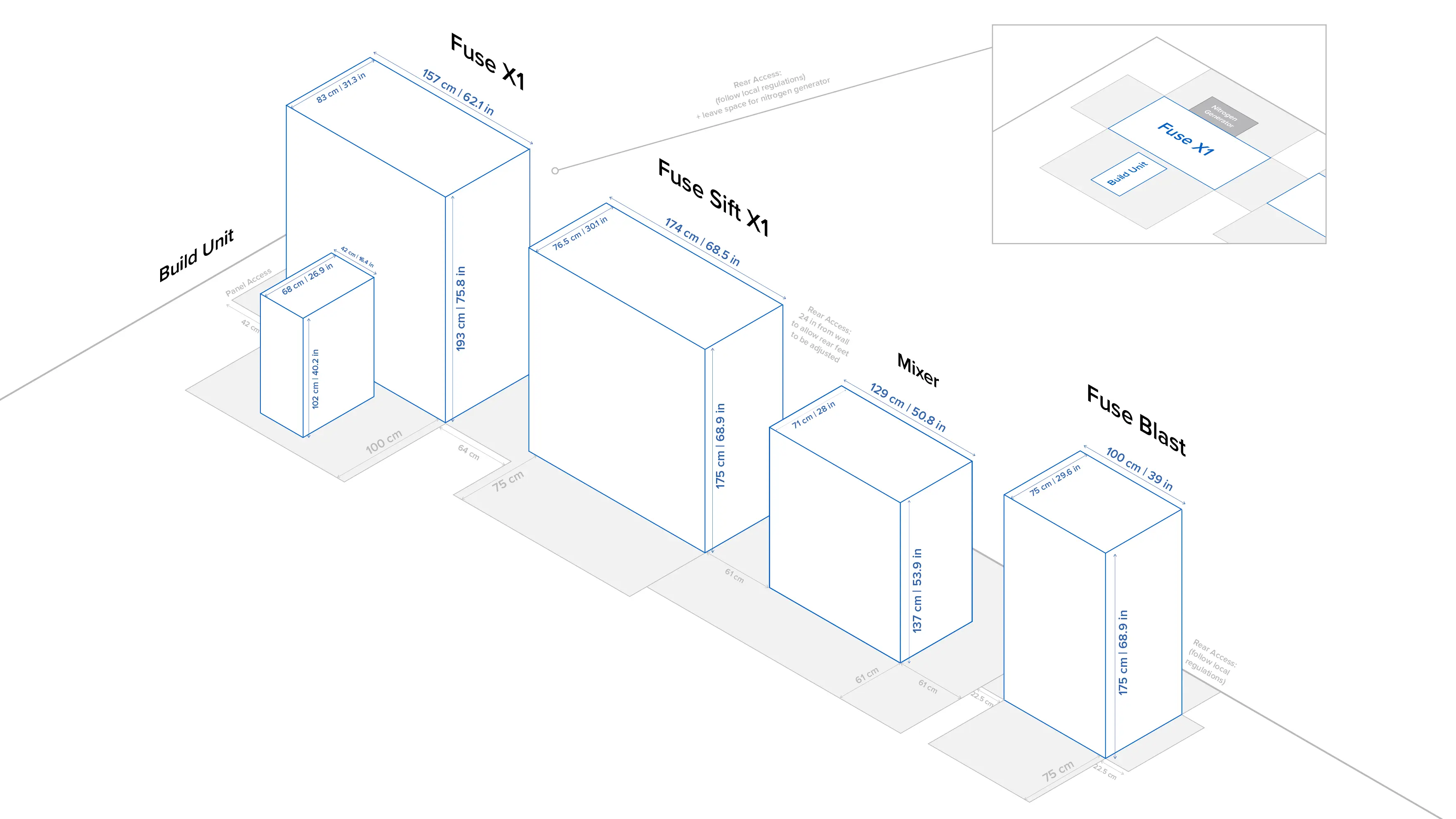
Example Fuse X1 ecosystem layout

Footprints

Reserve the following minimum dimensions for the most convenient access:

  • Fuse X1: 241 × 243 × 241 cm (94.8 × 95.8 × 95.1 in)
    • Leave at least 1.0 m in front and 0.4 m on the sides for door and panel access.
    • Place the printer at least 20.0 cm (8.0 in) from nearby walls, following any relevant local regulations.
    • Reserve additional space as needed for a nitrogen source (e.g., a nitrogen generator).
  • Build Unit: 42 × 68 × 102 cm (16.5 × 26.9 × 40.2 in)
    • One Build Unit can fit within the footprint of the printer. If additional Build Units are purchased, more space is needed for storage and cooling.
  • Nitrogen generator: Depends on installed generator
    • Install an oxygen monitor with an alarm located in the same room as the Fuse X1.
    • Printer requirements:
      • Purity: >99.5%
      • Nitrogen line fittings: ⅜ NPT (printer-side connector)
      • Pressure: >50 PSI, internally regulated to 50 psi
      • Continuous flow rate: 0.8 SCFM (22.65 L/min) minimum
      • Gas temperature at machine inlet: minimum 18 ºC
  • Fuse Sift X1: 174.0 × 157.5 × 175.0 cm (68.5 × 62.0 × 68.9 in)
    • Leave at least 61 cm (24 in) to the left, front, and right of the unit free for access.
    • Place the Fuse Sift X1 away from nearby walls according to local regulations.
  • Mix Kit: 100 × 100 cm (39.4 × 39.4 in)
  • Fuse Blast: 145 × 150 × 175 cm (57.4 × 59.6 × 69 in)
    • Leave at least 75 cm (29.5 in) in front of the unit and 22.5 cm (8.9 in) on the sides free for access.

Environs

Consider the following additional requirements:

  • Choose a location separate from any machinery or tooling that generates dust or sparks, such as wood or metal working equipment.
  • Unlike standard media blasting cabinets, the Fuse Blast can share a space with the Fuse X1 printer or Fuse Sift X1 without risk of media contamination. If you are using another blasting cabinet, place your media blasting tools in a separate room away from the printer and powder recovery system to prevent powder contamination and potential print failures. If you cannot move the media blaster into its own workspace, position any media blasting tools as far away from the printer and Fuse Sift X1 as possible to prevent media blasting particles from contaminating your powder supply.
  • Maintain low ambient humidity. When printing with Nylon 12, keep the relative humidity of the environment around the printer, the Fuse Sift X1 and other post-processing tools, and anywhere unsintered powder is stored to 70% (non-condensing) or less at all times. Higher humidity will lead to clumping, under-dosing, and print failures. For SLS powders, humidity affects shelf life significantly. For optimal results, follow Formlabs guidelines for storing and handling powder.
  • Maintain an ambient temperature of 18–28 ºC (64–84 ºF) with an HVAC system that actively moves air into and out of the space 24/7.

Compressed air

  • Fuse X1: Ensure you have a source of compressed air that meets your nitrogen generator’s requirements.
  • Fuse Sift X1: The machine has an interior regulator set to 50 psi. For more information, see the Fuse Sift X1 manual.
  • Fuse Blast: Ensure you have a source of compressed air that meets the machine’s requirements. For more information, see the support article Setting up a compressed air supply for the Fuse Blast.
  • Vacuum conveyor: Each vacuum conveyor requires the following to transport powder 1.5–4.6 m (5–15 ft). Most common Fuse X1 ecosystem setups require two vacuum conveyors: one on the printer and one on the Mix Kit.
    • 10 SCFM at 100 PSI
    • Input pressure of 86–116 psi
    • Rated for up to 13 SCFM

Caution:

Sintering nylon powder produces byproducts such as laurolactam which accumulates within the print enclosure, filter mediums, and exhaust. Proper ventilation is required whenever the printer is operating.

Power requirements

ProductMinimum power requirementSocket stylePlug style
Fuse X150 A @ 200–240 VACHardwiredPower cable not included. Specific cable and termination to be determined by the user in consultation with an electrician. There is a panel on the back of the printer that must be removed, exposing a terminal block. Users can wire in the cable that meets their requirements and local plug type.
Fuse Sift X120 A @ 120 VAC*
10 A @ 240 VAC*
IEC C19

Cables with the following plug style are included depending on shipping region:

  • NA: Type NEMA 5-20P
  • EU: Type CEE 7/4 "Schuko"
  • UK: Type G BS 1363
Fuse Blast6 A @ 120 VAC
3 A @ 230 VAC
IEC C19

Cables with the following plug style are included depending on shipping region:

  • NA: Type NEMA 5-20R
  • EU: Type CEE 7/3 "Schuko"
  • UK: Type G BS 1363

* The Fuse Sift X1 requires an AC circuit capable of powering both the Fuse Sift X1 and the third-party vacuum. Consult the manuals for both units and follow all relevant electrical codes.

Networking requirements

The Fuse X1 has an RJ-45 Ethernet (10BASE-T/100BASE-TX/1000BASE-T) LAN port. Connect with a shielded Ethernet cable (not included): minimum Cat5, or Cat5e or Cat6 for 1000BASE-T.

Additional supplies

Aside from the contents of the printer and Fuse Sift X1 package, you need additional supplies to post-process your printed parts and to clean and maintain the printer and powder recovery station.

Prepare your workspace by purchasing them in advance:

  • Alconox cleaning agent
  • Distilled water
  • Ethanol (laboratory-grade)
  • Disposable lint-free microfiber cloths
  • Disposable lint-free polyester cloth swabs
  • Proper personal protective equipment (PPE) based on the safety data sheets for the materials you plan to use
  • Blasting media (200–300 µm for best media filtering performance)