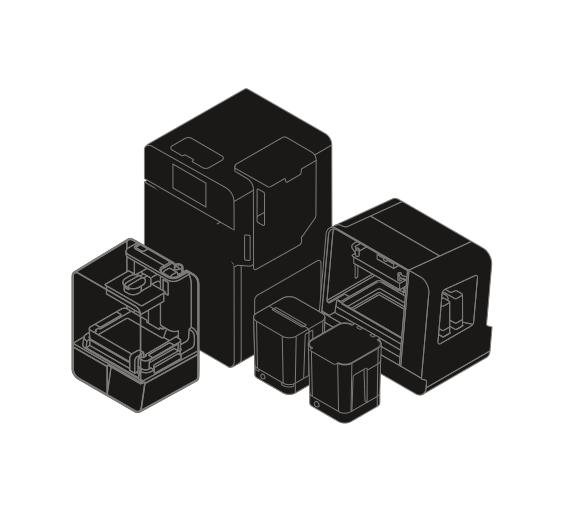
How do I prepare my workspace for SLA printing?
Designate a specific area for SLA printing, separate from other activities, to ensure a safer and more organized workspace. Make sure to set up your Formlabs printer and post-processing tools on a stable, level surface. This minimizes the risk of accidental spills or contamination in other areas.
While Formlabs resins don’t require special ventilation due to the lack of volatile chemicals like ACMO, you should always operate your Formlabs SLA printer and Form Wash in a space where air circulates freely to prevent the buildup of fumes and vapors. Follow code guidelines, such as those defined by the International Building Code (ICC), to ensure your space meets local requirements for a well-ventilated occupied space. Printers should not be operated in closed off, unventilated spaces such as closets or small storage rooms like a janitorial supply closet.
Formlabs recommends using its SLA products in room equipped with HVAC systems providing at least three full air exchanges per hour. If needed, you can increase the air exchanges per hour without having to change the HVAC systems in place by adding exhaust fans in windows.
How do I ensure safety during setup?
Desktop machines in the Formlabs SLA ecosystem, such as the Form 4, Form Wash, and Form Cure, can be safely set up by a single person. When setting up larger Formlabs SLA devices, such as the Form 4L, Form Wash L, and Form Cure L, always work with a partner and use the included lifting straps or carrying sling to move the machine.
Do not lift or reposition your machine:
- By the cover or any other movable part of the device
- When it is connected to a power source
- When it is connected to an Ethernet or USB cable
Are there hot surfaces that I should be mindful of?
For optimal printing, Formlabs SLA printers maintain the resin at approximately 35 °C (95 °F) while in use. Some Formlabs SLA printers, such as the Form 2 and Form 4, heat the resin with a resistive heating element under the resin tank. This heater can become very hot during the printing process. If you remove the resin tank immediately after printing, do not touch the areas under the tank until they reach room temperature. Other printers, such as the Form 3 and Form 3L, use air heaters to bring the resin to its target temperature and do not pose a burn hazard.
- The Form Cure and Form Cure L contain heaters to help ensure that parts reach the material’s optimum properties after post-curing. While the heaters and fan designs limit overheating and the heaters are insulated to contain heat, surfaces of the machines and printed parts may be hot during and after use. Take care when removing post-cured parts from the machine.
- Form Cure (1st Generation) only: The turntable can remain hot during and after a cure cycle. Always allow the turntable to cool completely before touching or cleaning.
- The Fast Cure contains banks of LEDs to post-cure parts. These LEDs generate heat during use, so surfaces of the Fast Cure and printed parts may be hot during and after use. Use thermal-insulating gloves safe to at least 160 °C (320 °F) when removing a hot turntable tray or post-cured printed part.
Has Formlabs performed any internal air quality tests?
Formlabs regularly performs internal air quality testing to ensure compliance with regulatory standards and occupational exposure limits for the chemicals used in our workplace.
Air quality evaluations are conducted under the following circumstances:
- When new chemicals with hazardous properties are procured
- When new job tasks with anticipated chemical exposure are introduced
- When changes to existing job tasks may impact employee chemical exposure
- When major changes to lab layout, equipment, or processes occur
- Periodically, to ensure our data remains current
- When qualitative reports indicate a potential issue
Formlabs air quality assessments are based on direct measurements. We perform both room sampling and employee sampling as part of our assessment process:
- Room sampling helps us understand potential exposure levels in a specific area over the course of a full day.
- Employee sampling reflects real-world exposure during typical working conditions and job specific activities.
Collecting quantitative data from both room and employee sampling allows us to make informed decisions regarding site policies and control measures. Results are compared against regulatory limits as defined in Section 8 of each chemical’s Safety Data Sheet (SDS).
At this time, all Formlabs facilities remain below OSHA exposure limits for the chemicals we use. Accordingly, our respirator policy for printing tasks is classified as voluntary use.