Aviso:
Para evitar dañar el equipo, comprueba la tabla de compatibilidad de los tanques de resina en Elección del material adecuado para confirmar que estás utilizando un tanque de resina compatible con este material.
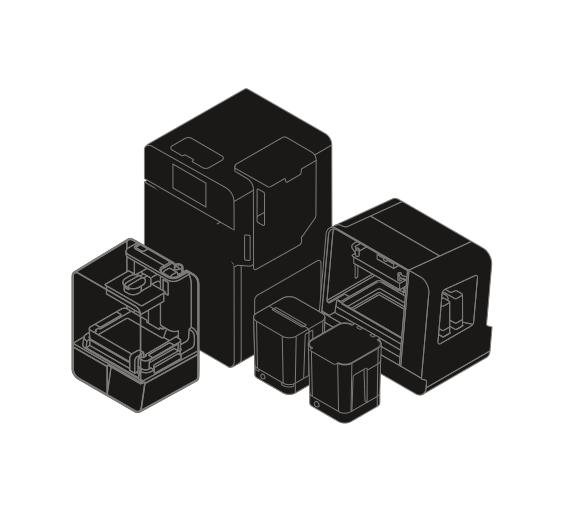

Aviso:
Para evitar dañar el equipo, comprueba la tabla de compatibilidad de los tanques de resina en Elección del material adecuado para confirmar que estás utilizando un tanque de resina compatible con este material.
La Silicone 40A Resin es una silicona pura, sin monómeros ni acrilatos añadidos, que combina las propiedades de la silicona fundida como material con las ventajas de la impresión 3D. Utiliza la Silicone 40A Resin para fabricar piezas blandas, maleables y duraderas.
Imprimir con la Silicone 40A Resin elimina la necesidad de utillaje especializado y procesos de fundición laboriosos, lo que permite producir piezas de silicona personalizadas con propiedades isotrópicas y geometrías complejas que no son posibles con la fundición o el moldeo.
Si necesitas más información sobre el rendimiento o las propiedades específicas de la Silicone 40 Resin como material, consulta la ficha de datos de seguridad (FDS) y la ficha técnica. Consulta siempre las FDS como fuente principal de información para entender la seguridad y el manejo de los materiales de Formlabs.
Se recomienda para:
No se recomienda para:
Materiales necesarios
Fabricados por Formlabs:
Aviso:
Usa una base de impresión y un tanque de resina exclusivamente para imprimir con la Silicone 40A Resin. Usar los mismos consumibles para varios tipos de resina puede provocar fallos de impresión cuando se imprime con la Silicone 40A Resin.
Fabricados por terceros:
| Artículo | Proveedor | Notas |
|---|---|---|
| Vevor UltraSonic Cleaner o un limpiador ultrasónico similar en el intervalo de frecuencias de 35-45 kHz | Amazon | Para lavar piezas de Silicone 40A Resin con alcohol isopropílico |
| Alcohol isopropílico (99 % o superior) | Amazon (EE. UU.) 3d-basics.com (UE) | Para crear una mezcla de disolventes para lavar piezas de Silicone 40A Resin |
| Acetato de n-butilo | Amazon (EE. UU.) 3d-basics.com (UE) | Para hacer la mezcla del disolvente para el lavado de las piezas de Silicone 40A Resin |
| Vaso de precipitados de vidrio (de al menos 500 ml) | Amazon | Para sumergir las piezas de Silicone 40A Resin en agua durante la fase de poscurado |
| Febreze HD (opcional) | Amazon | Para enmascarar el olor de las piezas impresas con Silicone 40A Resin |
| Tarro de cristal de 1,5 gal (opcional) | Amazon | Para almacenar disolventes de lavado y lavar piezas impresas con la Silicone 40A Resin si no se utiliza una Form Wash |
| Cortador ultrasónico (opcional) | Amazon | Para quitar de las piezas de Silicone 40A Resin las protuberancias que dejan los soportes |
Tu primera impresión con la Silicone 40A Resin
Para familiarizarte con el proceso de trabajo de la Silicone 40A Resin, Formlabs recomienda imprimir piezas más sencillas como esta correa o celosía para un reloj de pulsera (archivo FORM, archivo STL) que puedes imprimir directamente sobre la base de impresión sin soportes.
Cuando empieces a imprimir tus propios modelos, asegúrate de seguir nuestras recomendaciones de diseño para la Silicone 40A Resin y de orientar tus piezas y darles soporte correctamente.
En particular:

Cómo dar soportes a la Silicone 40A Resin
Aviso:
Si necesitas orientación sobre el diseño de las piezas, lee el artículo de asistencia Recomendaciones de diseño y soportes retirables para la Silicone 40A Resin.
Al orientar las piezas en PreForm y generar soportes para ellas:
Cómo preparar un modelo para su impresión en PreForm:
Lavado
Sigue las instrucciones de la Guía de lavado por sonicación en alcohol isopropílico de la Silicone 40A Resin para obtener los mejores resultados posibles al lavar las piezas impresas con la Silicone 40A Resin.
Otra opción es lavar las piezas impresas con la Silicone 40A Resin en una mezcla de un 80 % de alcohol isopropílico y un 20 % de acetato de n-butilo. Por ejemplo, si utilizas la Form Wash V1, vierte una botella de 2 l de acetato de n-butilo a la cubeta de lavado y, a continuación, añade alcohol isopropílico hasta alcanzar la línea de llenado máximo. La Form Wash V2 tiene varias líneas de llenado en la cubeta de lavado, correspondientes a volúmenes de 7, 10 y 14 l, así que utiliza 1,4, 2 o 2,8 l de acetato de n-butilo, respectivamente. Formlabs no ha probado la eficacia de esta mezcla de disolvente con otros materiales y no recomienda usarla para lavar piezas impresas con otras resinas de Formlabs. No laves únicamente con alcohol isopropílico a menos que estés siguiendo la Guía de lavado por sonicación en alcohol isopropílico de la Silicone 40A Resin.
Aviso:
La Form Wash agita el baño de disolvente y saca las piezas pasado un tiempo determinado. Lava las piezas según lo descrito en el artículo de asistencia Ajustes de tiempo de la Form Wash. Presta especial atención a la información que afecta a las propiedades mecánicas o a los requisitos de biocompatibilidad.
Si el modelo es hueco o tiene canales internos, asegúrate de que la resina líquida salga de todas las cavidades. Deja que las piezas se sequen por completo antes de llevar a cabo el poscurado.
Retirada de los soportes
Para obtener el mejor resultado posible, Formlabs recomienda retirar los soportes después del lavado pero antes del poscurado. El mejor método para conseguir un acabado de la superficie óptimo es tirar suavemente de las estructuras de soporte y deslizar un cuchillo de precisión afilado por la superficie de la pieza para cortar dichas estructuras. Ten cuidado de no dañar la pieza en sí misma. Si lo deseas, puedes utilizar un cortador ultrasónico para trabajar con mayor precisión.
Puede ser posible arrancar simplemente con la mano los soportes conectados a piezas gruesas, pero aun así, deberías retirar los soportes de los detalles finos o las paredes delgadas utilizando alicates de corte o un cuchillo de precisión.
También puedes utilizar discos abrasivos en miniatura de Scotch Brite y una herramienta rotativa para rectificar las marcas de los soportes en las piezas, poscuradas o no.
Requisitos de poscurado
Es necesario realizar el poscurado de la Silicone 40A Resin para conseguir sus propiedades mecánicas óptimas. Poscura la Silicone 40A Resin en agua, dentro un vaso de precipitados de vidrio colocado dentro de la Form Cure.
Las piezas de silicona poscuradas tienen un olor inofensivo que se disipa con el tiempo. Para enmascarar este olor, añade Febreze HD al agua del vaso de precipitados antes del poscurado. Añade 12,5 g de Febreze HD por cada 500 ml de agua. Para medir la cantidad necesaria de Febreze, pulveriza unos 12,5 g de Febreze HD en un recipiente vacío sobre una báscula tarada.
Consulta el artículo de asistencia Form Cure: ajustes de tiempo y temperatura para conocer las recomendaciones de poscurado.
Adhesivos
Antes de utilizar adhesivos, asegúrate de que las piezas se han lavado y secado a fondo y de que no hay superficies pegajosas o polvorientas. Para asegurar una unión satisfactoria, Formlabs recomienda utilizar una imprimación como la serie DOWSIL 1200 o una imprimación médica antes de utilizar adhesivos. Sigue las instrucciones del fabricante para utilizar estas imprimaciones y garantizar un resultado óptimo.
Cuando se haya secado la imprimación, utiliza un adhesivo de silicona como el DOWSIL 734. No utilices pegamentos de cianoacrilato, ya que son quebradizos y dejan una costra sobre la silicona.
Recursos adicionales