Notice:
To avoid damage to equipment, check the resin tank compatibility table in Choosing the right material to confirm you are using a resin tank that is compatible with this material.

Notice:
To avoid damage to equipment, check the resin tank compatibility table in Choosing the right material to confirm you are using a resin tank that is compatible with this material.
BioMed Durable Resin is a clear material for applications requiring impact, shatter, and abrasion resistance. This USP Class VI material is made in an FDA-registered, ISO 13485 facility and can be used in applications for long-term skin (>30 days) and short-term tissue, bone, and dentin contact (<24hrs).
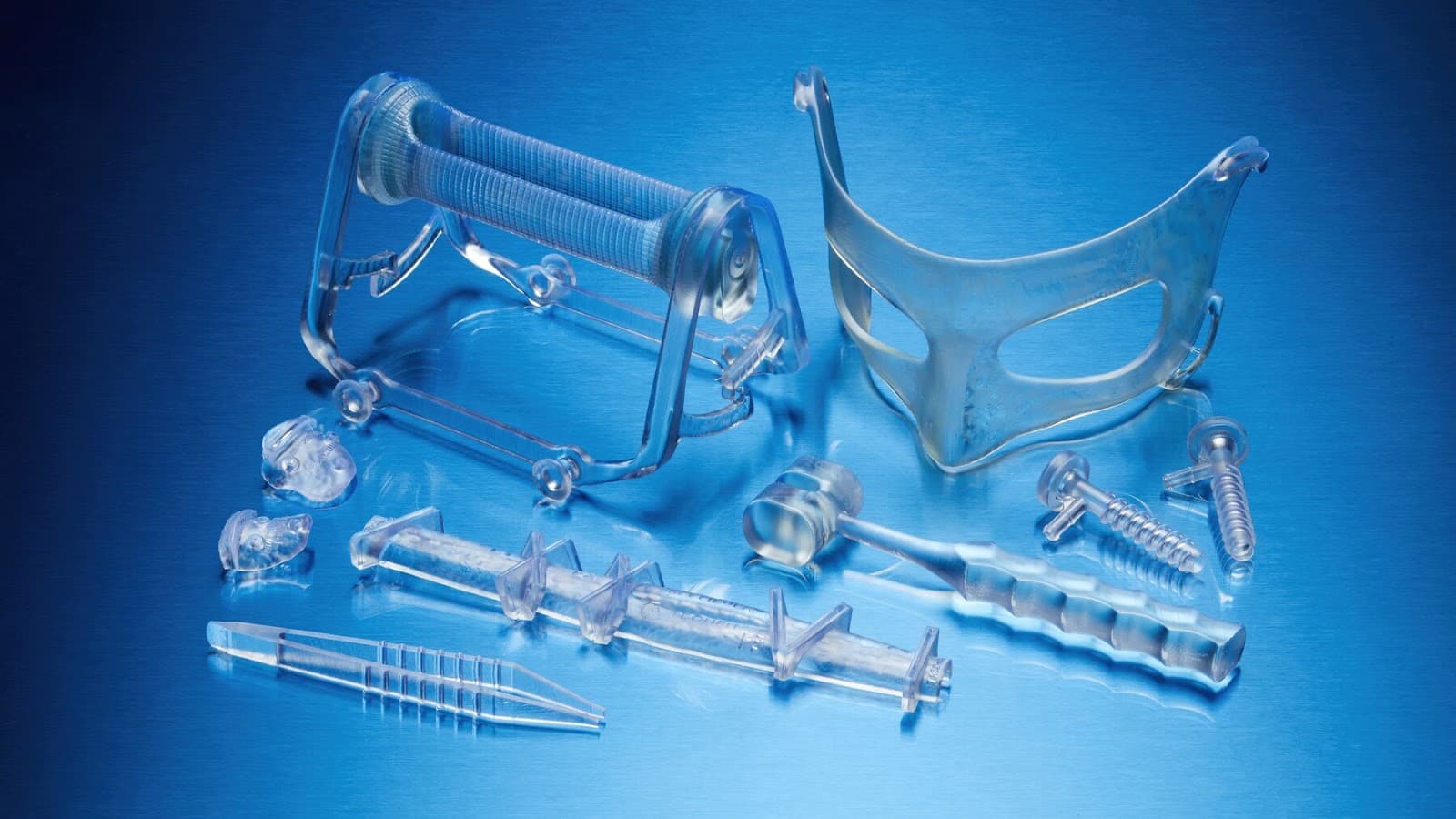
Recommended for:
BioMed Durable Resin prints at 100 microns.
Comparison with other materials
| BioMed Durable Resin | BioMed Clear Resin | |
|---|---|---|
| Ultimate tensile strength (MPa) | 29.1 | 52 |
| Tensile modulus (MPa) | 994 | 2080 |
| Elongation at break (%) | 33 | 12 |
| Durometer/Shore Hardness | 75D | 78D |
| Flexural modulus (GPa) | 0.64 | 0.23 |
| IZOD Impact strength (J/m) | 98 | 35 |
To learn more about the performance properties of Formlabs resins, refer to the library of material properties data sheets.
Printing with BioMed Durable Resin
Notice:
To avoid damage to equipment, check the resin tank compatibility table in Choosing the right material to confirm you are using a resin tank that is compatible with this material.
Install or update PreForm, then set up the next print job.
To prepare a model for printing in PreForm:
Washing
Follow the part washing recommendations in the manufacturing guide for the clearest and best possible results. Improper washing can lead to suboptimal mechanical and biocompatibility properties.
Post-curing requirements
Follow the post-curing recommendations in the manufacturing guide for the clearest and best possible results. Improper post-curing can lead to suboptimal mechanical and biocompatibility properties.
Additional resources