Notice:
To avoid damage to equipment, check the resin tank compatibility table in Choosing the right material to confirm you are using a resin tank that is compatible with this material.

Notice:
To avoid damage to equipment, check the resin tank compatibility table in Choosing the right material to confirm you are using a resin tank that is compatible with this material.
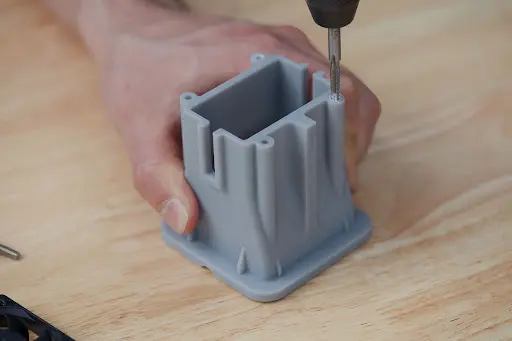
Flame Retardant Resin is a self-extinguishing and halogen-free material that performs well in environments with high temperatures or ignition sources. Use this resin to produce parts that can handle additional post-fabrication operations such as tapping, trimming, and drilling. Parts can undergo optional post-processing steps such as painting or electroplating.
Notice:
Priming or polishing the surface of parts printed with Flame Retardant Resin with mineral oil or other flammable lubricants may invalidate the UL flammability rating.
Flame Retardant Resin is UL94 V-0 and FAR25.853 certified. Use it to produce airplane, automobile, and railway interior parts, protective and internal consumer electronics components, and custom jigs, fixtures, and replacement parts for industrial environments.
Notice:
To learn more about the performance or specific material properties of Flame Retardant Resin, refer to the Safety Data Sheet (SDS) and Technical Data Sheet (TDS). Always consult the SDS as the primary source of information to understand safety and handling of Formlabs materials.
Recommended for:
Flame Retardant Resin prints at 50 microns and 100 microns on the Form 3 series of printers and at 100 microns on the Form 3L series of printers.
Comparison with other materials
| Flame Retardant Resin | High Temp Resin | Tough 2000 Resin | |
|---|---|---|---|
| Ultimate tensile strength (MPa) | 39 | 58 | 46 |
| Tensile modulus (GPa) | 2.9 | 2.8 | 2.2 |
| Elongation at break (%) | 9.4 | 3.3 | 48 |
| IZOD Impact strength (J/m) | 22 | 18 | 40 |
| Heat deflection temperature (HDT) @ 1.8 MPa | 71 | 99 | 53 |
| Heat deflection temperature (HDT) HDT @ 0.45 MPa (°C) | 94 | 142 | 63 |
To learn more about the performance properties of Formlabs resins, refer to the library of material properties data sheets.
Printing with Flame Retardant Resin
Notice:
To avoid damage to equipment, check the resin tank compatibility table in Choosing the right material to confirm you are using a resin tank that is compatible with this material.
Shake the resin cartridge vigorously while rotating for at least two minutes before starting a print with Flame Retardant Resin. Insufficient mixing may affect the flame retardant properties of printed parts. If it has been more than two weeks since you printed with Flame Retardant Resin, shake the cartridge for two minutes and stir the resin in the tank before printing.
Due to the viscosity of Flame Retardant Resin, Formlabs recommends priming a new resin tank to reduce print time and avoid tank fill error messages.
Install or update PreForm, then set up the next print job.
To prepare a model for printing in PreForm:
Note:
Formlabs recommends printing Flame Retardant Resin parts on supports instead of directly on the build platform. If parts need to be printed on the build platform, Formlabs recommends printing on the Build Platform 2 for easy removal.
Finishing
The Form Wash agitates the solvent bath and removes parts from the bath after a set time. Wash parts according to the support article Form Wash time settings. Pay particular attention to information that affects mechanical properties.
Small negative features may be difficult to fully clean due to the resin’s high viscosity. If the model is hollow or has internal channels, ensure liquid resin is flushed out thoroughly from these features using a skirt bottle filled with 99% isopropyl alcohol (IPA). Use compressed air to allow parts to fully dry before post-curing.
Post-curing requirements
Flame Retardant Resin requires post-curing to reach its optimal mechanical properties. For tall thin parts or for parts with large overhangs, Formlabs recommends post-curing with supports to prevent warping or sagging.
Note:
Take care while handling parts before post-curing, as the surface is prone to scratching.
Refer to the support article Form Cure time and temperature settings for post-curing recommendations.
Post-processing
After post-curing, use 600-grit sandpaper to remove support marks and scratches. A lower grit sandpaper may abrade the surface. You may also wish to use the Formlabs Finishing Tools kit.