
The A-TRAS Tactical Rack System can be used for organizing luggage during outdoor activities or sleeping in the car. A feature is its expandability, allowing hooks and holders to be freely customized.
AXIS handles custom parts for the aftermarket, such as car interior panels and smartphone holders. For the company, which primarily sells through e-commerce, the competitive edge comes from speedy product introduction aligned with new car releases. In April 2025, AXIS brought the Fuse 1+ 30W selective laser sintering (SLS) 3D printer in-house, enabling everything from prototyping to mass production.
Moving away from molds to the Fuse Series dramatically shortened AXIS’s development periods from six months to one month. We spoke with CEO Hideyuki Irie about using the Fuse Series for product development and manufacturing. The equipment used by the company, including the Fuse Series, was introduced through BRULE, an authorized Formlabs distributor.
Delivering Satisfaction to Car Enthusiasts for 17 Years
AXIS is a manufacturer headquartered in Nerima-ku, Tokyo, that consistently handles the design, development, manufacturing, and sales of aftermarket parts for cars and motorcycles. Since its founding in 2009, the company has continued to create products for car enthusiasts. Among the approximately 30 employees, including part-time staff, two engineers and one modeler play a central role in product development. The main products are aftermarket car accessories, focusing on interior parts like shift panel covers and door handle covers, LED products, and dry carbon parts, primarily for sports-type vehicles from major domestic manufacturers such as Toyota, Honda, Mazda, Subaru, and Nissan. In recent years, the product line has expanded to include outdoor equipment, selling items like the Tactical Rack System under the A-TRAS brand.
"Our goal is to continue providing satisfaction to car enthusiasts around the world."
Hideyuki Irie, CEO, AXIS

AXIS introduced custom parts at the Tokyo Auto Salon 2026.

AXIS focuses on aftermarket car accessories for sports vehicles.
All of the company's products are sold through e-commerce sites, allowing customers to purchase custom parts dedicated to specific car models. When a new car is released, AXIS quickly introduces corresponding custom parts. This sense of speed is required to build a competitive advantage in the aftermarket automotive parts market.
Due to the nature of e-commerce sales, customers are spread throughout the country. Car-loving users from Hokkaido to Okinawa purchase the company's products. Since sales are not conducted face-to-face, product quality and prompt response are crucial factors in building trust.
Next-Day Prototypes With the Fuse Series
AXIS began full-scale utilization of 3D printers in April 2025 with two Fuse 1+ 30W 3D printers plus a Fuse Sift and Fuse Blast for post-processing. Previously, they used Fused Deposition Modeling (FDM) 3D printers for prototyping, but decided to switch to the Fuse Series to achieve higher accuracy prints.
"Simple comparison is impossible because FDM and SLS are completely different molding methods, but SLS is definitely highly accurate and finishes almost exactly as per the drawing."
Hideyuki Irie, CEO, AXIS

Two Fuse 1+ 30W 3D printers are installed in AXIS's fabrication room. Prints are run daily and the two printers support the throughput required by AXIS.
The product development workflow begins with scanning the target vehicle or panel using a handheld 3D scanner. This scan is used to reverse engineer the vehicle in CAD software and then design the prototype. All 3D modeling is handled internally by CAD engineers, establishing a system that does not rely on outsourcing. Once designed, the resulting CAD file is set up for printing in PreForm print preparation software and sent to Fuse 1+ 30W.
"Previously, to create prototypes from development, we had to rely on specialized prototyping companies or create molds. Now, we can confirm the prototype in-house by the next day. The speed to enter mass production has also dramatically increased.”
Hideyuki Irie, CEO, AXIS
Irie emphasizes that this speed leads to more efficient trial and error. Coordination with the design team has become smoother, allowing prompt discovery and resolution of potential issues before mass production. On the same day the 3D scan is performed, a mock-up is fabricated to check the shape and design. Product design is completed in a short period by developing a prototype a day.
In the traditional mold-based manufacturing process, it was not uncommon for prototype confirmation to take several weeks. If design changes were needed, mold correction or new production was required each time, increasing time and cost. The introduction of 3D printers has dramatically shortened this iterative process from several weeks to a few days.
Reducing Prototyping by 83% and Eliminating Mold Costs
The greatest achievement from introducing 3D printers is the significant shortening of the development period. The conventional injection molding manufacturing process required about six months from development to the start of mass production. Designing and manufacturing the mold takes time, and if shape changes are required, the mold must be remade. This has been shortened to about one month with the introduction of the Fuse 1+ 30W.
"Creating a mold takes one-to-two months until mass production. With a 3D printer, we can confirm the product the next day. We can make additional data corrections the following day and fabricate it the day after. The ability to repeat this process is, I think, the biggest advantage."
Hideyuki Irie, CEO, AXIS
Cost-wise, there are also benefits. When using injection molding to produce small parts, a minimum of about one million yen is required for mold costs. Manufacturing with a 3D printer eliminates this mold cost and significantly reduces prototyping costs. The company calculates material costs using the following formula and manages product costs by adding electricity and personnel expenses to this.
Product weight (g) × 1.2 (assuming 20% powder remains) × powder unit price = material costs
Irie continues to analyze the difference in cost based on production volume and says, "If the quantity exceeds 300 units, injection molding can keep costs lower." Manufacturing with 3D printers truly demonstrates its value in product development that requires high-mix low-volume production or frequent design changes. Aftermarket parts, which require different shapes for each car model, are a product category that perfectly aligns with this characteristic.
Design freedom is also cited as a major advantage. When manufacturing resin using a mold, constraints such as draft angles arise, but 3D printers free designers from such restrictions.
"The most important thing is the ability to fabricate with free design. Manufacturing with molds creates various constraints due to issues like demolding, but 3D printers free us from that, allowing for design, prototyping, and manufacturing in a short period."
Hideyuki Irie, CEO, AXIS
Benefits are also seen in customer service. Previously, even if a customer requested product improvements, rapid response was difficult because mold correction or reproduction required time and cost. The introduction of 3D printers makes it possible to immediately respond to design problems or customer feedback. Since feedback from customers is received directly through e-commerce sales, this response speed is a critical factor directly linked to customer satisfaction.
Manufacturing Mass-Market Goods With SLS
AXIS operates two Fuse 1+ 30W 3D printers for mass production. They are generally run simultaneously once a day, producing about 20 to 30 items per printer, depending on the product size. Having two printers ensures production through redundancy — if one printer needs maintenance or is being used to run prototypes, the other can still print end-use parts.
"Basically, we use them for mass production, so we run the two printers once a day. We can operate them by making prototypes on one and mass-producing on the other. We have two printers partly so that if one breaks down, the other can continue to run."
Hideyuki Irie, CEO, AXIS

Fuse Sift is an all-in-one powder management station that combines part extraction, powder recovery, storage, and mixing in a single device.

Fuse Blast is a fully automated cleaning and polishing solution that has significantly improved the efficiency of post-processing work. The working time has been reduced compared to polishing solutions from other companies previously used.
AXIS prints with Nylon 12 Powder. They initially started with glass-filled Nylon 12 GF Powder but switched to Nylon 12 based on BRULE's advice, for easier management of mixing recycled and new powder. While they considered using it for products requiring heat resistance of about 90 °C, such as brackets, they settled on operating with Nylon 12 Powder, prioritizing the powder refresh rate.
Improvements have also been made in fabrication time. Initially, fully packed build chambers took about 20 hours to print, but this has been reduced to about 13 hours thanks to updates to PreForm software.
The release of PreForm 3.34.0 improved print speed by 25% due to changes in sintering patterns. This reduction in time has allowed for stable daily print cycles of about 16 hours, combining 13 hours of printing and three hours of cooldown.
Irie evaluates the equipment's reliability, saying, "It was more durable than I imagined; it exceeded expectations." The AXIS team manages powder dispersion by laying carpet on the floor of the fabrication room and cleaning daily By regularly replacing consumables, the two printers operate reliably.
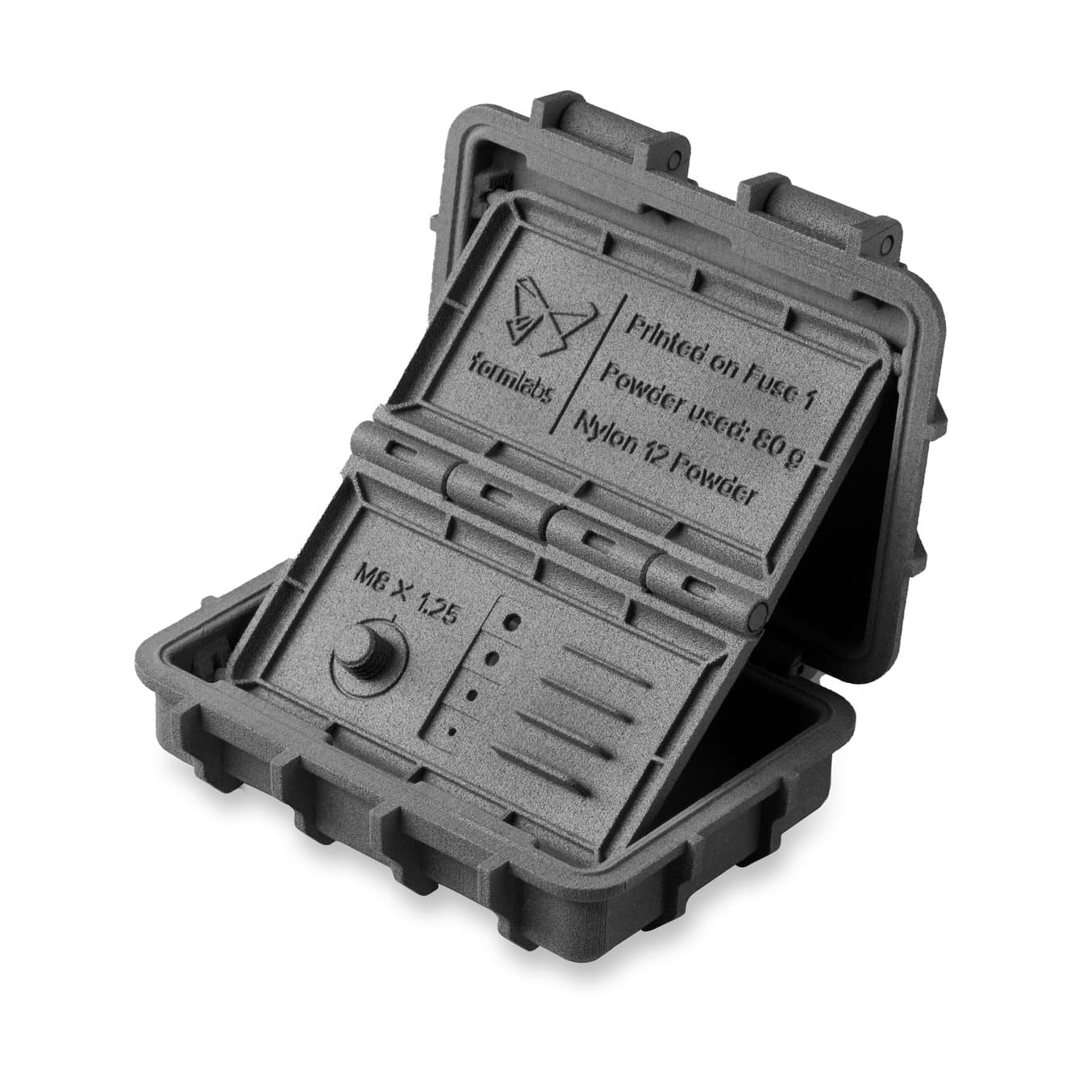
Request a Free Sample Part
See and feel Formlabs quality firsthand. We’ll ship a free SLS sample part printed on the Fuse 1+ 30W to your office.
Car-Specific Smartphone Holders
One of the main products manufactured with Fuse 1+ 30W are customized smartphone holders. They offer products compatible with a wide range of car models, including those from Toyota, Honda, Mazda, Subaru, and Nissan.

Smartphone holder design is tailored to the dashboard shape of each car model. It can be installed in a position that ensures both visibility and operability while driving. This smartphone holder was printed on Fuse 1+ 30W and then dyed and fitted with a red AXIS logo. Each model is designed to fit a specific car.
"Since we deliver 3D printed products to our customers, we pay attention to surface. Products that are 3D printed are a grayish color, but we are working hard to achieve a finish that does not make the customer think, “this is a 3D-printed product” when they hold it, by combining it with other materials," says Irie.
To achieve the desired surface, parts are dyed and the surface is then treated to resist UV exposure through a technique Irie calls "a showcase of the manufacturer's skill." Once dyed, a red emblem featuring the company's logo is added. The red product logo is a key design element for product image. For smartphone holders, a rubber O-ring is added to achieve smooth movement.
AXIS requires precision of about 0.2 mm, and since SLS fabrication tends to result in slight shrinkage, the design accounts for this. This makes print set up in PreForm easy — the team simply uses the presets in PreForm for packing and printing.
Load-Bearing Tactical Rack System Parts

This connector used for the A-TRAS Tactical Rack System Dedicated Aluminum Multi-Hook is fixed to a machined aluminum part with screws. The SLS 3D printed part is load-bearing.
Another main product is the connector for the aluminum multi-hook of the Tactical Rack System, sold under the outdoor equipment brand A-TRAS. Since it is used as a hook fixed to a machined aluminum part with screws, strength and durability are key, and the Nylon 12 part delivers.
3D Printing as an Industry Innovation
According to Irie, companies selling products manufactured with 3D printing are rarely seen in the Japanese aftermarket auto parts industry. While many companies restrict the use of 3D printers to prototyping, AXIS is pioneering by utilizing them in the manufacturing process.
"We don't see many companies selling them to customers as mass-produced goods. I believe that using 3D printers for mass production is a strength for our company within the aftermarket car parts industry."
Hideyuki Irie, CEO, AXIS
An additional advantage is BRULE's support system, which includes everything from advice on material selection to responding to issues. Irie says, "I'm fully satisfied. Issues are not zero, but when a problem occurs, they can be reached by phone, and there is a sense of security."
Irie says that the human labor required for post-processing is the challenge of utilizing 3D printers for manufacturing. Powder removal and polishing require manual effort. "Because the process of moving from print to end-use part inevitably requires human hands, we struggled to establish the flow initially." Currently, they are standardizing the processes and have established a stable workflow. By building a system where all post-processing and dyeing are completed internally, they have achieved agile production that does not rely on outsourcing.
Future Expansion: Scaling Up Printers and Throughput
AXIS plans to add more Fuse 1+ 30W 3D printers, dedicating a single printer to hit products requiring daily printing to meet demand. "We want to increase the number further and run them at full capacity. Since we have come this far, I hope we can continue to lead successfully in product development in this industry by applying data," says Irie.
"For e-commerce sites, speed is truly the key to success; it is determined by whether or not we can immediately release products accompanying a new car. I believe having a 3D printer allows us to achieve what we want."
Hideyuki Irie, CEO, AXIS
Regarding the potential for 3D printer utilization in the aftermarket parts industry, Irie offers his outlook saying, "Fundamentally, not much has changed, but I think the introduction of 3D printers will dramatically accelerate the speed of development and production."
The Fuse Series enables AXIS to achieve design freedom and development speed without molds, delivering precise and strong parts cost-effectively. Explore the Fuse Series or contact sales to learn more.