
ABS, or acrylonitrile butadiene styrene, is a thermoplastic polymer widely used for injection-molded parts including housings for consumer electronics housings and LEGO® bricks. ABS is a terpolymer composed of three individual monomers: the styrene and acrylonitrile components give the polymer matrix good strength and stiffness, while the softer butadiene component helps improve its impact strength and elongation at break. This gives ABS a versatile and highly useful set of properties versus some traditional homopolymers. Materials like PMMA (plexiglass or acrylic) and Polystyrene, are strong, but tend to be very brittle, while materials like Polyethylene and Polypropylene are much tougher, but lack the strength and stiffness required for many applications. ABS is able to effectively bridge this gap and is often the go to material for enclosures, functional prototypes, snap-fit assemblies, moving parts, jigs, and fixtures.
With the rise of 3D printing, users are demanding materials that can match traditional plastics, including tougher, more durable materials. ABS-like materials are tough, impact-resistant materials that include ABS filaments for fused deposition modeling (FDM) 3D printing and tough resins, like Formlabs Tough Resins Family.
To understand ABS vs. ABS-like resins, we compare properties, use cases, and best practices for printing ABS-like resin.
Talk to Our Sales Team
Whether you need to prototype at speed, or are producing end-use parts, we’re here to help. The Formlabs Sales team is composed of dedicated specialists who know exactly how to support you and your company's needs.
What Is ABS-Like Resin?
An ABS-like resin is a photopolymer resin with a UV acrylate base and added toughening agents meant to mimic ABS properties. Compared to standard resins, ABS-like resins offer better toughness and flexibility.
ABS-like resins differ from standard resins in strength, flexibility, and impact resistance. These properties are all tied together; a material that is stronger and stiffer is going to be less flexible and less impact resistant. In order to achieve these properties in an ABS-like resin, softer components are added to the resin. These act similarly to the butadiene in ABS, which improves impact strength and other toughness properties.
ABS Filament vs. ABS-Like Resin
When it comes to 3D printing, there is ABS filament for FDM, and ABS-like resin for stereolithography (SLA). Due to the printing method, ABS filaments are much weaker in the Z axis than the X and Y axes, meaning the layer lines can cause fractures. So, while parts may be tough when impacted in specific directions, they are less able to redistribute stress across the layer boundaries and tend to experience brittle fractures across the layers.
Like injection-molded ABS parts, SLA parts are isotropic, meaning they are equally strong in all directions. Additionally, ABS-like resin parts have fine resolution and smooth surface finishes as compared to FDM, meaning ABS-like resin parts are more aesthetically pleasing.
Due to this, ABS filament parts break less often than parts printed in standard filaments ABS-like resins, on the other hand, can be used to print highly functional parts like jigs and fixtures that are comparable to injection-molded ABS aesthetics and properties.
ABS-Like Resin Applications
The Formlabs Tough Resin Family was developed for functional engineering applications. Tough 2000 Resin is the resin within the Tough Family that matches ABS. Unlike other ABS-like resins that are just marginally tougher versions of standard resins, Tough 2000 Resin actually achieves mechanical performance comparable to injection molded ABS.
Tough 2000 Resin is a rugged material with strength and stiffness comparable to ABS, combining toughness with high temperature and creep resistance. It excels in heavy-duty applications, including:
-
Highly functional prototypes with an aesthetic, dark, matte finish
-
End-use parts that resist shattering, deformation, and have high environmental stability
-
Robust enclosures with high temperature and creep resistance
-
Snap-fit assemblies
-
Jigs and fixtures that need to survive long-term use
-
Structural components and load-bearing parts that resist long-term deformation

The Nudge Zero is expected to be a Class II medical device that uses low-intensity focused ultrasound to one day treat brain disorders, everything from opioid addiction to tinnitus to depression. There are high demands for the parts, including that some must work inside an MRI.
Engineers at Nudge 3D print robust enclosures, snap-fits, and thin-walled parts using Tough 2000 Resin, a tough, ABS-like Formlabs Resin. The printed parts withstand impact and can be tapped.
Unlike an injection-molded ABS part, ABS-like resin is unconstrained geometrically, enabling complex shapes that cannot be molded. Additionally, since molds are not needed, 3D printing enables Nudge to iterate in less than a day at low costs.
Learn how Nudge saves time and costs by printing with Tough 2000 Resin.
Toughness is often used to describe ABS-like resins, but can mean many different things, including ductility, elongation at break, impact resistance, and notched izod. Learn more about methods for measuring toughness here.
In order to fully understand standard resins vs. ABS-like resins vs. ABS, the mechanical properties must be compared.
| ABS, injection molded (Multibase Multi-ABS 3525 Black)^ | ABS, extruded sheet, (MacMaster-Carr)* | ABS filament (Bambu ABS)^ | Tough 2000 Resin V2 (SLA)* | Competitor ABS-like resin (Loctite® 3D IND6845TM)* | Nylon 12 Powder (SLS)* | |
|---|---|---|---|---|---|---|
| Ultimate Tensile Strength (MPa) | 37.5 MPa | 39 MPa | 33 MPa (xy) 28 MPa (z) | 40.4 MPa | 48 MPa | 50 MPa |
| Tensile Modulus | Not tested | 1800 MPa | 2200 MPa (xy) 1960 MPa (z) | 1800 MPa | 2000 MPa | 1850 MPa |
| Elongation at Break | 35.3% | 8% | 10.5% (xy) 4.7% (z) | 79% | 58% | 11% (X/Y) 6% (Z) |
| Izod Impact Strength (unnotched) | NB (from literature, not reported) | NB (from literature, not reported | 157 J/m (xy) 29.6 J/m (z) | 325 J/m | Not tested | Not tested |
| Gardner Impact Strength @ 1/32 in (0.8 mm) | 1.8 J | 2.3 J | Not reported | 1.6 J | 0.34 J | Not tested |
| Work of Fracture | Not reported | 2060 J/m2 | Not reported | 305 J/m2 | 44 J/m2 | Not tested |
| Heat Deflection Temp @ 0.45 MPa | 100 °C (from literature, not tested) | 100 °C (from literature, not reported) | 87 °C | 70 °C | 80 °C | 171 °C |
*Internally tested by Formlabs
^Data reported by manufacturer
| ABS, injection molded (Multibase Multi-ABS 3525 Black) | ABS, extruded sheet, MacMaster-Carr | ABS filament (Bambu ABS) | Tough 2000 Resin V2 (SLA) | Competitor ABS-like resin (Loctite 3D IND6845TM) | Nylon 12 Powder (SLS) | |
|---|---|---|---|---|---|---|
| Surface Finish | ★★★★★ | ★★★★★ | ★★☆☆☆ | ★★★★☆ | ★★★★☆ | ★★★☆☆ |
| Part Complexity & Detail | ★★★★★ | ★☆☆☆☆ | ★★☆☆☆ | ★★★★☆ | ★★★★☆ | ★★★★☆ |
| Material Cost | $1.59/kg when ordering 1000 kg | ~$30/kg | $20/kg | $137/kg | $180/kg | ~$100/kg when ordering 10 kg |
| Tooling Cost | ~$25,000 | ~$2,500 (thermoforming tool) | - | - | - | - |
| Ease of Printing | - | - | Easy | Easy | More difficult depending on the printer and settings | Medium |
| Post-Processing | - | - | Smoothing or finishing may be required | Easy with Form Wash and Form Cure | Messy depending on wash and cure units | Depowdering required; easier with Fuse Sift and Fuse Blast |
| Applications | Parts requiring strength and stiffness Jigs and fixtures to survive long-term use on the factory floor Robust enclosures with high temperature and creep resistance Aesthetic, production-ready parts | Tabletop miniatures Models Joints Gears | High performance prototyping Small batch manufacturing Permanent jigs, fixtures, and tooling Biocompatible, sterilizable parts* |
*Material properties may vary based on part design and manufacturing practices. It is the manufacturer’s responsibility to validate the suitability of the printed parts for the intended use.
Materials With Some Comparable Properties To ABS
ABS properties can vary significantly based on the composition of the polymer, so Tough 2000 Resin may not be a one-size-fits-all solution to applications that would typically use ABS. Depending on the exact need, one of these resins may be a good choice.
Tough 1500 Resin is more compliant than Tough 2000 Resin, making it ideal for parts that need a combination of stiffness and ductility, like compliant mechanisms including latches, flexures, and dampers.
Flame Retardant Resin has low creep and high HDT, for parts that will perform well long-term in indoor and industrial environments with high temperatures or ignition sources.
Formlabs General Purpose Resins, including but not limited to Clear Resin and Color Resin, are about as tough and ABS-like as low-cost ABS-like resins like materials offered by Siraya Tech, Sunlu, and Anycubic, while being much stronger and stiffer, making them a good choice for ABS-like prototypes and short run production.
| Formlabs Tough 2000 Resin V2 | Formlabs Grey Resin V5 | Siraya Tech Fast ABS-like Resin | Sunlu ABS-like Resin | Anycubic ABS-like Pro 2 Resin | |
|---|---|---|---|---|---|
| Tensile Strength | 40.4 MPa | 54 MPa | 33 MPa | 34 MPa | 40 MPa |
| Tensile Modulus (Stiffness) | 1800 MPa | 2450 MPa | 1100 MPa | 1020 MPa | 1600 MPa |
| Elongation at Break | 79% | 15% | 20% | 20% | 40% |
Find the Right Material for Your Application
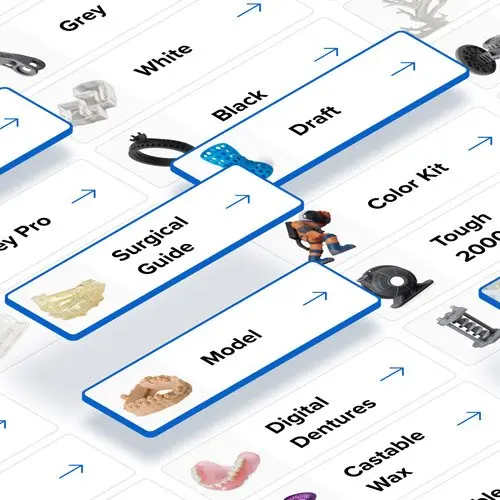
Need some help figuring out which 3D printing material you should choose? Our new interactive material wizard helps you make the right material decisions based on your application and the properties you care the most about from our growing library of resins.
When To Use ABS-Like Resins
ABS-like resins are ideal for 3D printed parts that need to be more robust and impact-resistant than those printed with standard resins. Select ABS-like resin for functional prototypes, end-use parts, short run manufacturing, and jigs and fixtures.
For parts that will be exposed to UV, ABS-like resins are not ideal, though coatings can help increase UV resistance. Parts that need to last over a decade are also not ideal.
Ideal for:
-
Impact-resistant parts
-
Figurines or models that can withstand dropping
-
Jigs and fixtures that can survive repeated use
-
Snap-fit enclosures
-
Functional prototypes
-
End-use parts
Not ideal for:
-
Extremely thin-walled parts. Note that the thickness of a 3D printed part can be changed to make a part tougher.
-
Parts that need to last for 10-20 years
-
Parts exposed to UV (Note that coating a part can help with UV resistance)
ABS-Like 3D Printing Materials and 3D Printers
Tough 2000 Resin and the other materials in the Tough Resins Family were designed to print on Form Series 3D printers including Form 4 and Form 4L, with settings for each Formlabs material and validated post-processing on Form Wash and Form Cure. This makes it easy to go from model to 3D printed part.
Tough 2000 Resin was formulated to leverage the technology of Form 4 Series 3D printers, for accurate, presentation-ready parts with smooth surfaces and fine details, making it one of the best ABS-like resins.
With Open Material Mode (OMM) on Form Series 3D printers, third-party ABS-like resins can be printed, making Form Series the best ABS 3D printers. Loctite makes resins, including LOCTITE 3D 3843, that have similar attributes to ABS and can be printed on Formlabs resin printers with OMM.
Other ABS-like materials are available, but many have complicated post-processing procedures, making them difficult to work with. Two-part resins like polyurethanes are also available, but the workflows are much more complicated, and there’s limited print life after mixing the materials. Additional restrictions include dry storage environments and additional curing steps. Some ABS-like materials from Carbon 3D fall into this category.
Other tough resins from Formlabs include:
-
Tough 1000 Resin is Formlabs’ toughest resin and is incredibly impact resistant and difficult to break, but, as a result, is less stiff and strong than Tough 2000 Resin. This resin is therefore less ideal for very thin-walled parts and more comparable to HDPE and Delrin (POM).
-
Tough 1500 Resin has a modulus between Tough 1000 Resin and Tough 2000 Resin, making it stiffer and stronger than Tough 1000 Resin. This resin is similar to polypropylene (PP).

Materials in the Formlabs Tough Resins Family are all named after their tensile modulus.
ABS-Like Resin vs. ABS Filament
Due to the resolution of FDM 3D printing, it’s difficult to make a thin-walled part, like the housing for a tv remote. Additionally, ABS filament is more likely to fracture along layer lines. Therefore, ABS-like resins are better for thin walls and enclosures. FDM tends to be better at prototyping parts or making parts out of ABS that are thick and chunky, like jigs and fixtures. However, due to the layer lines and surface finish, ABS-like resin is going to deliver a tougher, more fracture-resistant part than filament. Plus, the surface finish of an ABS-like resin print will be most like injection molded ABS, which can be critical in more precise applications.
Request a Free Tough 2000 Resin Sample Part
Tough 2000 Resin V2 is a rugged material with strength and stiffness comparable to acrylonitrile butadiene styrene (ABS), combining toughness with high temperature and creep resistance.
Best Practices for 3D Printing with ABS-Like Resin
Printer Settings
The specific printer settings will depend on the resin and printer being used. For Formlabs resins printed on Form Series 3D printers, the layer height, exposure times, and optimal support settings are available directly in PreForm. Users wanting to print third-party ABS-like resins on Form Series 3D printers can use OMM to create custom settings if none are available from the resin manufacturer. For example, while Loctite has some setting suggestions, dialing in settings will be necessary.
In general, ABS-like resins require more supports as the material is softer, longer UV exposure lengths, and slower peel and loiter times — or the amount of time that it takes to pull the part off of the film. Due to this, ABS-like resins will take a bit longer to print than standard resins. The powerful backlight in Form 4 Series 3D printers means ABS-like and other engineering resins are cured without significantly affecting print speed. Lower-cost printers and those without such a powerful backlight will take longer to print engineering resins, including ABS-like ones.
Post-Processing
After printing, wash the parts based on the manufacturer's instructions. Then, remove the supports before curing the part as the supports will only get tougher and harder to remove once cured.
The Formlabs Form Cure enables curing with heat, unlocking advanced mechanical properties. While low-cost cures are available, these do not cure with heat and therefore decrease the advanced properties that can be achieved, whether that’s toughness, strength, or heat resistance. Learn more about how curing with heat effects resins in the video below.
Once the part has been cured, then sandpaper can be used to touch up the part. Do not sand before post-curing as the part is softer and more gummy. Waiting to sand until after curing ensures a smoother surface finish.
Tips & Common Pitfalls
To prevent brittleness and cracking, ensure parts are not over-cured. If the part will be exposed to UV, it’s important to coat the part. This is true of both ABS as well as ABS-like resin parts.
FAQ
What does ABS stand for in 3D printing?
ABS stands for acrylonitrile butadiene styrene, a type of polymer.
What is ABS 3D printer filament?
ABS printer filament is an ABS polymer that has been extruded into a thin 1.75 mm or 3 mm diameter strand for use as a feedstock for FDM 3D printing. It offers improved properties like toughness that come from using a tougher base polymer than standard FDM 3D printing filaments like PLA. ABS filament, like all FDM Materials, suffers from poor properties in the Z-axis.
What is ABS-like resin?
An ABS-like resin is a resin that aims to be tougher than standard photopolymer resins. Since ABS has been the de-facto tough material option for FDM 3D printing “ABS-like” became the term for tougher resins even though their composition and properties vary.
Some SLA 3D printing resins, like Formlabs Tough 2000 Resin, can actually match the performance of injection molded ABS.
How strong is ABS-like resin compared to ABS?
The strength of an ABS-resin part compared to an injection molded ABS will depend on the part geometry, resin, and how strength is being defined.
Is ABS-like resin brittle?
ABS-like resins are tougher and less brittle than standard resins, making them a good choice for parts that need to withstand impact. Over-curing an ABS-like resin will make it more brittle.
What are the best 3D printing settings for ABS-like resins?
The ideal settings for printing ABS-like resins will depend on the specific resin and 3D printer being used. Formlabs Tough 2000 Resin, like all Formlabs resins, has validated settings. With Open Material Mode (OMM), Formlabs SLA 3D printers can print other ABS-like resins, though those settings will need to be either downloaded from the resin manufacturer (if available) or developed.
Is ABS-like resin safe to use?
When printing any resin, users should follow the guidelines in the instructions for use available from the resin manufacturer.
How long to cure ABS-Like resin?
Curing ABS-like resin parts depends on the printer and material used. Cure times and temperatures for Tough 2000 Resin on Form Series 3D printers can be found here.
How to smooth ABS 3D prints?
Resin 3D prints, especially those printed on Form Series 3D printers, will have a smooth, matte finish, especially if supports are placed on internal surfaces. However, parts can be further sanded if need be.
Can you sand and paint ABS-like resin prints?
ABS-like resin parts can be sanded and painted, and should be painted or coated if being used outside or being exposed to UV, as UV causes toughness to decrease over time. Black color specifically tends to dramatically increase the UV resistance of a part over time.
Choosing the Right ABS-Like Resin for Your Needs
ABS-like resins are tougher than standard resins, exhibiting similar mechanical properties to injection molded thermoplastics including ABS. While ABS filaments are available for FDM 3D printing, the nature of FDM 3D printing means that these parts are weak along layer lines and therefore more likely to fracture with impact such as dropping.
Formlabs Tough 2000 Resin is the best ABS-like resin for tough, impact-resistant 3D printed parts, with comparable mechanical properties to injection-holded ABS. Form 4 Series 3D printers are the best ABS 3D printers, delivering fine details and smooth finishes.
To learn more about the Tough Resins Family, explore the Formlabs Material Library or contact an expert. Request a free sample part to evaluate the material for yourself.