What Formlabs Material Should I Use Instead of Injection Molded Plastics Like ABS or Polypropylene?

In the world of traditional manufacturing, the "Big Three" — ABS, Polypropylene, and Nylon — have long been the gold standard. They are the workhorses of injection molding, valued for their predictable mechanical properties and reliability.
But as product development cycles shrink and the demand for functional, end-use 3D printed parts grows, engineers are increasingly looking for 3D printing materials that don't just "look like" these plastics, but behave like them.
At Formlabs, we’ve developed a library of functional resins specifically designed to bridge the gap between prototyping and production. So which Formlabs resin should you use when you’re replacing an ABS part? Or making a functional prototype for something that will eventually be injection molded or machined from nylon?
This guide will go through the most popular thermoplastics and which Formlabs material makes the most sense for you to choose, based on the most important mechanical property for your application.
Find the Right Material for Your Application
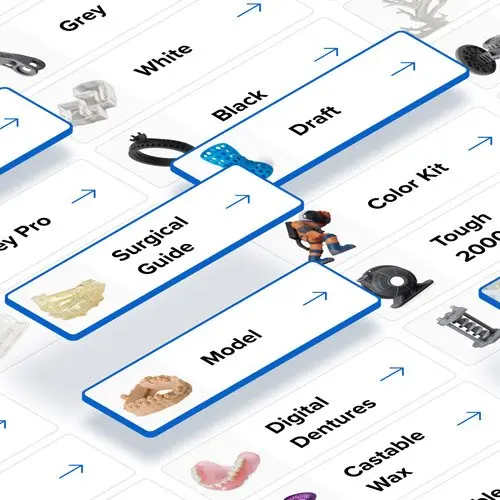
Need some help figuring out which 3D printing material you should choose? Our new interactive material wizard helps you make the right material decisions based on your application and the properties you care the most about from our growing library of resins.
ABS
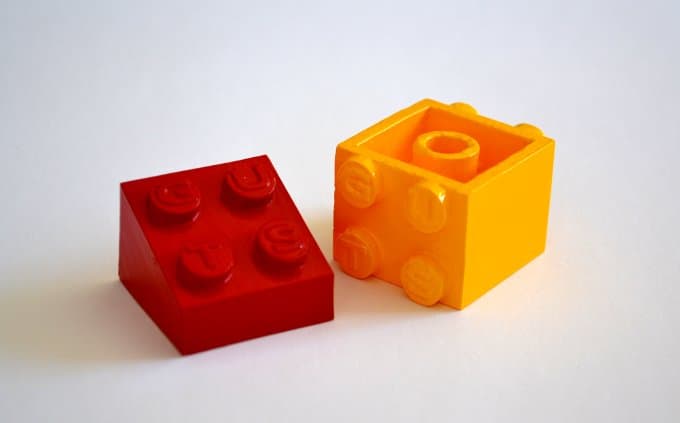
If you're looking for a Formlabs resin that can mimic the durability, rigidity, and stiffness (without brittleness) of ABS, like in Lego® bricks, Tough 2000 Resin is the best choice.
ABS, or Acrylonitrile Butadiene Styrene, is one of the most commonly used thermoplastics, typically mass manufactured through injection molding. It is extremely popular for large interior automotive components like dashboards and consoles, as well as many consumer products we use every day, like children’s toys (Lego® bricks), or speaker and kitchen appliance enclosures. ABS is also one of the most popular filaments used on fused deposition modeling (FDM) 3D printers.
For SLA 3D printers, users are looking for a durable, rigid material with stiffness — but not stiffness to the point of brittleness. For these applications, Tough 2000 Resin is the closest comparison. Tough 2000 Resin parts will not bend easily, will have good impact strength, and they will hold up to prolonged use. Though Tough 2000 Resin has much lower Notched Izod Impact Resistance than injection molded ABS, the benefits 3D printing confer in terms of design complexity and customizability make it possible design around constraints like this.
| Property | Injection Molded ABS | Formlabs Tough 2000 Resin |
|---|---|---|
| Tensile Modulus | 1.6 – 2.4 GPa | 2.2 GPa |
| Ultimate Tensile Strength | 33 – 50 MPa | 46 MPa |
| Elongation at Break | 10 – 50% | 48% |
| Flexural Modulus | 1.6 – 2.5 GPa | 1.6 GPa |
| Flexural Strength | 50 – 85 MPa | 61 MPa |
| Notched Izod Impact | 150 – 400 J/m | 40 J/m |
| Heat Deflection Temp @ 0.45 MPa | 85 – 105 °C | 63 °C |
Request a Free Tough 2000 Resin Sample Part
Tough 2000 Resin V2 is a rugged material with strength and stiffness comparable to acrylonitrile butadiene styrene (ABS), combining toughness with high temperature and creep resistance.
HDPE
HDPE, or high-density polyethylene, is easily identifiable as the mass-manufactured plastic for shampoo bottles, milk jugs, and cleaning product containers (it’s number two in the plastic recycling codes — ♴). HDPE products are often blow-molded and are highly resistant to wear and friction. That wear-resistance makes HDPE ideal for living hinges and parts that need to bend or depress frequently without cracking.
The best Formlabs material comparison for HDPE is Tough 1000 Resin. Tough 1000 Resin has replaced our previously very popular resin, Durable Resin, as the material of choice for parts that need excellent elongation at break, surface smoothness, and impact strength.
Tough 1000 Resin can replace HDPE in terms of mechanical properties in nearly every scenario, except those in which high temperatures are present — Tough 1000 Resin’s somewhat low HDT makes it more liable to deform slightly in heat.
| Property | HDPE (Typical Injection/Extruded) | Formlabs Tough 1000 Resin |
|---|---|---|
| Tensile Modulus | 0.8 – 1.2 GPa | 0.93 GPa |
| Ultimate Tensile Strength | 20 – 30 MPa | 26.3 MPa |
| Elongation at Break | 100 – 600% | 180% |
| Flexural Modulus | 0.7 – 1.4 GPa | 0.76 GPa |
| Flexural Strength | 20 – 40 MPa | 29 MPa |
| Gardner Impact Strength | ~5.4 J | 13.1 J |
| Heat Deflection Temp @ 0.45 MPa | 70 – 90 °C | 55 °C |

Request a Free Tough 1000 Resin Sample Part
Tough 2000 Resin V2 is a rugged material with strength and stiffness comparable to acrylonitrile butadiene styrene (ABS), combining toughness with high temperature and creep resistance.
Polypropylene

Tough 1000 Resin can replace injection molded polypropylene in situations where friction-resistance and smooth pliability are the main characteristics you're looking to replicate.
Polypropylene or PP, is widely used for its low friction, insulative, and chemical and impact resistant properties. Its popularity is due in part to its ability to adapt to a range of fabrication techniques, and for those techniques to create a wide range of thicknesses and stiffnesses of PP parts. PP Parts can be used for many different applications, including syringes, disposable cutlery, automotive cup holders, and more. PP can be identified by the number 5 recycling symbol (♷).
Both Tough 1500 Resin and Tough 1000 Resin have some of the best qualities of polypropylene. You should choose Tough 1000 Resin if the friction-resistance and smooth pliability of some PP parts are what you’re looking for. However, if you’re looking for the strength and durable rigidity of thicker polypropylene parts, you should choose Tough 1500 Resin.
Tough 1500 Resin is ideal for parts that need to balance stiffness and ductility, whether for compliant mechanisms or rugged enclosures with self-tapping screws and snap fits. The ultimate tensile strength, and flexural strength of Tough 1500 Resin actually outperform traditionally injection molded polypropylene materials, though its elongation at break is significantly lower.
| Property | Polypropylene | Formlabs Tough 1500 Resin |
|---|---|---|
| Tensile Modulus | 1.3 – 1.8 GPa | 1.5 GPa |
| Ultimate Tensile Strength | 30 – 40 MPa | 51 MPa |
| Elongation at Break | 100 – 600% | 51% |
| Flexural Modulus | 1.2 – 1.7 GPa | 1.6 GPa |
| Flexural Strength | 35 – 55 MPa | 68 MPa |
| Gardner Impact Strength | 20 – 100 J/m | 67 J/m |
| Heat Deflection Temp @ 0.45 MPa | 85 – 110 °C | 52 °C |
Polyamides

SLS 3D printed nylon materials, like these parts printed in Formlabs Nylon 11 Powder, are chemically the same as injection molded polyamides. There is no direct 'nylon' resin for SLA 3D printers, but Tough 1000 Resin can replace nylon 6, Tough 1500 Resin can replace nylon 12, and Rigid 10K Resin can replace glass-filled nylon.
Polyamides, commonly referred to as nylons, are strong and stiff without being brittle – they can ‘snap back’ and have excellent thermal and fatigue resistance. Polyamides (nylons) come in several different structures. They’re typically identified by numbers that refer to the number of carbon atoms in their starting building blocks (monomers). For example, Nylon 6 is made from a 6-carbon building block, while Nylon 12 comes from a 12-carbon building block.
The best Formlabs material to substitute for mass-produced nylon is, of course, SLS 3D printed nylon — an all-purpose material like Nylon 12 Powder, which is excellent for strong, durable parts, or a more specialized, performance-focused material like Nylon 11 Powder. There are additionally, very specific nylon composites as well, like Nylon 11 CF Powder for extremely stiff parts.
However, if SLS 3D printed nylon is not an option, and you need a Formlabs SLA resin material, the best replacement for a polyamide depends on the material property you care most about. Polyamides can have a range of stand-out mechanical properties, so decide if you want the stiffness, durability, or impact strength of nylon most. For stiffness, or replacing a filled or composite nylon, the best material may be Rigid 10K Resin, which is extremely stiff and dense. If you’re more interested in flexibility and fatigue resistance of nylon 12, the best option for a comparable resin is Tough 1500 Resin. For a more ‘slippery’ nylon 6 material, Tough 1000 Resin is your best bet.
| If your Nylon application requires... | Industry Benchmark | Best Formlabs Match | Key Comparison Metric |
|---|---|---|---|
| Impact & Wear Resistance | Nylon 6 | Tough 1000 Resin | 114 J/m Izod Impact: Matches the high energy absorption and "slippery" feel of Nylon 6. |
| Resilience & Fatigue Life | Nylon 12 | Tough 1500 Resin | 1.5 GPa Modulus: Perfect "spring-back" and recovery for high-cycle snap-fits and hinges. |
| Maximum Rigidity & Heat | Glass-Filled Nylon | Rigid 10K Resin | 10.0 GPa Modulus: Extreme stiffness and 218°C HDT for parts that must not bend. |
POM

This manufacturing aid, or production consumable, is designed and used by Eaton at their Olean, NY location to move parts through their single-piece flow manufacturing system. Originally machined from Delrin (left) it's now 3D printed on the Fuse Series SLS 3D printer in Nylon 12 Powder.
Polyoxymethylenel (POM), also known as acetal or by its commercial name, Delrin®, is extremely popular in manufacturing scenarios as a machineable plastic due to its high stiffness, low friction, and excellent dimensional stability. Because it does not bend, stretch, or absorb moisture, it’s particularly popular in factory settings for production consumables or manufacturing aids.
Delrin has the ductility of PP and the stiffness of ABS, so depending on your use case, either Tough 1000 Resin or Tough 2000 Resin could work. For higher volume manufacturing aid production, like at Eaton, replacing Delrin production consumables with SLS 3D printed Nylon 12 Powder can reduce material costs and labor time — while achieving the same stiffness and durability of the original Delrin parts.
| Property | Delrin (POM) - Acetal | Tough 1000 Resin | Formlabs Tough 2000 Resin |
|---|---|---|---|
| Tensile Modulus | 2.5 – 3.0 GPa | 0.9 GPa | 2.2 GPa |
| Ultimate Tensile Strength | 60 – 70 MPa | 26 MPa | 46 MPa |
| Elongation at Break | 25 – 60% | 180% | 48% |
| Flexural Modulus | 2.5 – 3.0 GPa | 0.8 GPa | 1.6 GPa |
| Flexural Strength | 50 – 90 J/m | 131 J/m | 61 MPa |
| Notched Izod Impact | Delrin (POM) - Acetal | Tough 1000 Resin | 40 J/m |
| Heat Deflection Temp @ 0.45 MPa | 2.5 – 3.0 GPa | 0.9 GPa | 63 °C |
TPU

There are no resins that are chemically the exact same as injection molded TPU, but there are FDM filaments and SLS powders, like these two SLS 3D printed TPU 90A Powder gaskets, printed at different durometers on the Fuse Series using Print Settings Editor.
Thermoplastic polyurethane, or TPU, is a flexible elastomer with excellent durability, resistance to chemicals, and abrasion resistance. It’s used for vibration-dampening applications, footwear, and many parts that need to bend and bounce back or absorb impact. TPU can be manufactured with a range of shore hardnesses, making the end-use product more or less stiff, ranging from soft 50A to harder 90A+.
While Formlabs has a TPU material for the SLS Fuse Series (TPU 90A Powder), there is no resin formulation of TPU. However, you can replace mass manufactured TPU with resin parts printed in Elastic 50A Resin for softer durometers and Flexible 80A Resin for slightly harder durometers.
| Property | TPU (Standard Injection Molded) | Formlabs TPU 90A (SLS) | Flexible 80A Resin (SLA) | Elastic 50A Resin (SLA) |
|---|---|---|---|---|
| Tensile Modulus | 50A – 95A | 90A | 80A | 50A |
| Ultimate Tensile Strength | 25 – 45 MPa | 8.7 MPa | 8.9 MPa | 3.4 MPa |
| Elongation at Break | 300 – 600% | 310% | 120% | 160% |
| Flexural Modulus | 30 – 100 kN/m | 66 kN/m | 24 kN/m | 12 kN/m |
| Flexural Strength | 20 – 50% | 59.9% | 5.0% | 3.1% |
| Notched Izod Impact | TPU (Standard Injection Molded) | Formlabs TPU 90A (SLS) | Flexible 80A Resin (SLA) | Elastic 50A Resin (SLA) |
| Heat Deflection Temp @ 0.45 MPa | 50A – 95A | 90A | 80A | 50A |
PEEK

Rigid 10K Resin can replace PEEK in situations where you're looking for an extremely stiff, strong, rigid material. Many Formlabs users rely on Rigid 10K Resin to make 3D printing injection molding tooling which can be used in industrial injection molding machines for thousands of shots.
Polyetheretherketone, or PEEK, is an industrial, high-performance plastic that can be used to replace metal in aerospace, automotive, medical, and utility applications. It’s not possible to replace PEEK with just one 3D printing materials — it’s too comprehensively performative across different properties. A structurally different, but related material called PEKK, is easier to process, and shares many of the extreme properties of PEEK.
However, if you’re looking for the stiffness of PEEK and can sacrifice some of its impact resistance, Rigid 10K Resin is suitable. If you need the high heat resistance of PEEK, then High Temp Resin is the best choice. And if you need the biocompatibility of PEEK, then Formlabs range of biocompatible resins is ideal, such as BioMed Clear Resin, BioMed White Resin, or BioMed Black Resin.
| Property | PEEK (Unfilled) | Rigid 10K Resin | High Temp Resin |
|---|---|---|---|
| Tensile Modulus | 3.6 – 4.0 GPa | 11.0 GPa | 2.8 GPa |
| Ultimate Tensile Strength | 90 – 100 MPa | 88 MPa | 58 MPa |
| Elongation at Break | 15 – 40% | 0.7% | 3.3% |
| Flexural Modulus | 3.7 GPa | 9.9 GPa | 2.6 GPa |
| Flexural Strength | 160 – 250°C* | 238°C | 238°C |
| Notched Izod Impact | PEEK (Unfilled) | Rigid 10K Resin | High Temp Resin |
| Heat Deflection Temp @ 0.45 MPa | 3.6 – 4.0 GPa | 11.0 GPa | 2.8 GPa |
Conclusion: Which Formlabs Resin Can Replace Industrial Plastic?
Industrial plastics like ABS, PEEK, and polypropylene aren’t going to be fully replaced by 3D printed materials anytime soon — it’s too cost-effective and efficient to produce them through injection molding, blow-molding, thermoforming, and other mass-production processes.
However, as 3D printers and materials become more advanced and technically capable, 3D printed parts are able to replace traditional industrial plastics in many end-use scenarios, from consumer goods to manufacturing aids and functional prototypes.
Formlabs resins are good replacements for these common materials in many situations. They have been specifically formulated and rigorously tested to ensure they can perform as needed.
To see for yourself, request a free 3D printed sample. Or, contact our team to discuss your particular application and get a custom sample of one of your files.