
End-use applications
End-use applications
3D printing has been ubiquitous in prototyping and product development for decades. Manufacturers are already leveraging the flexibility of 3D printing for producing internal tools, such as jigs, fixtures, and other manufacturing aids, or even rapid tooling such as molds for injection molding or thermoforming.
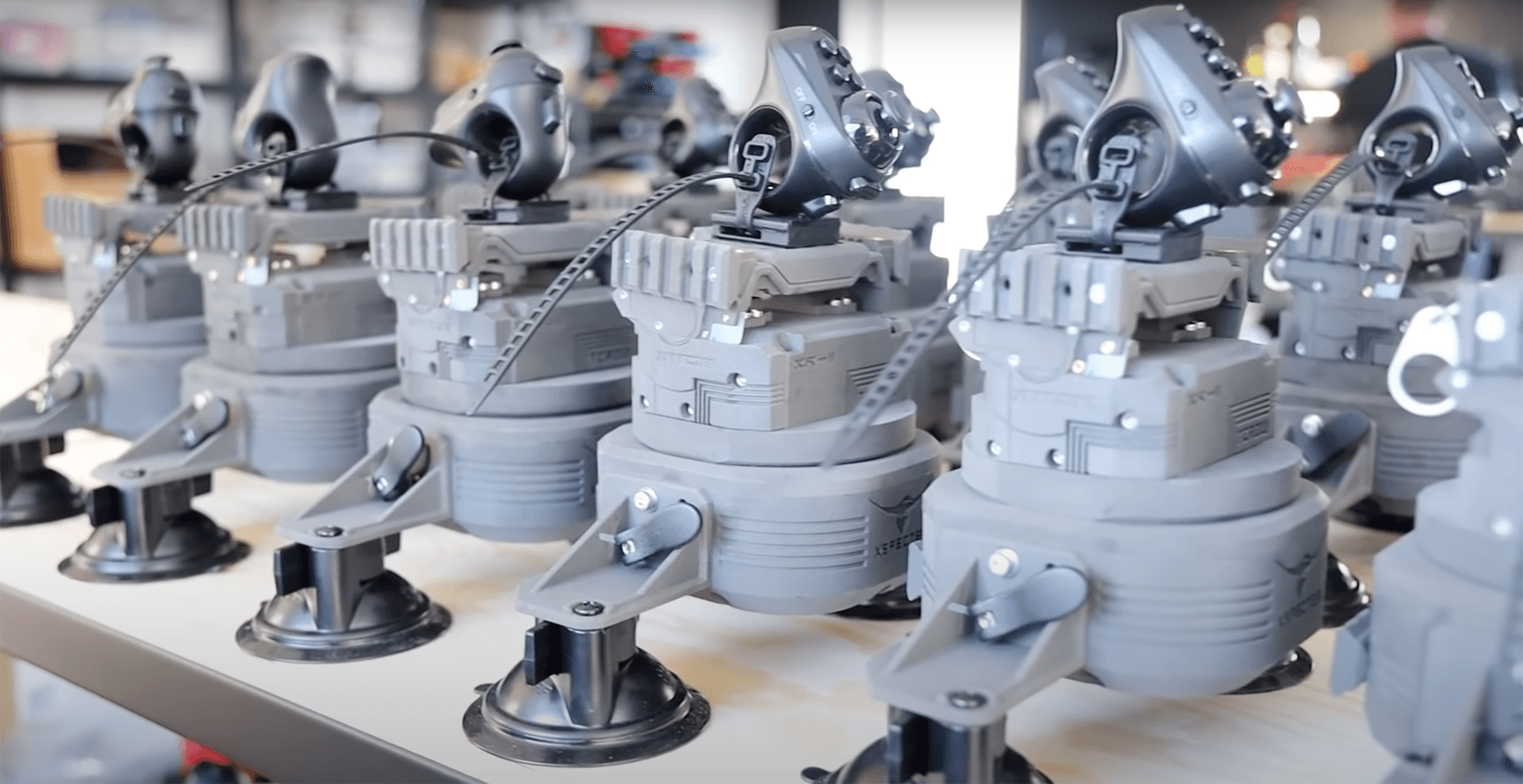
Recent advances in machinery, materials, and software open opportunities for producing high-precision, functional 3D prints that can stand in for end-use parts—parts that are sold to and used by the final customer—empowering businesses to bring innovative products to market and make small and mid-scale manufacturing finally accessible.
Formlabs recommended materials
Formlabs has a wide portfolio of materials suitable for end-use applications.
SLA
SLA printed parts are isotropic, and have the highest resolution and accuracy, the clearest details, and the smoothest surface finish of all plastic 3D printing technologies. Formlabs offers a portfolio of biocompatible resins to serve the healthcare sector, from dental splints and occlusal guards to medical devices. A range of engineering SLA materials are also available with advanced mechanical and thermal properties that enable applications in demanding environments.
- Rigid 10K Resin offers high stiffness, strength, and resistance to heat and chemicals, designed to maintain structural integrity under any condition.
- Tough 2000 Resin simulates both the feel and important mechanical properties of Acrylonitrile Butadiene Styrene (ABS) plastic and withstands high stress and strain.
- Flexible 80A Resin is an elastomeric resin designed to print stiff, flexible parts that simulate the flexibility of rubber.
- BioMed Clear Resin is a medical-grade material designed for rigid, non-brittle, biocompatible parts that require long-term skin and mucosal membrane contact and for end-use medical devices.
SLS
SLS printed parts are ideal for complex geometries, including interlocking links, functional assemblies, and living hinges. Parts produced with SLS printing have excellent mechanical characteristics, with strength resembling that of injection-molded parts. The combination of low cost per part, high productivity, and established materials makes SLS an ideal choice for producing limited-runs of end-use parts.
- Nylon 12 Powder is a general purpose powder for strong, functional parts with great dimensional accuracy. It is the best fit for most applications including electronic housings, connectors and adapters, or prostheses.
- Nylon 11 Powder is a ductile, strong, flexible material for when durability and impact resistance are key. It is the best choice for snaps, clips, hinges, and pliable parts.
- Nylon 12 GF Powder is a glass-filled material with enhanced stiffness and thermal stability for demanding industrial environments and for parts ongoing sustained loads and high temperatures.
- Nylon 11 CF Powder is a carbon fiber-filled material; it is highly stable and lightweight for optimized stiffness
Design considerations
Follow Formlabs best practices when designing a successful 3D model. Take the material type and printer generation into consideration, as they may have specific requirements for print success.
Thicken the part design if necessary to compensate for the lower impact strength when switching from the original material to a Formlabs material.
Simplify part geometry by eliminating molding features such as draft angle, ejector pin locators, gating locations, and uniform thickness.
Printing considerations
Follow Formlabs best practices for model orientation.
Orient your parts on the build plate so that critical surfaces are free of support marks.
Maximize packing density for SLS printed parts with 3D Packing.
Post-processing considerations
Follow Formlabs best practices for washing and post-curing prints. Refer to the individual material articles for specific wash and cure instructions. Consider further post-processing for added strength, durability, and user experience, such as electroplating or coating for SLA printed parts or media blasting for SLS printed parts.
Before deployment, Formlabs recommends in-house stress testing and environmental testing printed parts to mimic conditions in the field.
End-use recommendations and limitations
3D printing enhances the production process by improving its flexibility, agility, and ability to quickly scale up to meet demand. It is particularly recommended for:
- Product innovation
- Bridge manufacturing
- Supply chain resilience
- Aftermarket parts
- Spare parts
- Consumer goods
Some limitations include:
- UV and chemical exposure may degrade some SLA materials over time—test in-use conditions when appropriate.
- Abrasive loads or long-term heat can reduce part lifespan unless using engineered resins.
- Post-curing and part orientation impact final strength—be consistent for production parts.
Additional resources