
Jigs and fixtures for welding and machining
Jigs and fixtures for welding and machining
Metal components are highly valued for their durability, strength, reliability, and resistance to wear and high temperatures. Metalworking is a critical element in global manufacturing and plays a pivotal role in end-use industries such as automotive, aerospace, construction, energy, and consumer goods. The need for precision, efficiency, and scalability has driven the evolution of tools and techniques.
Machining, welding, forming, and casting are common ways to produce metal components. Each process requires specialized tools to hold metal in place despite high forces, heat, or chemical exposure and ensure precision, safety, and replicability in production.
- Jigs help guide cutting tools to ensure consistent, precise cuts.
- Fixtures hold workpieces securely in place during machining or welding to prevent movement that could result in errors.
Traditional tooling methods like CNC machining, casting, or manual assembly, are time-consuming and expensive. 3D printing technologies, such as stereolithography (SLA) and selective laser sintering (SLS), offer a faster and more cost-effective alternative for manufacturing jigs, fixtures, and tooling in metalworking.
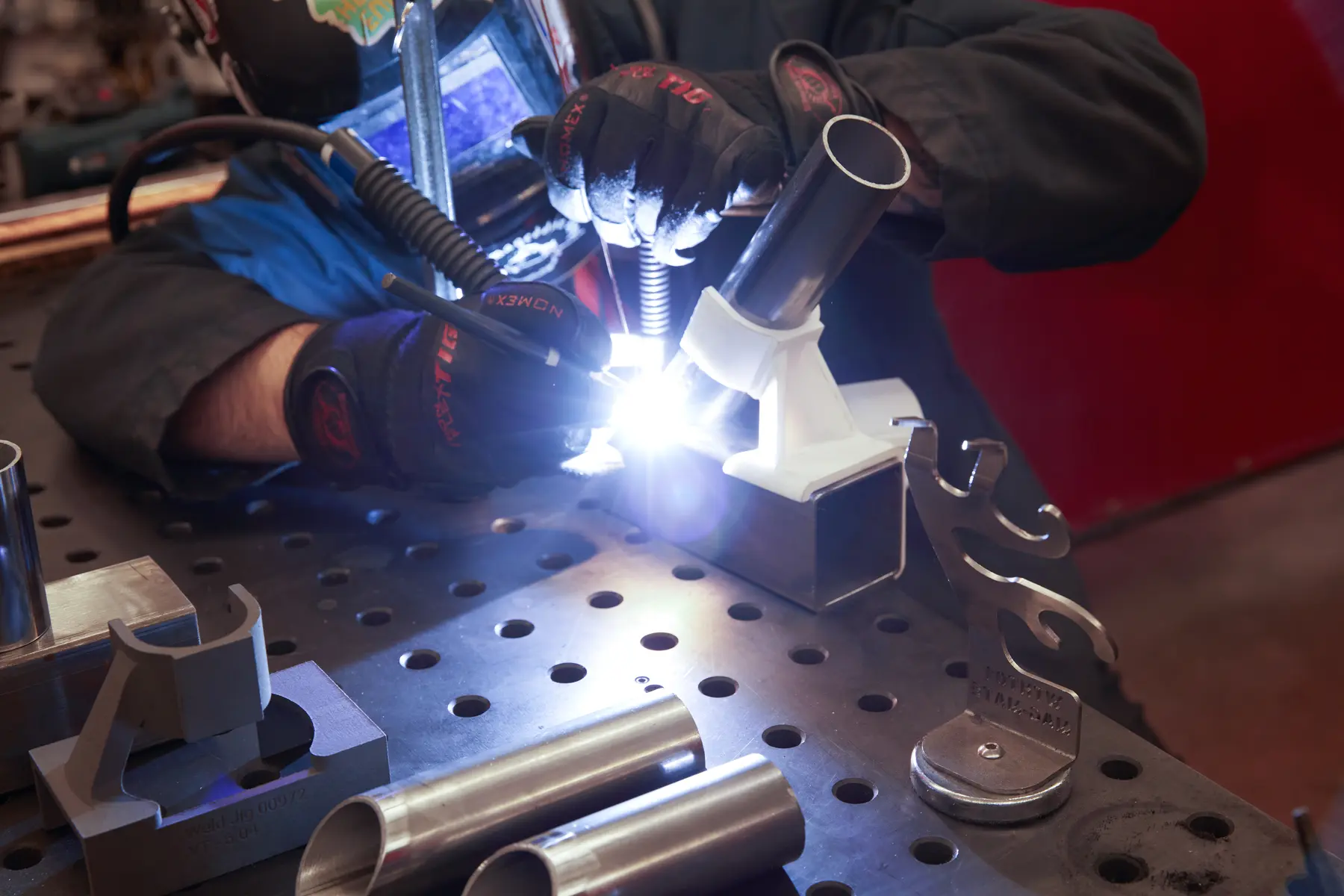
This support article focuses on 3D printed jigs and fixtures for working with metal parts for welding and machining. For more information about other 3D printed tools, refer to the relevant support article:
- Jigs, fixtures, and manufacturing aids for assembly, inspections, replacement parts, etc.
- Dies for sheet metal forming
- Patterns for industrial investment casting
- Molds for injection molding, silicone molding, blow molding, and thermoforming
Formlabs recommended materials
Formlabs offers robust material options for metalworking. However, recommendations differ on usage cases.
Machining jigs
Machining is a subtractive manufacturing process that removes material from a workpiece using tools like lathes and mills to produce precision components. Jigs and fixtures securely hold workpieces and ensure accurate alignment during machining.
Technical requirements for these jigs include high rigidity to withstand cutting forces, precise dimensions to maintain alignment, thermal stability to resist distortion from the heat generated during machining, vibration damping, and resistance to coolants, cutting fluids, and cleaning agents running inside the machines.
Formlabs strongly recommends printing machining jigs with Nylon 12 Powder on the Fuse series printers due to its chemical resistance. Other benefits include:
- High tensile strength (50 MPa)
- Best suited for complex assemblies and durable parts
- Parts printed in Nylon 12 Powder absorb little moisture and are resistant to light, heat, chemicals, and cooling solvents.
Welding fixtures
Welding is a fabrication process that joins materials by applying heat and pressure to create strong bonds. Jigs and fixtures are essential for accurately positioning workpieces and maintaining alignment during welding.
Technical requirements for these jigs include high heat-resistance, rigidity, and durability to handle repeated cycles without warping. Precision alignment and ease of clamping are essential for accurate, repeatable welds while safety features and accessibility are critical for operator protection.
Formlabs recommends printing welding fixtures with Rigid 10K Resin on the Form series printers due to its high-temperature resistance.
| Material | Details |
|---|---|
| Fast Model Resin | Formlabs’ fastest resin, capable of printing at speeds of over 100 mm per hour. Print large welding fixtures in less than two hours. |
| Tough 2000 Resin | Similar strength and stiffness to ABS plastics, making it ideal for functional parts that are difficult to bend and will hold up with extended use. Ideal for jigs and fixtures requiring minimal deflection. |
| Rigid 10K Resin | Heat deflection temperature (HDT) of 218 °C @ 0.45 MPa and a tensile modulus of 10,000 MPa. Strong, extremely stiff, and thermally stable molding material that maintains its shape under pressure and temperature. |
| Nylon 12 Powder (SLS) | Impact-resistant, high detail, and great dimensional accuracy. High stiffness and durability. Ideal for low-heat welding processes such as ultrasonic welding. |
Design considerations
Digitize existing tooling designs with reverse engineering to move to a digital inventory or identify tooling needs and design new tooling files. When designing a 3D printed jig or fixture, several key design considerations differ from traditional metal machined tools, allowing for unique features only possible with additive manufacturing:
- Leverage complex geometries and create intricate internal features like channels, undercuts, and hollow structures.
- Create lightweight jigs with lattice or honeycomb structures to reduce weight without sacrificing strength.
- Design with wall thickness of 2–3 mm.
- Integrate features like clamps, locators, and guides into a single part to simplify design and reduce the need for assembled components.
- Incorporate smooth fillets with 1–2 mm radii at stress points for strength.
- Add ergonomic features such as custom grips or contoured edges directly into designs.
- Design modular jigs and fixtures that can be easily customized or updated.
- Simplify assembly with single-part designs.
Printing considerations
Follow Formlabs best practices for model orientation.
When printing on an SLA printer, orient parts to minimize supports on functional surfaces and reinforce walls as necessary.
Post-processing considerations
Follow Formlabs best practices for washing and post-curing prints. Refer to the individual material articles for specific wash and cure instructions. Consider further post-processing for added strength, durability, and user experience, such as electroplating or coating for SLA printed parts or media blasting for SLS printed parts.
- Inspect the printed part against the original CAD model. Use a caliper, micrometer, or other metrology equipment to validate.
- Test the functional performance of the fixture. When the part is loaded onto the fixture, pay close attention to how well it is seated against locating surfaces and supports. A properly designed and built fixture will support the part, eliminating any movement once clamping force is applied.
- For processes with higher operating forces, like machining, calculate clamping requirements based on feeds and speeds, the power of the machine, and the selected material, as well as safety.
End-use recommendations and limitations
3D printing jigs and fixtures provides a practical solution to the challenges of traditional tooling in metalworking. It enables faster fabrication, reduced costs, and greater design flexibility. This is particularly beneficial for custom tools in processes like machining and welding, where precision and durability are critical. It is particularly recommended for:
- Small to medium production runs of around 1000 parts per jig or 3000 welds per fixture
- Precise, durable customized tools for multi-part setups or irregular geometries
- Cost-effective, highly flexible manufacturing option
Some limitations include:
- SLA printed parts show wear over time
- Not as durable as metal jigs or fixtures. Consider coating or sealing printed parts for additional longevity.
Additional resources