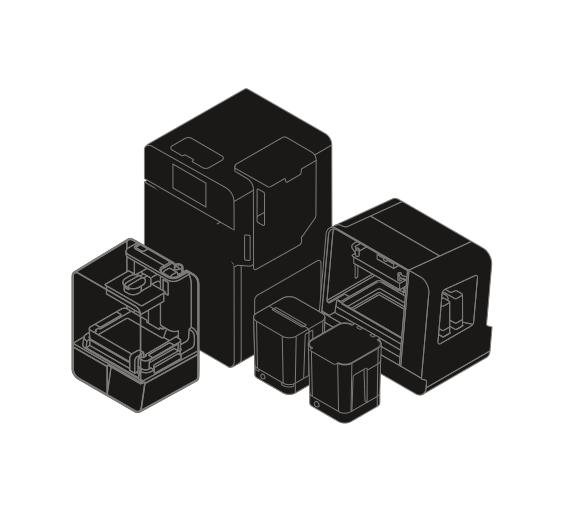
Designers can only iterate at the pace of their tools. A few years ago, creating a single prototype for a cargo ebike at Radio Flyer would have taken two months. The release of Form 4L shortened this timeline to two weeks. Now, with the Fuse X1 large-format selective laser sintering (SLS) 3D printer, producing a full-size cargo ebike prototype takes two days.
“With Fuse X1, we can now print an entire Flyer Loop cargo ebike overnight and be gluing it together the next day. So we went from two months to two weeks to a couple of days.”
Agostino LoBello, Product Development Engineer, Radio Flyer
Since its founding over 100 years ago, Radio Flyer has delivered wagons, scooters, strollers, go-karts and bicycles to families. Product Development Engineer Agostino LoBello, who engineered the Flyer Loop, has always been an early adopter of time-saving technology, using Fuse 1+ 30W, Form 4L, and now Fuse X1, to rapidly iterate and directly print roadshow prototypes.
“Fuse X1 raises the bar in what we can deliver for our roadshow prototypes — what we show to our retail customers to get buy-in. I can iterate three times as often with nine times less labor, that's a super appealing value proposition.”
Agostino LoBello, Product Development Engineer, Radio Flyer

Fuse X1 has a footprint of 12.2 square feet with a 330 x 330 x 565 mm build volume, for production of big parts in small spaces.

Talk to Our Sales Team
Whether you need to prototype at speed, or are producing end-use parts, we’re here to help. The Formlabs Sales team is composed of dedicated specialists who know exactly how to support you and your company's needs.
Shortening Timelines by 90% With 9x Less Labor
“Our frame and accessories are totally custom and very intentionally designed to best serve families. We can do that by printing things in-house and not being restricted to off-the-shelf components or other limitations.”
Agostino LoBello, Product Development Engineer, Radio Flyer
From the frame to the baskets and sunshades, Radio Flyer electric bikes and accessories are designed in-house. A few years ago, when Radio Flyer first started developing ebikes, it would take two months to prototype a frame. First, a metal frame would be built. Then, it would be clad in small prints from multiple printers. The large build volume of Form 4L and the more robust materials enabled the engineers to skip the metal frame, dividing the CAD model into 19 builds to print. This required a week of print time followed by days of gluing parts together.

Prior to Fuse X1, a bike frame prototype was printed in 19 builds and then glued together.

The Flyer Loop electric bike frame can be printed on Fuse X1 and assembled in a total of three days.

The final Flyer Loop cargo ebike.
Had they outsourced large parts instead, it would have taken weeks. Plus, LoBello prefers having control over the process, ensuring the quality of prototypes. While Radio Flyer has considered other large-format 3D printers, they couldn’t justify the price tag based on the number of large prints they’d need. Fuse X1 changed that.
“The paradigm has shifted with Fuse X1 because now the value of the machine and the number of parts that we're printing make sense. And for us, it's a really good fit for how we print and prototype.”
Agostino LoBello, Product Development Engineer, Radio Flyer

Fuse X1, at left, has a compact footprint. Fuse Sift X1, at right, is a large-format powder recovery and management station used to clean parts and reclaim powder.
At Radio Flyer, working prototypes are imperative for testing ergonomics, and seeing how children and families interact with the product, while road show prototypes are shown to retail customers to get buy-in. The more a prototype looks like a final product, the better.
The 330 x 330 x 565 mm build volume of Fuse X1 makes it possible for LoBello to print an entire cargo bike frame in two builds, or an entire scooter or tricycle in one build. Unlike outsourcing, which would take weeks, printing in-house takes a single day. This means more iterations in less time, and a faster time to market.
“With Fuse X1, I can iterate three times as often with nine times less labor — that's a super appealing value proposition.”
Agostino LoBello, Product Development Engineer, Radio Flyer

Fuse X1 builds are prepared for printing in PreForm. LoBello says, “Fuse X1 is especially easy because I don't necessarily need to worry about splitting things up. I can pretty much just take things from CAD and reliably drop them into PreForm, and it prints pretty much every time.”
Accurate Parts Fast
“When you print something on Fuse X1, it comes off the printer and fits together without additional filing or sanding or post-processing, and that's just so satisfying.”
Agostino LoBello, Product Development Engineer, Radio Flyer
The Flyer Loop bicycle frame can be printed in two Fuse X1 builds. LoBello finds that the parts are dimensionally accurate, enabling him to slot them together with ease. This allows him to focus on the design of the final product and not on designing for printing.
The rest of the Radio Flyer team has been impressed at the speed at which they can now go from render to prototype, enabling them to learn more about designs and iterate faster. Having a physical frame faster gives the soft goods department more time to design accessories like kid carriers and sun shades. The Design team is able to print full-scale preschool products, like scooters and trikes, in a single build overnight and review them the next day against past and similar products.

LoBello has found parts printed on Fuse X1 to be dimensionally accurate, enabling him to slot parts together without adjustments or sanding.

Quickly printing large prototypes in-house enables more iterations as the team can test and respond to feedback.
Fuse X1: The Competitive Edge
“There is a ton of ongoing innovation in the cargo bike space. Fuse X1 allows us to develop more quickly and be on that bleeding edge of cargo ebike development and iterate to bring new ideas to market in a rapid and efficient way.”
Agostino LoBello, Product Development Engineer, Radio Flyer
Three weeks after receiving Fuse X1, the Radio Flyer engineering department had already printed full-size prototypes of multiple products, while still running builds on their Form 4L and Fuse 1+ 30W. For the Radio Flyer Team, Fuse X1 is the newest tool in their toolbox, expanding the size of what they can print while cutting down on timelines and labor.
From Form 4L to Fuse 1+ 30W to Fuse X1, Formlabs 3D printers are helping the Radio Flyer product development team speed up iterations and bring innovative products to market that, in LoBello’s words, “bring the world out to play.”
Explore Fuse X1 to learn more about industrial SLS 3D printing, or contact sales to request a quote.


