COVID-19 Pandemic
Formlabs is dedicated to helping the medical community address the COVID-19 epidemic and associated supply chain shortages with 3D printing technology. We have many customers in the healthcare space already using Formlabs’ products to test applications for COVID-19 related projects, and recently launched the Formlabs Support Network for COVID-19 Response. This is an initiative to match healthcare organizations and providers with Formlabs customers who are willing to use their printers and volunteer their time to help address critical supply chain shortages and other healthcare needs. We are working closely with health systems, government agencies, and our network of over 1,500 volunteers to help design, prototype, and produce parts to be tested and potentially adopted by clinicians.
Page Last Updated: March 30, 2020, 4:20 PM CEST
Formlabs Support Network for COVID-19 Response
Formlabs is aware of many hardware projects that seek to address global healthcare-related supply shortages around the world. We are reaching out to our incredible community to connect those in need with those who have engineering, clinical, and 3D printing resources to offer.
You should fill out this form if either of the following apply:
You or your organization is working on COVID-19 related projects and need access to 3D printed parts, or
You or your team have access to Formlabs manufactured 3D printers and are willing to volunteer your time and equipment in the fight against COVID-19.
We will do our best to connect available Formlabs printers and relevant services to the people who need them most. Join the 1,500+ volunteers who already signed up.
Join the 1,500+ volunteers who already signed up
Sign Up HereCurrent Focus Areas
Formlabs has fielded hundreds of requests, evaluated dozens of potential applications for 3D printed products, and is now supporting a handful of projects with high-impact potential. The current priority areas were selected based on clinical demand, technical feasibility, and regulatory implications. Priority areas for focus include test kit swabs, ventilator splitters, and face shields.
Below are the three key projects that Formlabs is spearheading, with guidance from medical thought leaders and physician innovators. These projects are currently being conducted in the US only. Please visit our US website for the latest updates regarding COVID-19 Efforts.
Visit our US website for the latest updates
Test Kit Swabs
Problem
There is a shortage of the nasopharyngeal (NP) swabs needed to collect samples for COVID-19 testing. These swabs are typically used for testing for influenza and other respiratory infections. The current and impending supply chain shortages are serious enough that clinicians are beginning to design and test their own swabs as quickly and safely as possible.
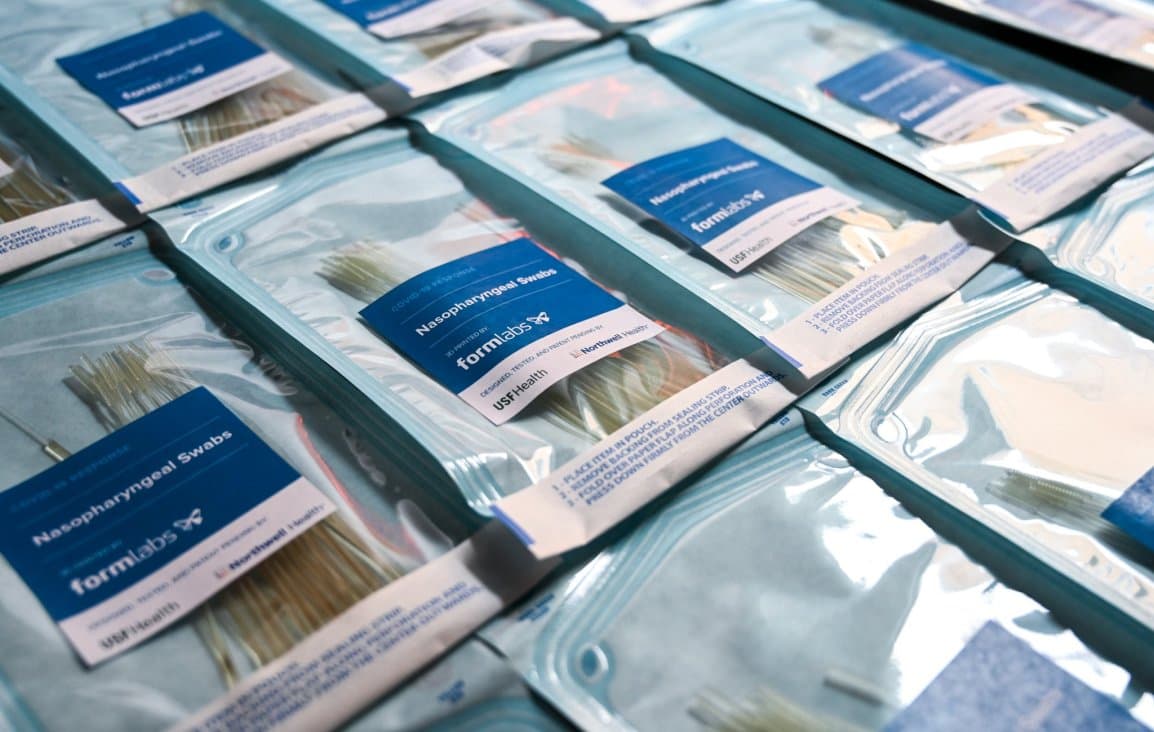
NP swabs are flexible sticks with a bristled end that are inserted into the nose to the back of the nasal cavity and swept around to collect material that sticks to or wicks up the bristles. The swab is then placed into a vial that contains a culture medium. Swab sticks have an intentionally weak point 7-8cm from the bristled tip, which allows the stick to be broken to the correct length so that the vial can be capped before it is transported to a laboratory for testing.
Solution
Currently we are printing and optimizing swab designs co-created by doctors at USF Health and Northwell Health, as well evaluating designs from other leading hospitals.
Validation Status
Formlabs has printed samples of the test swab using the same material as our biocompatible, autoclavable Surgical Guide Resin. These samples have passed a variety of tests at USF Health, which has received an emergency IRB approval as well as authorization from regulatory, infectious disease, and virology, among others. These swabs are for US distribution only.
Visit our US website for the latest updates.
Conversion Kits
Dr. Alex Stone and Dr. Jacqueline Boehme from a leading hospital in Boston
Problem
Front-line providers are running out of personal protective equipment (PPE). At many hospitals, there is a very limited supply of PPE remaining. PPE includes face masks and/or respirators (N95 masks) and face shields. All are in short supply with people stockpiling these at home and stealing them from hospitals. In addition, the typical forms of PPE are disposable and more durable solutions are needed given the limited supply. Moreover, most PPE is designed to be used for minutes at a time, not for an entire day.
Solution
Adapting a full face snorkel mask to fit a filter already in use for breathing circuits and in hospitals. Because this filter is reusable, and unavailable/unknown to the general public, it will be less at risk to be taken from providers treating ill patients.
Validation Status
Dr. Alex Stone and Dr. Jacqueline Boehme from a leading hospital in Boston are currently testing and validating designs for: seal, breathability, fogging, and ability to communicate with other physicians while wearing it.
Visit our US website for the latest updates.
Ventilator Splitter
Problem
As the number of patients in critical condition grows, mechanical ventilation is required to provide sufficient oxygen into the lungs and body. Ventilator machines are limited in supply, and hospitals can run out of machines faster than they can order new devices.
Experimental Solution
Adding an adapter to one ventilation system to be used with more than one patient can help expand capacity. These adapters allow for two, three, or four patients with similar needs and conditions to potentially use one ventilator.
Several Formlabs customers are working on this problem, including Northwell Health and Southern Maine Community College.
The 3D Design and Innovation Lab at Northwell Health has provided Formlabs with STL files that fit standard tubing. These files allow for a HEPA filter to be placed at each end then connecting patient vent tubing.
Note
Ventilator splitters should only be considered as a last resort and with appropriate protections in place. Multiple medical associations have discouraged the use of ventilator splitters. Healthcare organizations need to assess and make decisions based on their own circumstances and judgement.
Validation Status
Northwell Health has conducted lab testing and states that while this would allow one to split a ventilator in a life or death situation there are certain caveats one needs to be aware of.
Northwell is currently writing clinical protocols. Neither Northwell Health, nor the CDC, have studied ventilation splitting on human patients.
While there is the new capability to ventilate multiple patients for a short period of time without utilizing front line clinical staff, patients likely need to be similar in height, IBW (weight), lung dynamics, COVID-19 carrier status. Also, heavy sedation / paralytics may be necessary to eliminate asynchrony, and tandem weaning.
Please watch Dr. Charlene Babcock explain how to modify a ventilator and the risks involved, or watch Dan Abbott at Southern Maine Community College explaining how he created and tested his ventilator connector.Visit our US website for the latest updates.
Face Shields
Problem
Face shields are personal protective equipment (PPE) devices that are used for protection of the facial area and associated mucous membranes (eyes, nose, mouth) from splashes, sprays, and spatter of body fluids. Face shields are in short supply, with some hospitals reusing disposable units or improvising solutions from commercial products not intended for this use.
Solution
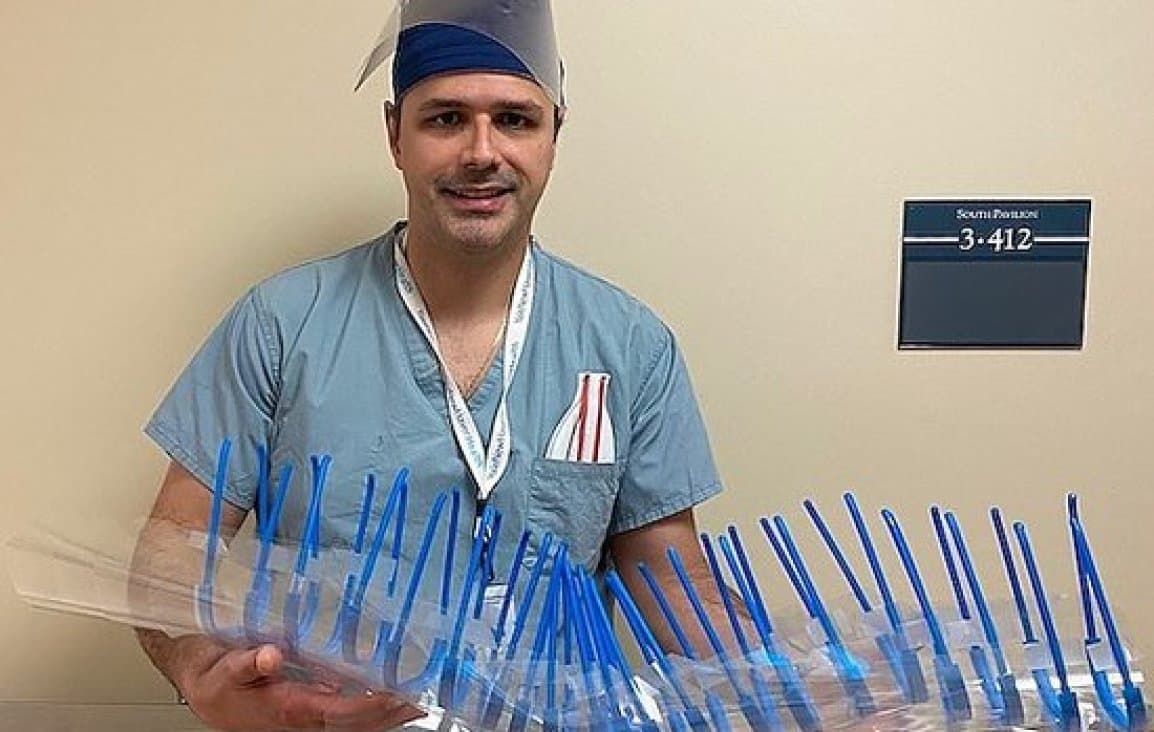
Formlabs is prototyping and evaluating several 3D printed and non-3D printed designs in parallel to determine effectiveness and near-term scalability. Current focus is on producing parts onto which a shield may be mounted and tightened, emulating existing designs such as from Halyard Health and McKesson. The shield itself is not being 3D printed.
Validation Status
Prototypes are being sent to Beth Israel Deaconess Medical Center for preliminary evaluation.
Visit our US website for the latest updates.
Formlabs’ Customers in the News
Our users continue to amaze us with the innovative and groundbreaking ways they are using 3D printing to advance their industry: the healthcare field is no exception. Several Formlabs customers are already making headlines for using Formlabs' products in the fight against COVID-19.
One example of this is Mologic, a diagnostic testing company based out of the United Kingdom that was recently given a grant by the UK government for COVID-19 research. Mologic is using Formlabs’ printers to rapidly prototype COVID-19 test kits.
"Mologic currently uses the Form 2 3D printer for the prototyping of all of its test devices as the system is easy to use, has a wide range of useful materials, and is quick. The production of high quality detailed parts is invaluable to the speedy device development and the fact we can produce parts in a matter of hours enables us to progress quickly from testing towards the tooling stages."
"For the development of the Covid-19 test, we would primarily use our Formlabs 3D printer to generate prototype devices to enable us to quickly progress with testing, providing the team with enough devices for the initial stages of the development process. This speeds up the generation of tooling for the final device design and enables a quicker overall delivery of the test into the manufacturing stages and release."
Adrian Walker, Lead Biomedical Engineer, Mologic
Tips for 3D Printing From Home
How to Maintain Productivity During Work Disruptions With 3D Printing
Disclaimer
Formlabs has created this website and has become involved in varying degrees with the projects described here during a global medical crisis. Formlabs is working on many projects to address global healthcare-related supply shortages around the world, but in trying to mitigate these shortages, patient safety is still Formlabs’ top concern. We must remind those who are helping to alleviate these shortages that masks, swabs, face shields, and other 3D printed products intended to prevent or treat COVID-19 are medical devices. These devices must be safe for their intended purpose and anyone considering the manufacturing of these products should consider the following items:
-
Formlabs is a manufacturer of 3D printing materials capable of fabricating finished devices according to their labeling and any other product manufactured from these materials should be verified and validated according to their intended purpose.
-
You may be fabricating a device that does not have the required regulatory approvals and clearances. If you are fabricating devices, follow the guidelines on the label for each material. You may seek to obtain reliable regulatory advice.
-
Please consider local regulations, material safety data sheets, software capabilities, sterilization requirements, and institutional requirements before 3D printing medical devices.
-
Regulatory agencies (such as BfArM) may consider expedited review of manufacturing information and/or premarket submissions.
Formlabs cannot warrant that any products not manufactured by Formlabs are suitable for their intended purpose.