For 15 years, Formlabs has worked to create powerful, affordable, and intuitive tools so that anyone can bring their ideas to life. Fuse 1 Generation 3D printers brought selective laser sintering (SLS) 3D printing to the benchtop, but industrial throughputs and large parts have remained expensive and out of reach — until now.
Fuse X1 delivers production-quality parts same-day at 50% less and 3x the throughput of competitors. Starting at £63,499, Fuse X1 makes large-format industrial SLS 3D printing finally accessible — with the quality, ease of use, and service you’ve come to expect from Formlabs.
Fuse X1 makes it possible to deliver large prototypes next-day with less stitching or gluing and at a lower cost, minimizing labor and speeding up innovation. It also delivers the best cost per part (CPP) and the highest throughput for end-use parts, making SLS 3D printing competitive with injection molding for a wider range of applications.

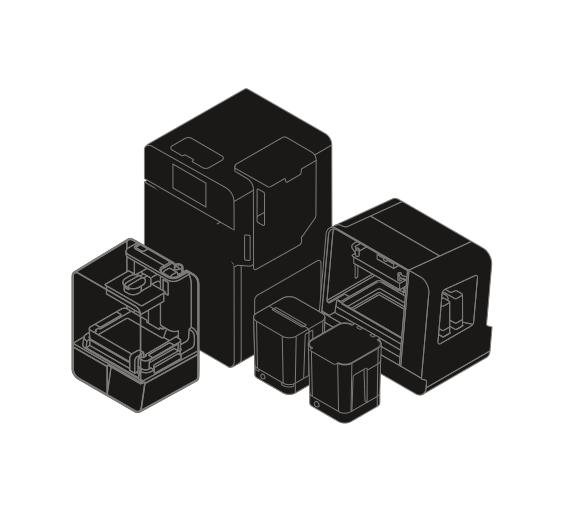
The Fuse X1 Ecosystem consists of the Fuse X1 SLS 3D printer and Fuse X1 Build Unit, Fuse Sift X1 for powder recovery, the Fuse X1 Vacuum Conveyor for powder management, and a Fuse Blast High Capacity Kit for cleaning and polishing.
Build Big With Fuse X1
Fuse X1 delivers production-quality SLS parts at a new scale, with 7.5x the build volume of Fuse 1+ 30W. Previously, producing large parts would require expensive outsourcing or added labor as large parts were sectioned, printed, and then glued together. With a 330 × 330 × 565 mm (13.0 x 13.0 x 22.2 in) build volume and maximum part length of 713 mm (28.1 in), Fuse X1 makes it possible to print large parts without extensive sectioning. This lowers costs, eliminates some labor, and shortens timelines.
Fuse X1 delivers these large parts in a small footprint of 1.3 m2 (12.5 ft2) — less than half that of legacy industrial printers and only ~2.5x larger than Fuse 1+ 30W, making in-house printing of large parts achievable even in small spaces.

Print large parts, like this intake manifold, in under 24 hours.
How Radio Flyer Prints a Cargo eBike Frame in Two Days With Fuse X1
“Fuse X1 raises the bar in what we can deliver for our roadshow prototypes — what we show to our retail customers to get buy-in. I can iterate three times as often with nine times less labor, that's a super appealing value proposition.”
Agostino LoBello, Product Development Engineer, Radio Flyer
Designers can only iterate at the pace of their tools. From the frame to the baskets and sunshades, Radio Flyer electric bikes and accessories are designed in-house. A few years ago, when Radio Flyer first started developing ebikes, it would take two months to prototype a frame. First, a metal frame would be built. Then, it would be clad in small prints from multiple printers. The large build volume of Form 4L and robust materials enabled the engineers to skip the metal frame, dividing the CAD model into 19 builds to print. This required a week of print time followed by days of gluing parts together.
“With Fuse X1, we can now print an entire Flyer Loop cargo ebike overnight and be gluing it together the next day. So we went from two months to two weeks to a couple of days.”
Agostino LoBello, Product Development Engineer, Radio Flyer
With Fuse X1, the Flyer Loop bicycle frame can be printed in just one Fuse X1 build. LoBello finds that the parts are dimensionally accurate, enabling him to slot them together with ease, for nine times less labor and prototypes in 10% of the time. This allows LoBello to iterate more, and focus on the design of the final product and not on designing for printing.
Achieve a Low Part Cost

Print densely packed builds with high mix, like these drone parts.
The Fuse X1’s large build volume, coupled with 30%+ packing density by volume, enables delivery of production-quality parts for 50% less than competing printers, all in half the floor space. This low cost per part makes manufacturing more accessible than ever. Use the Formlabs API to integrate Fuse X1 with your Manufacturing Execution System (MES) for streamlined production.
At announcement, Nylon 12 Powder, a versatile and biocompatible material with high detail and dimensional accuracy, is available for Fuse X1. Settings for additional materials are coming soon: Nylon 11 Powder will be available by the end of 2026, and both Nylon 12 GF Powder and TPU Powder by Summer 2027. To achieve the lowest cost per part, bulk powder discounts are available for all Formlabs materials; contact sales to place a bulk order.
Achieving 3x the Throughput at Autotiv Manufacturing
“The Fuse X1 has returned on investment about five times faster than comparable SLS systems that we already own and are evaluating, thanks to about half the upfront cost and about double the throughput. You can get a return on investment extremely quickly.”
Evan LaBelle, CEO, Autotiv Manufacturing
Delivering 10,000 3D printed parts a week requires high throughput from every square foot of a facility. Printers have to be fast and reliable, all with a low cost per part. At Autotiv, over 200 printers run round the clock, delivering parts to customers in the US and beyond — often in a single business day.
Prior to Fuse X1, Autotiv would print large parts on their Farsoon SS403P legacy SLS 3D printer, which would take about 70 hours to cycle. With a cycle time of ~24 hours, Autotiv can effectively run two or three builds on one Fuse X1 in the same amount of time it would take to run one build on the Farsoon. This allows them to scale production without taking up more space, delivering large SLS parts to clients in drastically shorter lead times.
Bulk powder discounts and fast print times result in a low cost per part on Fuse X1, for a fast return on investment, making it easy for Autotiv to continue to scale SLS 3D printing with Fuse X1.
“Thanks to its compact footprint, Autotiv can fit many Fuse X1s in the same amount of space that larger SLS platforms would take. This means that we can fill our facility with more machines running more materials, delivering higher volumes of parts for our clients.”
Evan LaBelle, CEO, Autotiv Manufacturing
High-Throughput Production
Fuse X1 delivers same-day large parts, with 3x the throughput of competitors and 5x the throughput of Fuse 1+ 30W.
Adaptive Thermal Control is a new thermal architecture designed to maintain stable print conditions across the build chamber. It collects and processes 700 times more thermal data per second than the Fuse 1+ 30W. This data is used to drive 13 independent thermal zones that deliver, maintain, and sinter powder at an incredibly precise and stable temperature from the first layer to the last, giving customers unlimited freedom and exceptional part quality.
Adaptive Thermal Control unlocks unlimited packing freedom in large-format SLS for the first time. While maximum packing density for MJF 3D printers is approximately 10% and around 20% for legacy large-format SLS printers, Fuse X1 can achieve over 30% volume packing density to fit more parts per build and achieve unprecedented throughput.

3,280 Form 4 Mixer Latches can be set up in PreForm in just a few clicks.

One build of over 3,000 Form 4 Mixer Latches can be printed on Fuse X1 in 41 h 30 min. This would take four HP 5200 builds.
Prints are set up in PreForm, Formlabs’ free print preparation software. Fuse X1 packing is only limited by part geometry. Only 1 mm spacing is required between parts and the parts will dictate print set up.
Tesla Prints 20,000 Parts a Month on Fuse X1 Instead of Injection Molding
At Tesla Giga in Nevada, the additive manufacturing department delivers 10,000 to 30,000 parts a week. Printers need to be fast, changeover times minimal, and uptime is key.
“With the increased throughput and decreased costs, Fuse X1 has completely changed our perspective on what kinds of projects our lab can support versus what we would have traditionally moved to an injection mold.”
Cody Jepson, Engineering Technician, Additive Manufacturing at Tesla Giga NV
Tesla’s team uses a non-marring shim to hold glass without marring or marking it. It’s a stopgap part that will be needed for six months. Jepson had initially looked into injection molding the non-marring shim, but found that the cost per part of SLS 3D printing them was competitive. Prior to Fuse X1, Jepson printed 10,000 to 20,000 non-marring shims a month in dedicated builds, as with traditional large-format SLS 3D printers, packing small parts around one large part would impact the dimensional accuracy of the parts due to the inferior thermal control. However, with the high packing densities enabled by the Adaptive Thermal Control of Fuse X1, Jepson says, “With the X1, we are able to pack these in around other parts and utilize what would have otherwise been empty space, further driving down our cost per part.”
Printing the non-marring shim on legacy SLS was more costly due to the dedicated builds required, meaning it would have made sense to move to injection molding two to three months into the project. But Jepson says, “Now with the reduced part cost on the Fuse X1, that changes that math completely and we may not move to an injection mold at all.”
Fuse X1 vs. Legacy Industrial Printers
With a price point that’s less than a third of comparable SLS and MJF powder bed fusion 3D printers, and a smaller footprint, Fuse X1 is accessible, making it easier and more cost-efficient than ever to produce large parts fast.
Fuse X1

Ecosystem MSRP
Printer starting at $84,999
Build Volume
330 × 330 × 565 mm
63 L
Agents & Printheads
None
PA12 Refresh Rate
30%
Max Packing Density
Volume: 30%+*
Mass: 48%+
EOS P3 Next

Ecosystem MSRP
$400,000+
Build Volume
340 x 340 x 600 mm
69 L
(Fuse X1 is 91% as large)
Agents & Printheads
None
PA12 Refresh Rate
30-50%
Max Packing Density
Volume: ~20%
Mass: ~35%
HP MJF 5210

Ecosystem MSRP
$500,000+
Build Volume
380 x 284 x 380 mm
41 L
(Fuse X1 is 54% larger)
Agents & Printheads
Ongoing cost
PA12 Refresh Rate
20%
Max Packing Density
Volume: ~8-10%
Mass: ~20%
*There is no firm limit on volume packing density on the Fuse X1 — even the entire addressable build volume can be sintered into a solid block. Minimum part spacing and geometry are the only factors limiting packing density.
The higher upfront costs and longer return on investment of legacy industrial printers can be barriers to many companies wanting to bring large-format 3D printing in-house. The accessible starting price of Fuse X1 means lower upfront costs and faster ROI — or more printers. For the starting cost of a legacy industrial printer, it’s possible to purchase multiple Fuse X1s, for significantly higher throughput at the same starting price.
One of the main pain points for those using legacy industrial SLS printers is service and uptime, with users waiting for days or weeks for parts or technicians to arrive. The Fuse X1 Production Service Plan offers a five-year warranty and onsite support within 48 hours by expert technicians, ensuring you get back up and running as soon as possible.
“For us, machine uptime is critical. Formlabs’ customer support absolutely sets the gold standard for industrial 3D printing. The responsiveness, communication, and ability to work with the customer just keep us coming back to Formlabs equipment.”
Cody Jepson, Engineering Technician, Additive Manufacturing at Tesla Giga NV
Intuitive From Print-Preparation to Finished Part
Formlabs is known for intuitive, easy-to-use printers, and Fuse X1 is no exception. The Fuse X1 Ecosystem follows a similar workflow to the Fuse 1 Ecosystem, optimized for high-volume production. The intuitive workflow takes minutes to learn, and, unlike many legacy industrial printers, does not require a dedicated expert.
The Fuse X1 Workflow

Once prints are prepared in PreForm, they can be sent to the Fuse X1 with one click.The Fuse X1 touchscreen walks the user through printer preparation including rolling in a Fuse X1 Build Unit, a modular, wheeled cart that rolls between the printer and Fuse Sift X1 for a nonstop production workflow. Once printing starts, the touchscreen shows a live video of the build.

Once a print completes, the Build Unit is rolled out from the printer to cool. Integrated insulation inside the Build Unit cools prints inside the unit, freeing the printer to start the next job while the last one is still cooling for near continuous operation.
Blind-mate power and data connectors enable a Build Unit swap in under five minutes with no manual cabling or alignment.

After cooling, the Build Unit is wheeled to Fuse Sift X1, where powder is removered with a clean, hands-off workflow. Inside the sealed glovebox, which keeps the operator and the workspace clean, the build rises from the Build Unit with the touch of a button.

An integrated compressed air gun enables operators to recover powder from parts in seconds, replacing slow manual brushing. Once parts are depowdered, they are moved through the built-in parts hatch to a transfer bin, freeing up the bench. Meanwhile, an integrated powder transport system moves used powder from the Fuse Sift X1 to the Mix Kit automatically. With capacity for three-to-five full builds of used powder, Fuse Sift X1 keeps high-volume operations moving without bottlenecking on cleanup.

From Fuse Sift X1, parts are moved into Fuse Blast for cleaning and polishing. Now with 50% higher capacity for larger parts and bigger batches, the Fuse Blast High Capacity Kit is a drop-in upgrade and includes a large-diameter tumbler basket with an opening of 400 mm, compared to the 270 mm opening of the standard basket processing the equivalent of two to three Fuse 1+ 30W build volumes.
For users with an existing Fuse 1 Ecosystem, the High Capacity Kit can be easily added to an existing Fuse Blast in about three minutes, unlocking the ability to process Fuse X1 parts, or multiple batches of Fuse 1 and Fuse 1+ 30W builds.

The Fuse X1 Vacuum Conveyor is the building block of the powder transport system. One unit on the Fuse X1 loads refreshed powder into the printer, and a second unit moves sifted reclaimed powder from the Fuse Sift X1 to the Mix Kit.
Adding a third Fuse X1 Vacuum Conveyor adds capacity, enabling storage of mixed or used powder in fiber barrels.
Reliable With AI-Powered Print Intelligence™
Formlabs engineers built on the technology of Fuse 1+ 30W, developing AI-powered Print Intelligence™ for Fuse X1. Print Intelligence monitors, adapts, and protects every stage of the print process, delivering the reliable, easy-to-use printing you’ve come to expect from Formlabs.
One of the most common causes of print failures in SLS is foreign debris. A single hair can ruin a build and cost thousands of dollars in downtime. Print Intelligence eliminates this problem by detecting part defects in real time and selectively removing the affected part from the following layers. On another printer, a single hair could cause compounding defects that ruin an entire print. On Fuse X1, Print Intelligence isolates the failure and completes the rest of the build, maximizing part yield.
Print Intelligence includes five integrated subsystems:
-
AI Failure Prevention uses computer vision to monitor every layer with real-time thermal imaging to detect anomalies before your build fails. Print Intelligence™ detects part defects in real time and selectively removes the affected part from the following layers, saving materials and time.
-
Thermal Management maintains stable conditions across the entire build volume using 13 independently controlled thermal channels with continuous sensing across temperature, heater-current, and thermal camera feedback.
-
Motion Control ensures consistent recoater and doser operation through five-axis closed-loop motion with encoder feedback.
-
Systems Health Monitoring continuously verifies system readiness and operational stability with chamber pressure control, powder level sensing, and interlock monitoring.
-
Optics Control ensures consistent performance throughout every build with real-time regulation of the 120W laser and high-performance galvanometers, including temperature, current, and IR window clarity.
These subsystems monitor printing to sense issues before they ruin an entire build, saving time, material, and ensuring delivery of parts when you need them.
Bringing Fuse X1 In-House
While traditional powder bed fusion 3D printers require costly facility buildout, specialized HVAC, and multiple days setup with a technician, Fuse X1 can be rolled through a standard door and installed in less than one hour so that you can start printing on day one. Single phase power and external nitrogen are required, for installation and printing without a facility retrofit.

The Fuse X1 printer footprint is less than 50% of that of an EOS P3 or HP 5200.
The 1.3 m2 (12.5 ft2) footprint of Fuse X1 means it takes up less than half the space of a legacy industrial printer. This means twice as many printers can fit in the same space, maximizing throughout per square foot and making it possible for even small prototyping labs to deliver large parts.
The Tools to Bring Your Ideas to Life
Formlabs is committed to building the tools that make it possible for anyone to bring their ideas to life. With the Fuse X1 Ecosystem, large-format industrial SLS is now accessible, empowering users to produce larger parts than ever before, or deliver higher volumes of parts — all at a lower cost per part.
Explore the Fuse X1 Ecosystem to learn more or contact sales to start printing.


