
Resin 3D Printing Safety: Frequently Asked Questions
There’s a commonly held assumption that “safer” 3D printing materials and methods are also lower performing, but this is not the case: it is possible to manufacture high-performance 3D printing materials without compromising on safety. But just what is safety?
Safety is generally thought of as not causing injury or danger. When we examine 3D printing safety, we are examining risk: how to understand it, and how to mitigate risk to maximize safety.
When it comes to resin 3D printing, there are a lot of myths and misconceptions around risk and safety. In this article, we answer frequently asked questions and break down some of the common resin terms so that you can approach resin 3D printing with a better knowledge of risk and how to mitigate it.
Resin 3D Printing Safety: Frequently Asked Questions
There’s a commonly held assumption that “safer” 3D printing materials and methods are also lower performing, but this is not the case: it is possible to manufacture high-performance 3D printing materials without compromising on safety. But just what is safety?
Safety is generally thought of as not causing injury or danger. When we examine 3D printing safety, we are examining risk: how to understand it, and how to mitigate risk to maximize safety.
When it comes to resin 3D printing, there are a lot of myths and misconceptions around risk and safety. In this article, we answer frequently asked questions and break down some of the common resin terms so that you can approach resin 3D printing with a better knowledge of risk and how to mitigate it.
FAQ
Resin 3D Printing Basics
How is resin 3D printing different from other kinds of 3D printing?
The most common consumer 3D printing technology is fused deposition modeling (FDM), in which a plastic filament is melted and extruded into shape layer by layer, somewhat like a precise hot glue gun. Resin 3D printing, or stereolithography (SLA), instead uses a light source to selectively cure liquid resin into the desired shape, layer by layer. Resins are photopolymers, a broad class of light-curing materials used well beyond 3D printing.
Why would I choose SLA over FDM?
SLA parts have smoother surfaces and finer detail than filament prints, and because each part cures into a single continuous polymer network, they're isotropic and watertight straight out of the printer. Resin also opens up material properties that filament can't reach: soft elastomers, highly-filled stiff materials, and true optical transparency. Dive into the exact differences in our FDM vs. SLA vs. SLS: 3D Printing Technology Comparison.
How is the resin 3D printing workflow different?
When an SLA print finishes, excess uncured resin is usually left on the surfaces of the part and has to be washed off, most commonly with isopropyl alcohol (IPA) or Formlabs Resin Washing Solution. Some resins also require post-curing with light and heat. These two extra steps are where most direct contact with uncured resin happens, which is why gloves are recommended throughout.
Understanding Resin Safety
Is resin 3D printing safe?
By following recommended safety precautions, wearing PPE, and educating yourself on best practices, you can mitigate risk and safely 3D print with resin. Some materials and systems are inherently safer than others. Formlabs resin 3D printers are designed with performance and safety in mind.
Is there such a thing as a safe resin?
Safety is not binary. Every resin is made of chemicals, and a resin's hazards follow from the hazards of the chemicals that go into it. Some ingredients are meaningfully less hazardous than others, so it is possible to formulate a significantly safer resin by choosing them. Safety comes from understanding and then mitigating risk, and everyone's risk tolerance is different. Knowing what is in a material and how to handle it is what lets you make judgments for yourself.
We have a vested interest in keeping our customers safe. Whether you’re printing in a lab or your home studio, with Formlabs materials or those from other manufacturers, you deserve to know what you’re printing with and how to do so safely. Formlabs resins are manufactured entirely in the United States, and in all of our offices we have print farms, where our employees work safely and comfortably around resin all day.
How do I find out what is in a resin before I buy it?
Look up the safety data sheet (SDS) before you start printing, and ideally before you purchase. An SDS is documentation from the manufacturer covering a material's hazards, how to handle it, and the recommended PPE.
There is a gap in the industry here. Formlabs analyzed dozens of commercially available 3D printing resins and found that for a large fraction of them, no SDS could be located online, or the SDS that did exist showed discrepancies with the resin's stated composition. If you cannot find an SDS, or the one you find looks incomplete, contact the manufacturer and ask.
PPE, Skin Contact, and Sensitization
Do I need to wear gloves when handling resin?
Yes. Gloves should be worn whenever handling liquid resin or unwashed parts, regardless of the material. 3D printing resins are sensitizers in liquid form, meaning repeated exposure may cause an allergy over time. If you do get uncured resin on your skin, wash the area well with regular soap and water.
Do I need to wear a respirator when handling liquid resin?
Formlabs resins do not require a respirator. For resins from other manufacturers, consult the SDS to determine the appropriate PPE, and contact the manufacturer with any questions. Some materials do call for respiratory protection, including those containing ACMO.
What is the difference between a skin irritant and skin sensitizer?
An irritant causes a local reaction at the point of contact through direct chemical action on the skin: redness, dryness, itching, or burning. The reaction appears where contact occurred and generally clears up once contact stops.
A sensitizer provokes an immune response. The first exposure may produce no visible reaction at all, but it primes the immune system, so later contact produces a progressively stronger reaction, and that reaction is not necessarily limited to the area that touched the material. Poison ivy is the familiar example.
The practical difference is that irritation is dose-dependent and reversible, while sensitization is cumulative and, once established, lasting. A material can be one, the other, both, or neither, which is why a non-irritant classification does not remove the need for gloves.
What is a resin allergy, and how does it develop?
What people call a resin allergy is sensitization. It can develop when organs such as the skin and lungs are repeatedly exposed to uncured resin and its VOCs. Once sensitized, continued exposure triggers an inflammatory response, much like a seasonal allergy. Susceptibility varies widely. Some people develop a sensitivity after years of exposure, and many never do.
Because sensitization is driven by cumulative exposure, minimizing contact is the most effective prevention. That means proper PPE, particularly gloves, and it also means choosing systems that limit contact by design. Automated cartridge dispensing avoids pouring resin by hand, and an external filtration device like the VOC Extractor reduces airborne exposure to the minimum. Low-hazard formulations, contact-minimizing hardware, and consistent PPE together substantially reduce total exposure.
Odor, VOCs, and Workspace Setup
Are resin odors toxic?
The odor of resin does not indicate whether or not it is toxic. A VOC, which may or may not have an odor, can be toxic. However, toxicity cannot be determined by the sense of human smell alone.
Some people may dislike the scent of resin 3D printing, but this does not necessarily mean that the scent they smell is toxic. Check the material safety data sheet for the resin you are using to determine the type of ventilation required for printing.
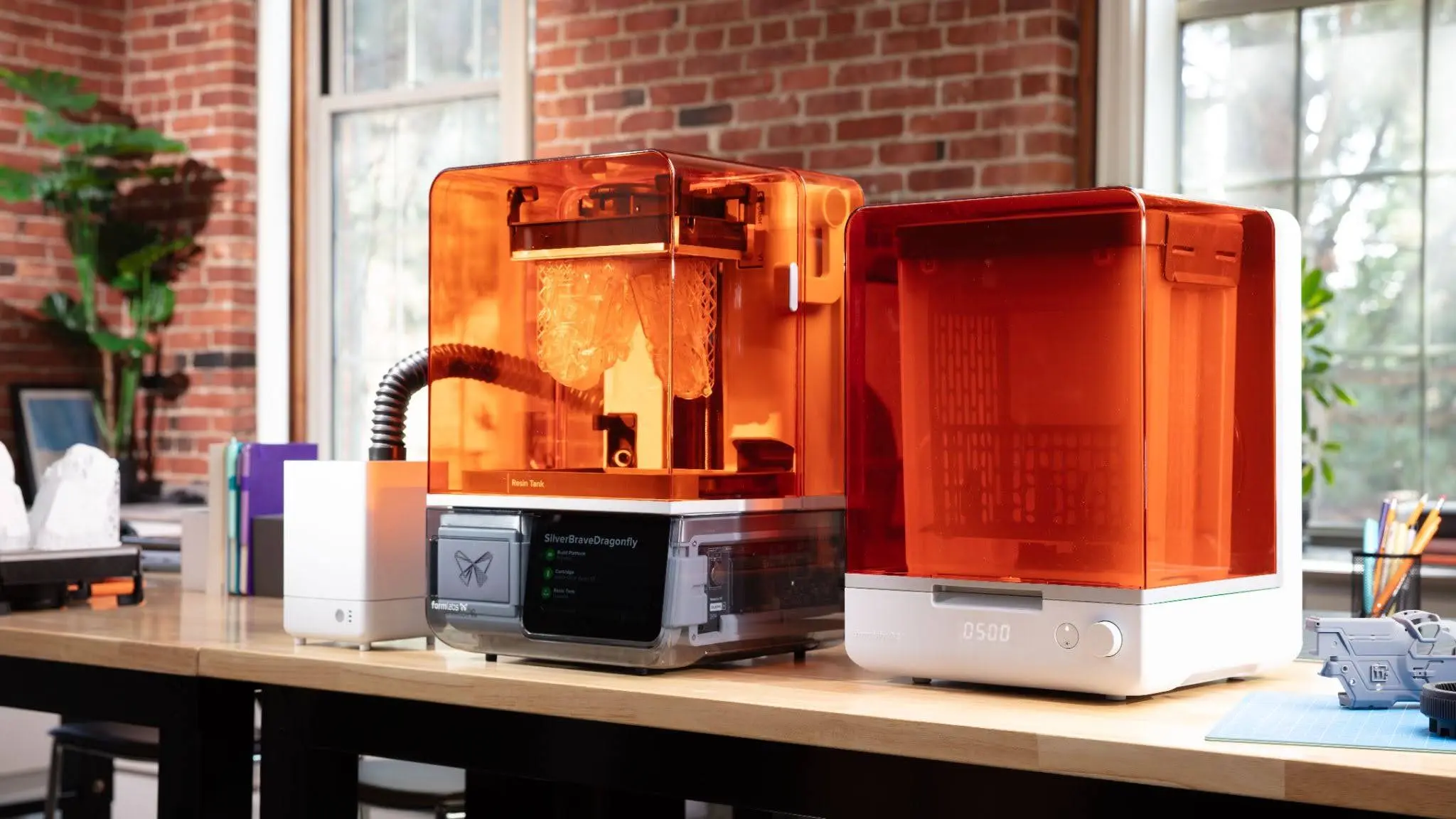
The Alpha Resin Family is low-odor, for a more pleasant printing experience, and UL GREENGUARD Gold Certified when printed on Form Studio 1 with the VOC Extractor.
How do I set up my workspace for resin 3D printing?
Check out the guide on Safety with Formlabs SLA products to learn how to prepare your space for 3D printing with Formlabs resin 3D printers.
Do I need a dedicated space or extra ventilation to print with resin?
It depends on the printer and the resin.
Formlabs resins are formulated with user safety in mind and do not require enclosures, respirators, or dedicated exhaust systems for safe use. Alpha Resins for the Form Studio 1 have been specifically tested for VOC emissions and are safe to use in residential environments without additional environmental controls. For users who want an extra layer of protection, Formlabs VOC Extractor is available for both the Form 4 and Form Studio 1. Always consult the SDS on our website before printing to confirm safe operating procedures for your specific resin.
For other printers and resins, check the SDS and the manufacturer's guidance, as some combinations do require dedicated ventilation. Some users prefer a separate space regardless, to contain incidental resin or solvent drips and fumes from washing parts.
What are ways to minimize VOCs when printing?
Many users of low-cost resin 3D printers use grow tents to contain VOCs. Fume hoods and ventilation systems can also be used.
Formlabs VOC Extractor is an external filtration device that attaches to Form Studio 1 or Form 4 and removes VOCs during printing. A fan pulls air from the printer through the hose and pushes it through a HEPA filter (pre-filter plus activated carbon) to strip VOCs before venting clean air out.
Materials and Performance
Do safer resins perform worse or print more slowly?
The assumption behind this question is that hazardous chemicals are necessary for good performance, and that is not the case. ACMO is the common example. It is inexpensive and low-viscosity, cures very quickly, and produces stiff materials, which is why it appears in so many 3D printing resins. But it is one ingredient among the thousands you can use in resin formulations, and fast, cost-effective resins can be made without it. Alpha Resins and other Formlabs resins do not contain ACMO.
Printability and speed are also closely tied to the printer. Tuned print settings account for much of the balance between speed and reliability, independent of the formulation.
What makes Alpha Resins safer than other consumer resins?
Formulation and testing. We chose ingredients with fewer hazards and established safety track records in adjacent applications such as dental appliances and restorations, and we left out known hazardous ingredients like ACMO.
Alpha Resins on Form Studio 1 with Formlabs’ VOC Extractor is the first resin printer to be certified according to UL Greenguard Gold, which is an independent test for indoor appliances that certifies low VOC emissions.
And we made Alpha Resins using low-odor chemicals, so they generally are much less odorous than resins from other 3D printing manufacturers. Testing also covers the liquid resin and the finished part. Liquid Alpha Resins are considered non-irritants under OECD 439, and printed parts are evaluated against the same ISO biocompatibility standards used for Formlabs medical device resins, meeting the requirements for long-term skin contact when post-processed as recommended.
Handling, Washing, and Disposal
Are resin parts safe to handle after they are cured?
Printed and post-processed parts in Alpha Resins are tested for long-term skin contact, which means they are safe to handle. This depends on proper washing and post-curing: acrylic monomers are contact allergens in liquid form but inert once fully polymerized, so an incompletely cured part can still cause a reaction. For other resins, check the manufacturer's documentation, as cured parts are not automatically safe to handle.
What can I use to wash parts instead of IPA?
IPA is popular because it works well for most resins and is very cheap, but it is flammable and has a strong odor. Formlabs Resin Washing Solution is a low-odor, non-flammable alternative that washes as well as IPA and lasts longer. Other solvents are available as well. The important caveat is that not every resin washes well in every solvent, so you have to select the right solvent based on the resin you are printing with.
How do I dispose of uncured resin? Can I pour it down the sink?
Never pour resin down the sink. Disposal rules are region-specific, so check local regulations. In general, trace amounts, such as what is left in an empty bottle or on a paper towel, can go in the trash. Larger quantities should be cured into a solid state first and then discarded, or taken to a drop-off location that your local municipality can identify. Excess or old IPA can be left to evaporate in a well-ventilated outdoor space.