Technical Data Sheet
Nylon 11 Pro Powder
Material Code : FLP11P01 | Datasheet Version : V1 | Revision Date : October 1, 2026 | Category : Engineering Powder | Safety Datasheet
Material Properties | Thermal Properties | Electrical Properties | General Properties | Biocompatibility | Workflow | Environmental Stability | Appendix
| Mechanical Properties | Value | Method 1,2 |
|---|---|---|
| Tensile Properties | ||
| Ultimate Tensile Strength (X/Y) | 46 MPa [6670 psi] | ASTM D638-14 Type I |
| Ultimate Tensile Strength (Z) | 45 MPa [6570 psi] | ASTM D638-14 Type I |
| Tensile Modulus (X/Y) | 1580 MPa [229 ksi] | ASTM D638-14 Type I |
| Tensile Modulus (Z) | 1580 MPa [229 ksi] | ASTM D638-14 Type I |
| Elongation at Break (X/Y) | 49% | ASTM D638-14 Type I |
| Elongation at Break (Z) | 26% | ASTM D638-14 Type I |
| Flexural Properties | ||
| Flexural Strength (X/Y) | 50 MPa [7250 psi] | ASTM D790-15 |
| Flexural Strength (Z) | 50 MPa [7250 psi] | ASTM D790-15 |
| Flexural Modulus (X/Y) | 1120 MPa [162 ksi] | ASTM D790-15 |
| Flexural Modulus (Z) | 1200 MPa [174 ksi] | ASTM D790-15 |
| Toughness Properties | ||
| Notched Izod (X/Y) | 45 J/m [0.86 (ft·lb)/in] | ASTM D256-10 |
| Notched Izod (Z) | 40 J/m [0.76 (ft·lb)/in] | ASTM D256-10 |
| Unnotched Izod (X/Y) | 1675 J/m [31.4 (ft·lb)/in] | ASTM D4812-25 |
| Unnotched Izod (Z) | 1220 J/m [22.9 (ft·lb)/in] | ASTM D4812-25 |
| Notched Charpy (X/Y) | 6.9 kJ/m2 [3.3 (ft·lb)/in2] | ISO 179-1 |
| Notched Charpy (Z) | 3.8 kJ/m2 [1.8 (ft·lb)/in2] | ISO 179-1 |
| Gardner Impact at 1/32" (0.79 mm) thickness (X/Y) | 2.9 J [26 in·lb] | ASTM D5420-21 |
| Fracture Properties | ||
| Maximum Stress Intensity Factor (Kmax) | 3.3 MPa·m1/2 [3000 psi·in1/2] | ASTM D5045-14 |
| Work of Fracture (Wf) | 1550 J/m2 [106 (ft·lb)/ft2] | ASTM D5045-14 |
| Thermal Properties | Value | Method 1,2 |
|---|---|---|
| Heat Deflection Temp. at 1.8 MPa | 50 °C [122 °F] | ASTM D648-16 |
| Heat Deflection Temp. at 0.45 MPa | 178 °C [352 °F] | ASTM D648-16 |
| Vicat Softening Temperature | 202 °C [396 °F] | ASTM D1525 |
| Coefficient of Thermal Expansion (-30-140 °C) | 164.8 (μm/m)/°C [91.6 (μin/in)/°F] | ASTM E831 |
| Flammability | HB (3.0 mm) | UL 94 Section 7 |
| Electrical Properties | Value | Method 1,2 |
|---|---|---|
| Surface Resistivity | 1.7x10¹⁵ Ω | ASTM D257-14 |
| Volume Resistivity | 2.6x10¹⁵ Ω·cm | ASTM D257-14 |
| Comparative Tracking Index | ≥ 600 V (no electric tracking failure) | ASTM D3638-21 |
| Dielectric Strength | 16.7 kV/mm [424 V/mil] | ASTM D149 |
| Dielectric Constant (k') at 7 MHz | 3.12 | ASTM D150-22 |
| Dielectric Constant (k') at 27 MHz | 2.66 | ASTM D150-22 |
| Value | Method 1,2 | |
|---|---|---|
| General Properties | ||
| Water Absorption (printed part) | 0.4% | ASTM D570 |
| Density (printed part) | 1.03 g/cm3 [0.0372 lb/in3] | ASTM D792 |
| Shore Hardness | 75D | ASTM D2240-15 |
Biocompatibility
Samples printed with Nylon 11 Pro Powder have been evaluated in accordance with ISO 10993-1, and have passed the requirements for the following biocompatibility risks: 2
| ISO Standard | Result |
|---|---|
| EN ISO 10993-5:2009 | Not cytotoxic |
| EN ISO 10993-10:2021 | Not a sensitizer |
| EN ISO 10993-23:2021 | Not an irritant |
| EN ISO 10993-11:2017 | No systemic toxicity |
| USP-NF, General Chapter <151>, Pyrogen Test: 01 MAY 2017 | Non-pyrogenic |
Workflow
Printer Compatibility
| Platform | Printer | Compatibility | Nitrogen Required? |
|---|---|---|---|
| Fuse 1 | Fuse 1 | Incompatible | N/A |
| Fuse 1+ 30W | Supported | Yes | |
| Fuse X1 | Fuse X1 | Supported (Available in Q1/2027) | Yes |
Supported: Validated on this printer, with print settings available in PreForm.
Incompatible: Not validated on this printer; no print settings are available in PreForm. Open Material Mode is required.
Storage and Handling
| Recommended Refresh Rate | 30% |
| Shelf-life | 2 years |
| Storage temperature | 0 - 45 °C |
Environmental Stability
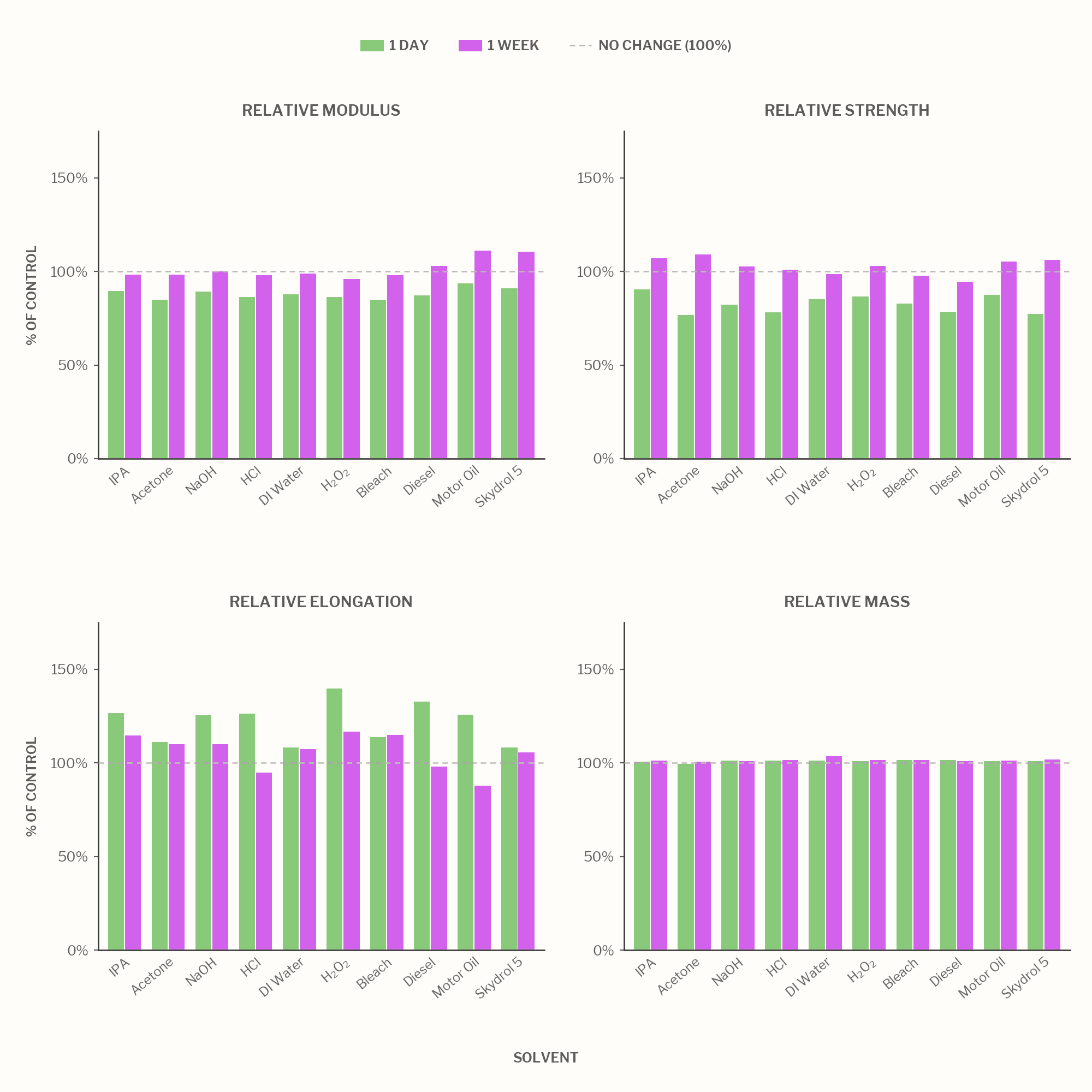
Chemical Compatibility (ASTM D543)
Tested for chemical compatibility according to ASTM D543. The influence of various chemicals was tested by measuring tensile modulus and strength after different exposure times. Exposed samples were stored in containers and fully immersed in the test chemicals for 1 day and 1 week. After removal, exposed samples were washed and conditioned for 24 hours at 22 °C before mechanical testing. Mechanical testing was conducted according to ASTM D638 using Type 4 tensile samples at standard lab conditions (22 °C). Results are reported as a % difference from the measured values of non-exposed samples. 3
Appendix
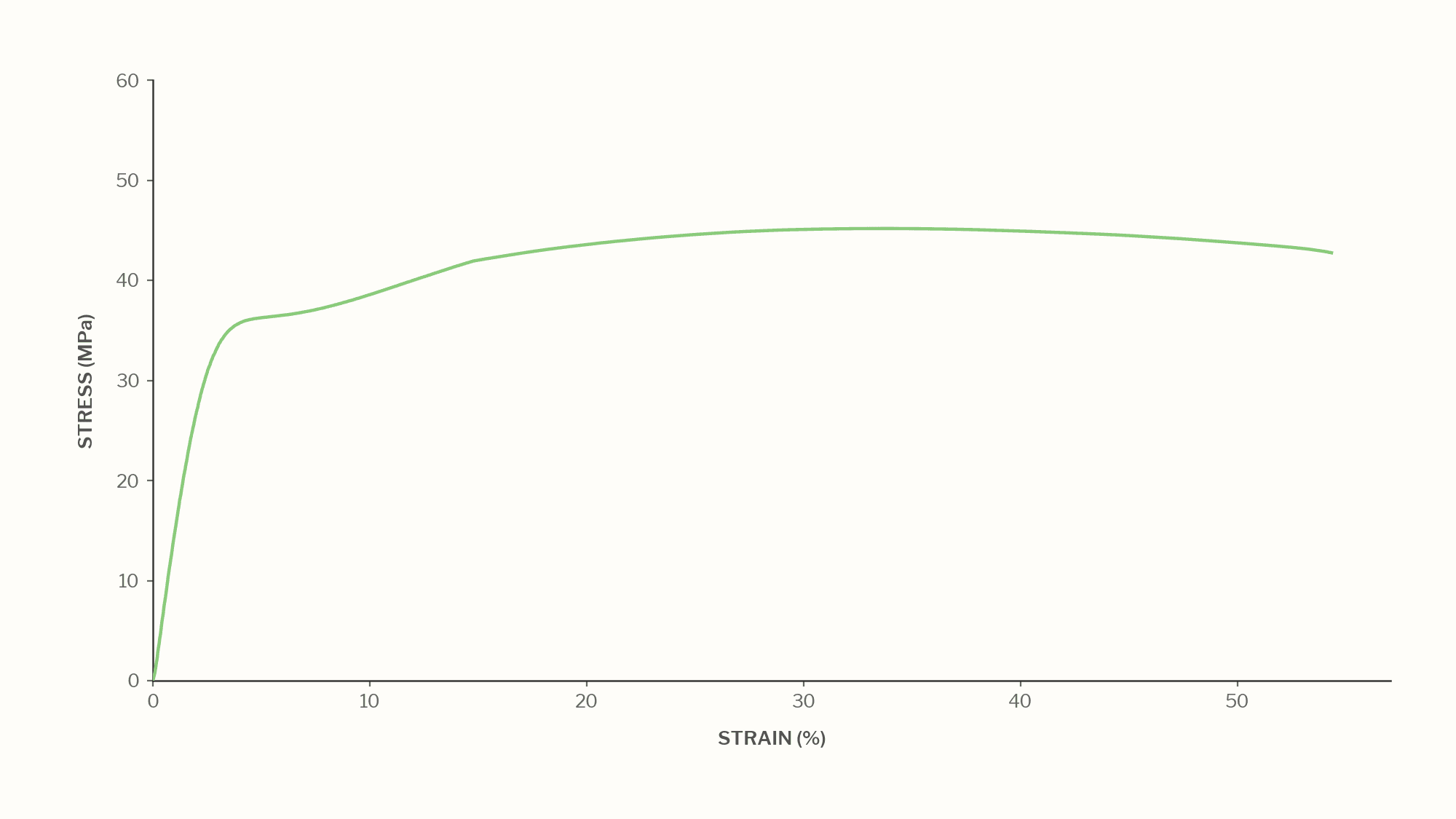
Stress-Strain Curve
Tensile properties were determined according to ASTM D638 (Type I). Samples were printed in the X/Y orientation and conditioned at 23 °C and 50% RH for 48 hours prior to testing. The displayed curve represents a single sample selected to illustrate typical stress-strain behavior. See the Material Properties section for average values.
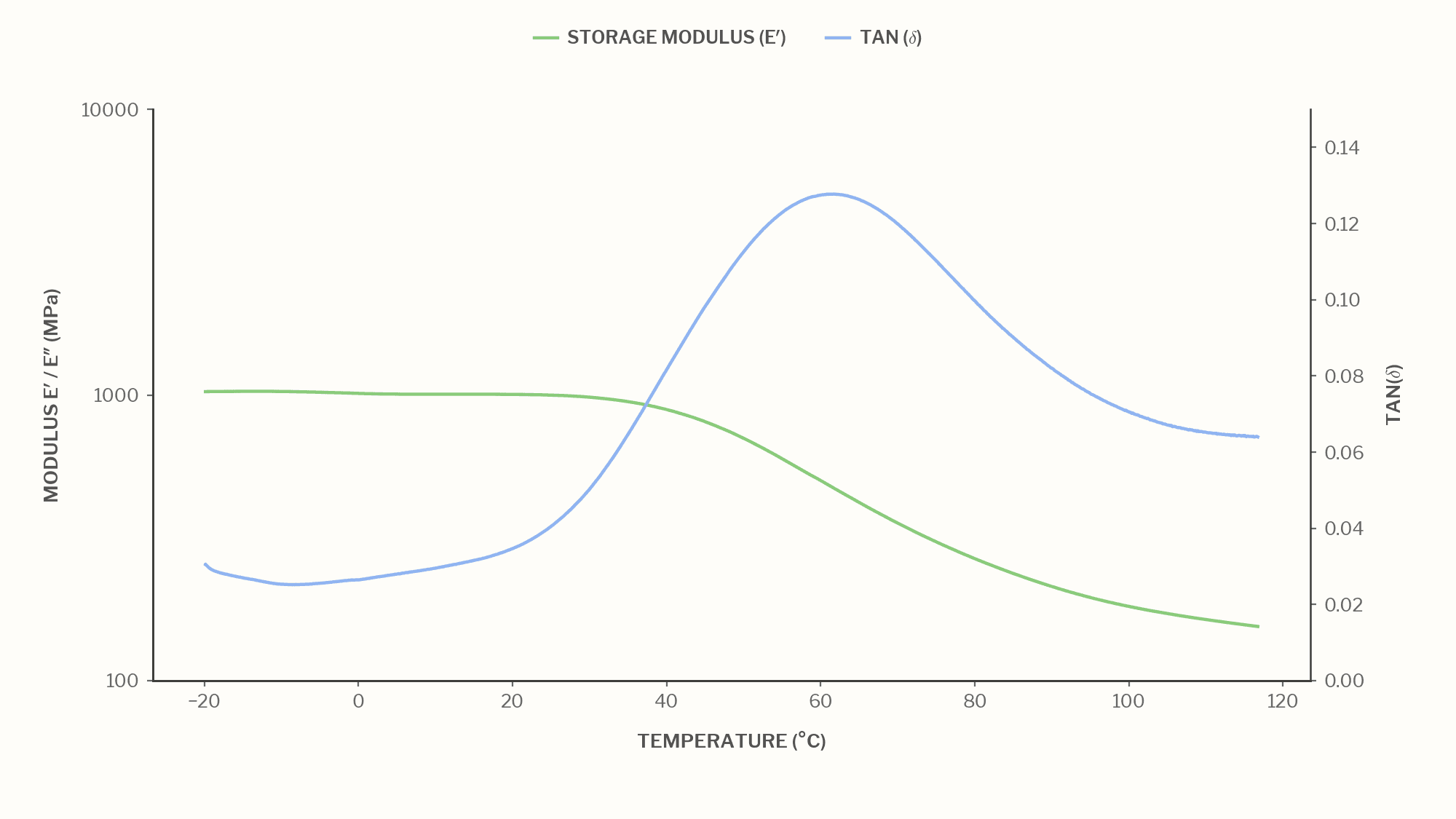
Dynamic Mechanical Analysis (DMA)
Dynamic mechanical analysis was performed on a rectangular specimen (35 × 12 × 3.07 mm) at 1 Hz while heating from -20 °C to 120 °C at 3 °C/min.
Footnotes
- Material properties may vary with part geometry, print orientation and temperature.
- Parts were printed using Fuse 1+, with 30% refreshed Nylon 11 Pro powder. Parts were conditioned for 48 hours at 23 °C and 50% RH.
- Chemical compatibility results are reported relative to non-exposed control samples; a value of 100% indicates no change from control.