Technical Data Sheet
Clear Resin V5
Version: V1
REVISION DATE: TBD
General Purpose Resin
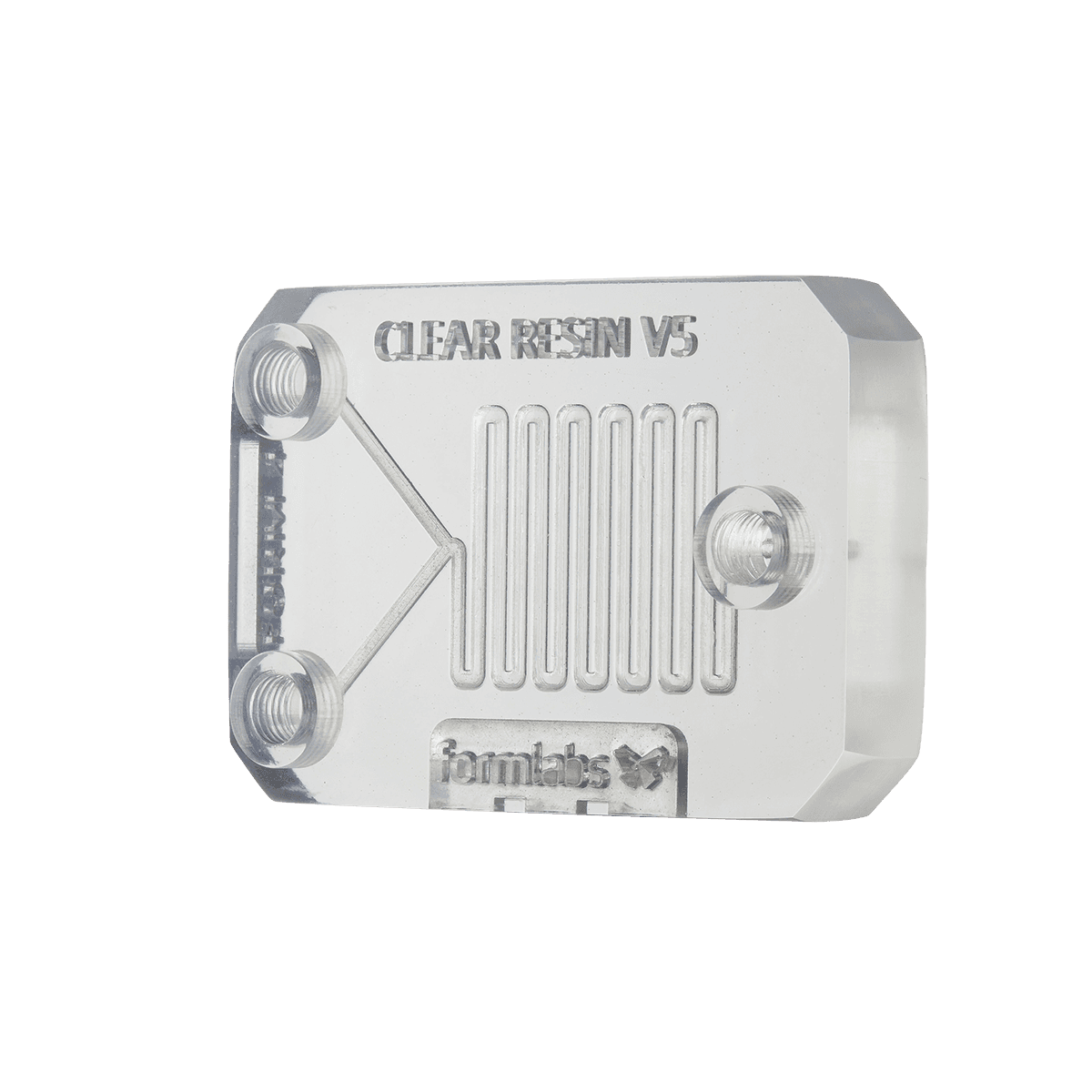
An optimally-balanced Clear Resin for transparent applications
Clear Resin V5 is an exceptionally clear and color-neutral General Purpose Resin, offering an optimal balance of fast print speed, high dimensional accuracy, and presentation-ready appearance.
Clear Resin V5 creates highly transparent and colorless parts that can be polished to near optical transparency. Create parts that are stiff and strong with a smooth surface finish that rivals acrylic.
Clear Resin V5 is a new material formulation that leverages the Form 4 ecosystem to print three times faster than the previous version.
Use Examples:
- Transparent enclosures, optical components, and lighting prototypes
- Parts showcasing internal features
- Molds, masters, and other rapid tooling
- Fluidic devices
Workflow
Printer Compatibillity
| Platform | Printer | Compatibility | Validated Layer Heights |
|---|---|---|---|
|
Form 4 |
Form 4 |
Compatible |
0.1 mm |
| Form 4B | |||
| Form 4L | |||
| Form 4BL | |||
|
Form 3 |
Form 3/+ |
Not Compatible |
|
| Form 3B/+ | |||
| Form 3L | |||
| Form 3BL | |||
Post-Processing
| Step | Recommended Hardware | Default | Max Strength |
|---|---|---|---|
| Washing | Form Wash V2 Form Wash L V2 |
5 minutes in Wash Gen 2 or until clean | |
| Drying | -- | 10 min | |
|
Post-Curing |
Form Cure V1 Form Cure L V1 |
5 min at room temperature | 15 min at 60 °C |
| Form Cure V2 Form Cure L V2 |
1 min at room temperature | 4 min at 60°C | |
Handling and Storage
| Shelf-life | 2 years |
| Storage temperature | 10 - 25 °C |
Storage and Handling notes
Review Safety Data Sheet to ensure safe handling, storage, and disposal.
Shake resin containers before printing to ensure the resin is thoroughly mixed.
To avoid contamination, do not pour resin back into cartridges.
For best performance and shelf life, store resin between 10–25 °C (50–77 °F), and keep opened resin away from direct light.
Short-term freezing (e.g., during shipping) is generally not detrimental to shelf life. Thaw and shake the resin cartridge thoroughly before use.
High temperatures decrease shelf life. Transient high temperature conditions (e.g., during shipping) should have a minimal effect.
Material Properties
Green Properties
| Value | Method 1 | |
|---|---|---|
| Ultimate Tensile Strength | 46 MPa [6700 psi] |
ASTM D638-14 |
| Tensile Modulus | 2200 MPa [320 ksi] |
ASTM D638-14 |
| Elongation at Break | 13% | ASTM D638-14 |
Tensile Properties
| Default Post-Cure | Max Strength Post-Cure | Method 2, 3 | |
|---|---|---|---|
| Tensile Properties | |||
| Ultimate Tensile Strength | 51 MPa [7300 psi] |
60 MPa [8700 psi] |
ASTM D638-14 |
| Tensile Modulus | 2600 MPa [370 ksi] |
2800 MPa [400 ksi] |
ASTM D638-14 |
| Elongation at Break | 10% | 8.0% | ASTM D638-14 |
| Flexural Properties | |||
| Flexural Strength | 92 MPa [13000 psi] |
105 MPa [15000 psi] |
ASTM D790-15 |
| Flexural Modulus | 2400 MPa [360 ksi] |
2700 MPa [392 ksi] |
ASTM D790-15 |
| Toughness Properties | |||
| Izod Impact Strength (Unnotched) | 150 J/m [2.8 (ft·lb)/in] |
170 J/m [3.2 (ft·lb)/in] |
|
| Izod Impact Strength (Notched) | 29 J/m [0.54 (ft·lb)/in] |
29 J/m [0.54 (ft·lb)/in] |
ASTM D256-10 |
| Gardner at 1/16" (1.6 mm) thickness | <0.1 J [<2 in·lb] |
<0.1 J [<2 in·lb] |
ASTM D5420-21 |
| Maximum Stress Intensity Factor (Kmax) | 0.63 MPa·m^(1/2) [57 psi in^(1/2)] |
-- | ASTM D5045-14 |
| Work of Fracture (Wf) | 27 J/m^2 [1.8 (ft·lb)/ft^2] |
-- | ASTM D5045-14 |
| General Properties | |||
| Density | 1.21 g/cm^3 [0.0437 lb/in^3] |
1.21 g/cm^3 [0.0437 lb/in^3] |
ASTM D792 |
| Shore Hardness | 78D | 80D | ASTM D2240-15 |
| Thermal Properties | |||
| Glass Transition Temp (Tg) | 101 | 107 | ASTM D4065 |
| Heat Capacity at 25 °C | 1.8 J/(g·K) [0.43 BTU/(lb·°F)] |
-- | ASTM E1269 |
| Coefficient of Thermal Expansion (-30-140 °C) | 110 (μm/m)/°C [63 (µin/in)/°F] |
-- | |
| Heat Deflection Temp. at 1.8 MPa | 59 | 65 | ASTM D648-16 |
| Heat Deflection Temp. at 0.45 MPa | 51 | 54 | ASTM D648-16 |
| Thermal Conductivity | 0.54 W/m·K [3.8 BTU·in/(hr·ft^2·°F)] |
0.54 W/m·K [3.8 BTU·in/(hr·ft^2·°F)] |
ASTM E1530-25 |
| Electrical Properties | |||
| Surface Resistivity | >1x10^12 Ω/sq | >1x10^12 Ω/sq | ASTM D257 |
| Comparative Tracking Index | 600 V | -- | ASTM D3638 |
| Dielectric Strength | 16 kV/mm [420 V/mil] |
-- | ASTM D149-20 |
| Dielectric Constant (k') at 1 MHz | 4.3 | -- | ASTM D150-22 |
| Dielectric Dissipation (D) at 1 MHz | 0.036 | -- | ASTM D150-22 |
| Optical Properties 5 | |||
| Refractive Index | 1.62 | 1.62 | ASTM D542-22 |
| Gloss Level (60°, XY) | 89 GU | -- | ASTM D523 |
| Gloss Level (60°, Z) | 24 GU | -- | ASTM D523 |
| Transmission (2 mm) | 85 % | 85 % | ASTM D1003-21 |
| a* (2 mm) | -4.0 | -4.3 | ASTM E 1348-15 |
| b* (2 mm) | 7.5 | 5.6 | ASTM E 1348-15 |
| Transmission (10 mm) | 59 % | 59 % | ASTM D1003-21 |
| a* (10 mm) | -4.2 | -4.0 | ASTM E 1348-15 |
| b* (10 mm) | 6.0 | 5.9 | ASTM E 1348-15 |
| Outgassing 4 | RT 5 min |
|---|---|
| TML | 1.70% |
| CVCM | < 0.01% |
| WVR | 0.33% |
The Outgas Test was performed in a vacuum environment of less than 5 X 10⁻⁵ torr according to ASTM E595, for a duration of 24 hours, at 125°C on three specimens per sample
Extended Properties
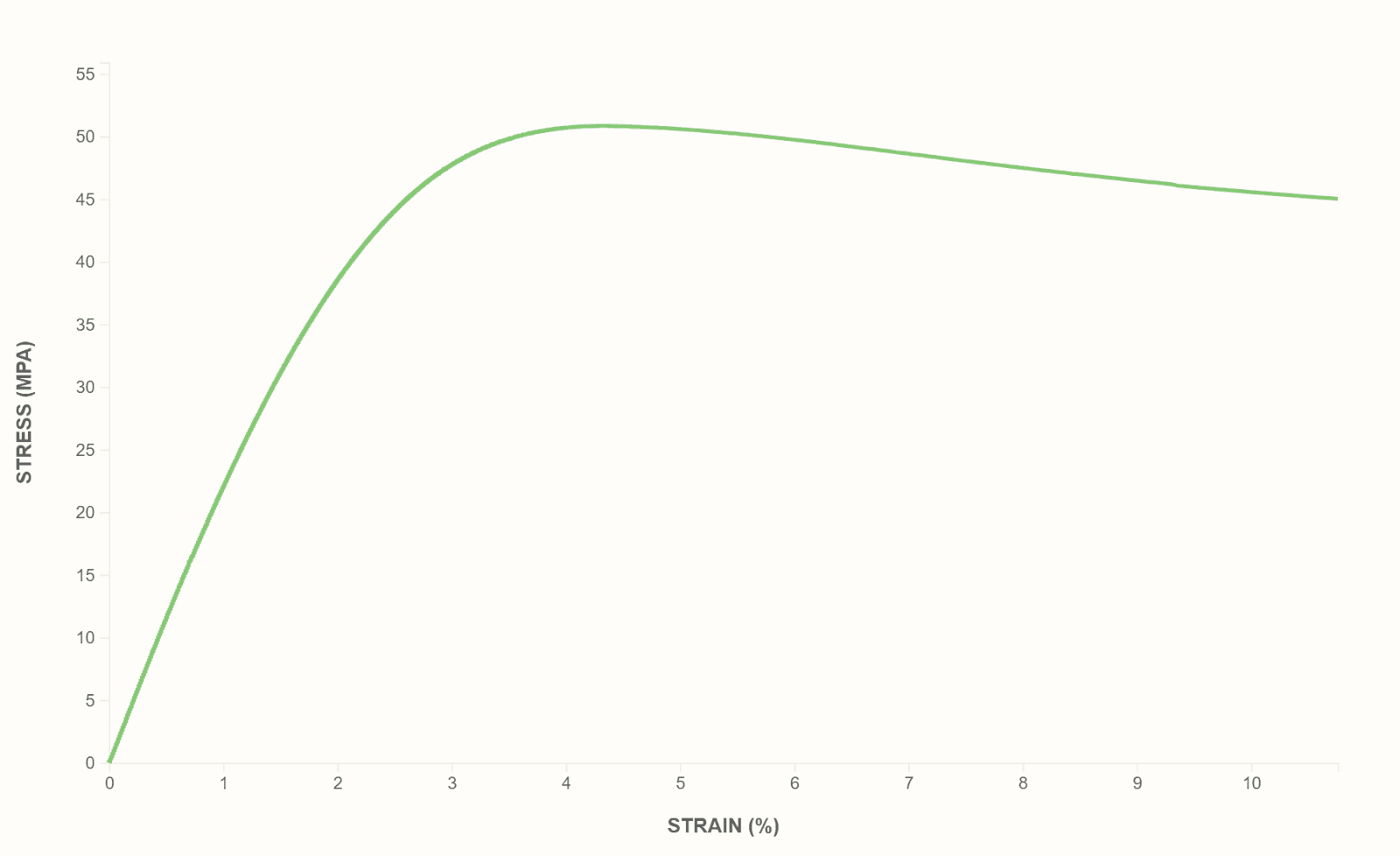
Representative Tensile Curves
Tensile properties were determined according to ASTM D638 (Type I). Samples were prepared following the Default post-processing workflow and conditioned at 23°C and 50% RH for 48 hours prior to testing. The displayed curve represents a single sample selected to illustrate typical stress-strain behavior. See the Material Properties section for average values.
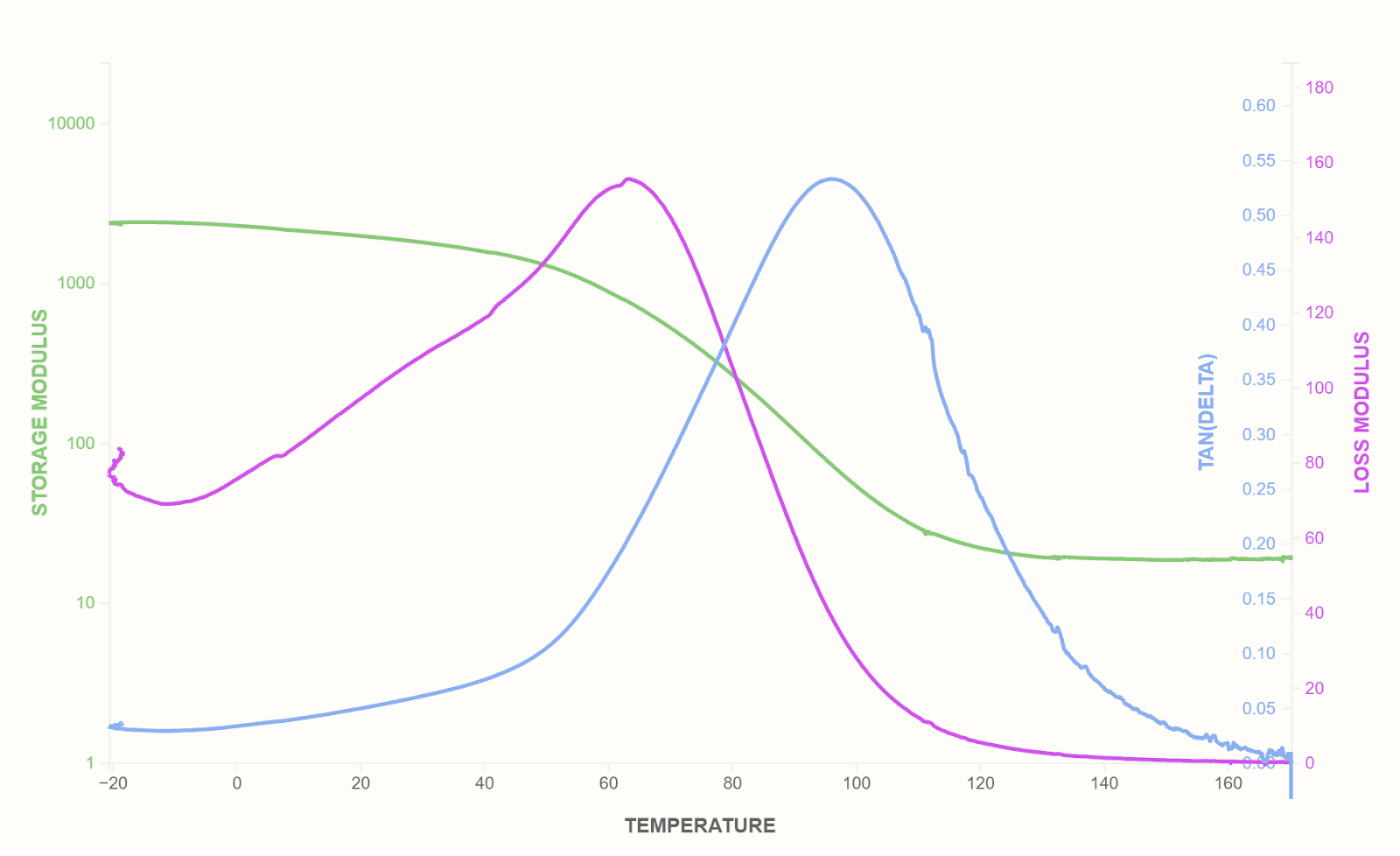
Dynamic Mechanical Analysis (DMA)
DMA was performed using a TA Q800 with dual cantilever clamps from -20°C to 170°C using a heating rate of 3°C/min. Samples were prepared following the Default post-processing workflow. The resulting curve characterizes the material’s viscoelastic response over the temperature range and indentifies the glass transition (Tg).
ASTM D543
Chemical Compatibility
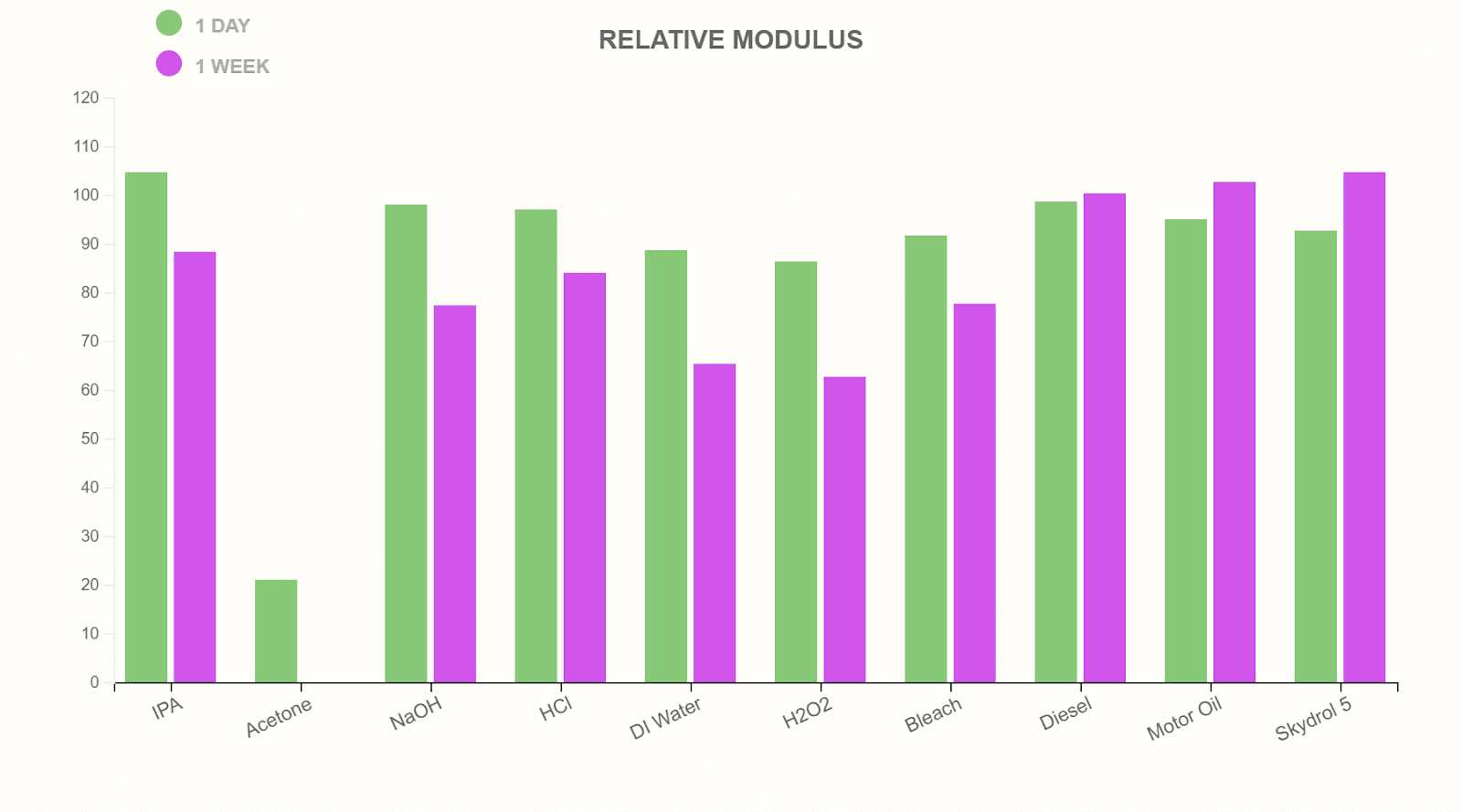
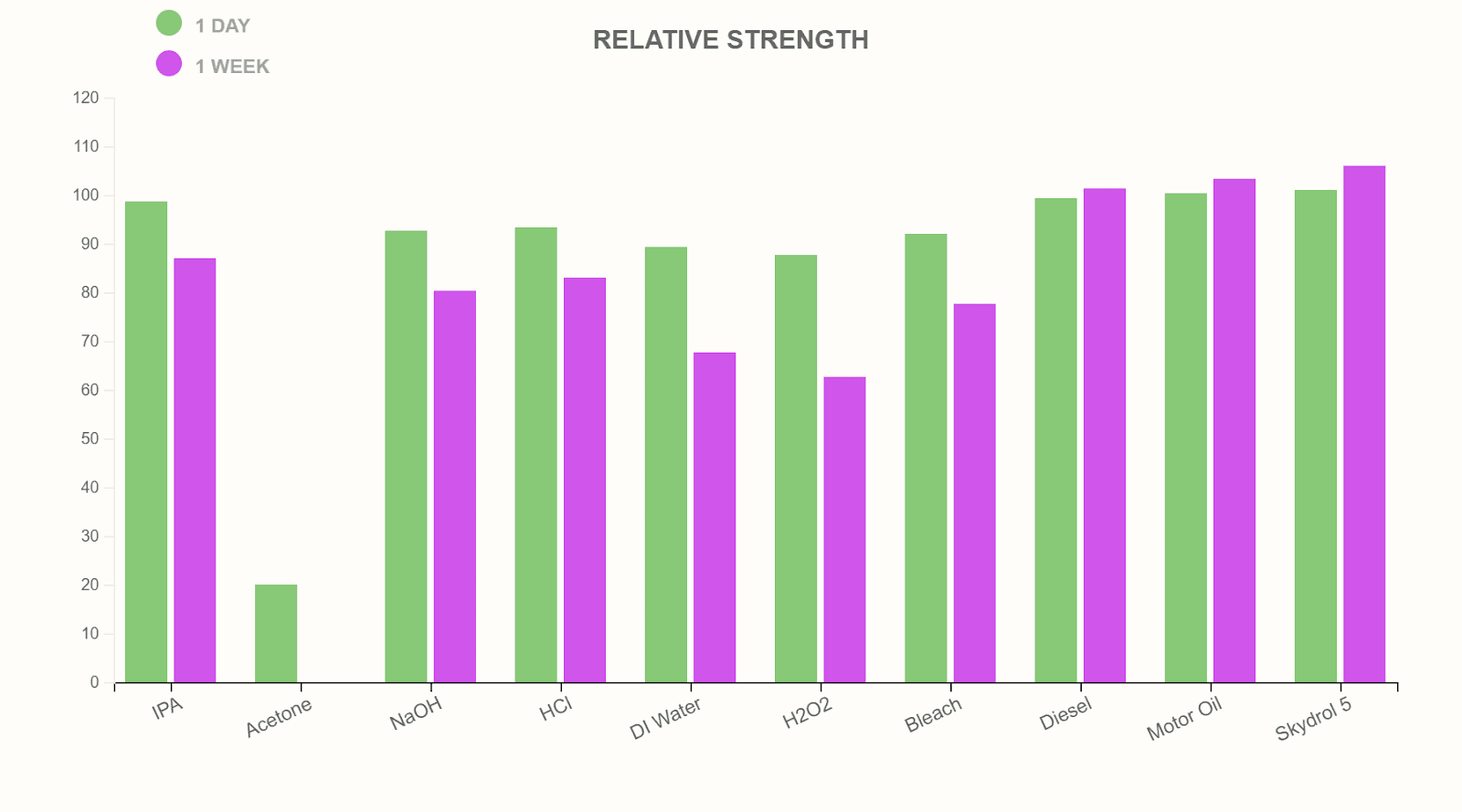
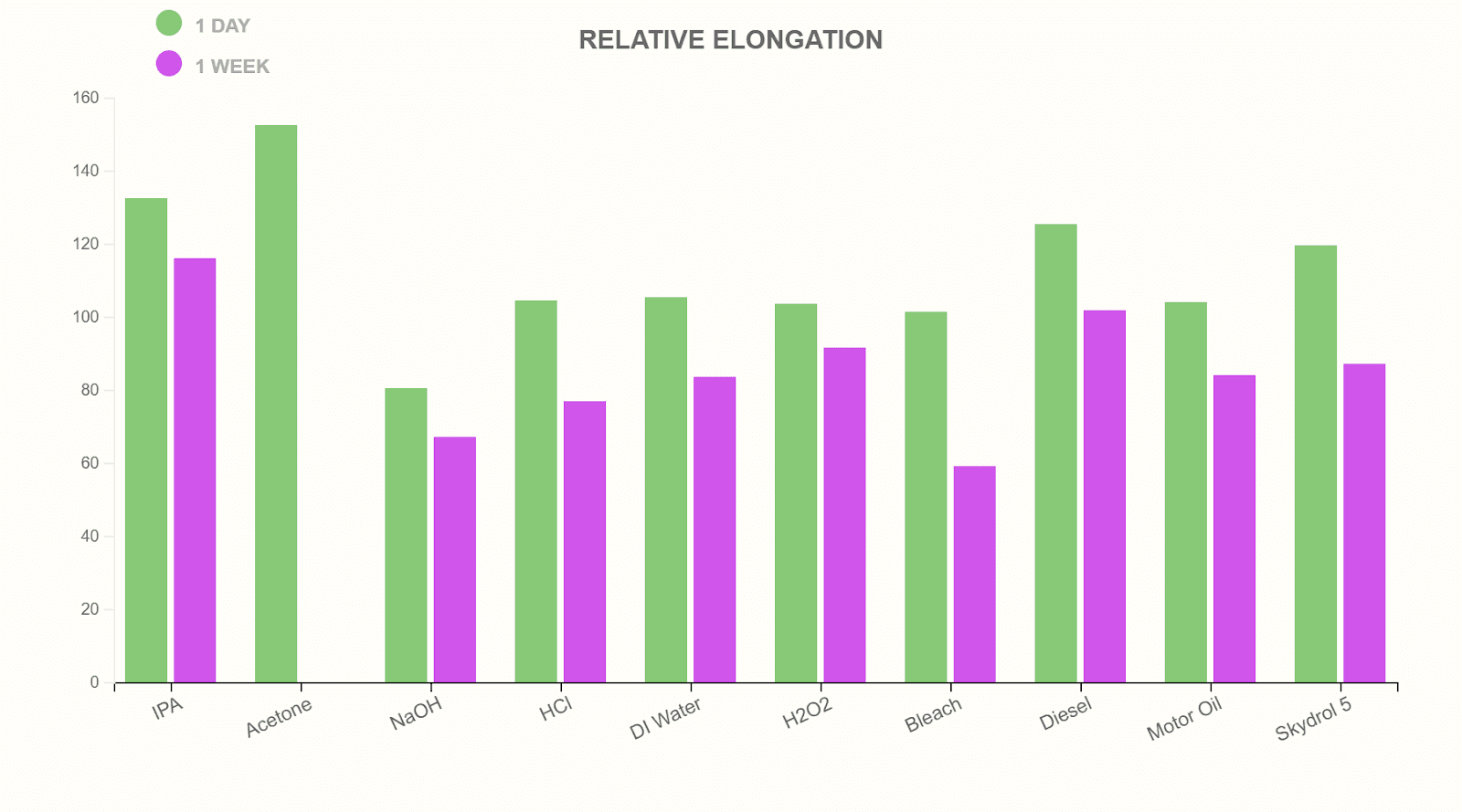
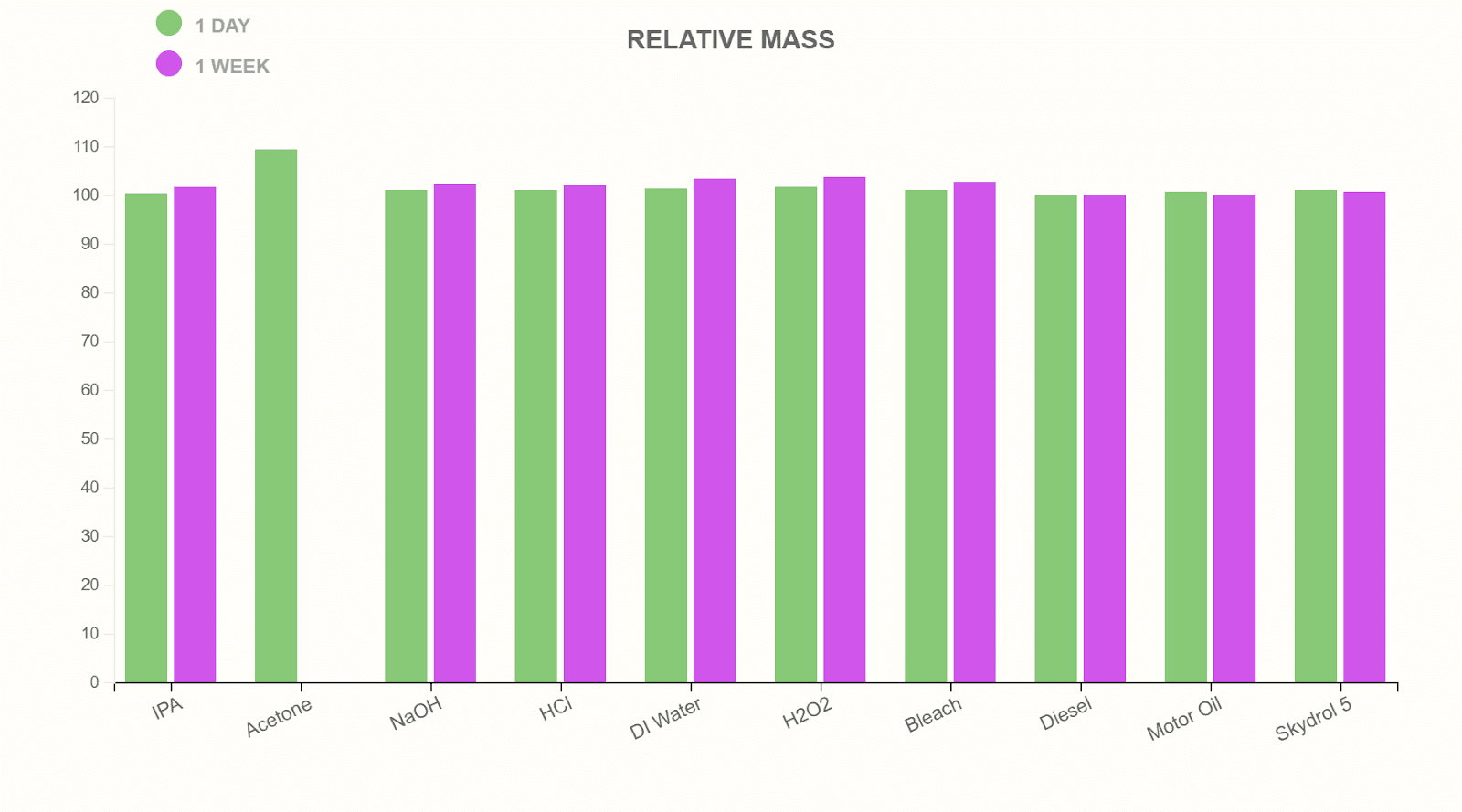
Chemical resistance was evaluated according to ASTM D543. Samples were prepared following the Default post-processing workflow then fully immersed in test chemicals for durations of 1 day and 1 week. Following exposure, samples were manually wiped off and conditioned at 23°C and 50% RH for 24 hours. Mechanical testing was conducted per ASTM D638 (Type IV). Results are reported as the percentage change from non-exposed control samples. 6
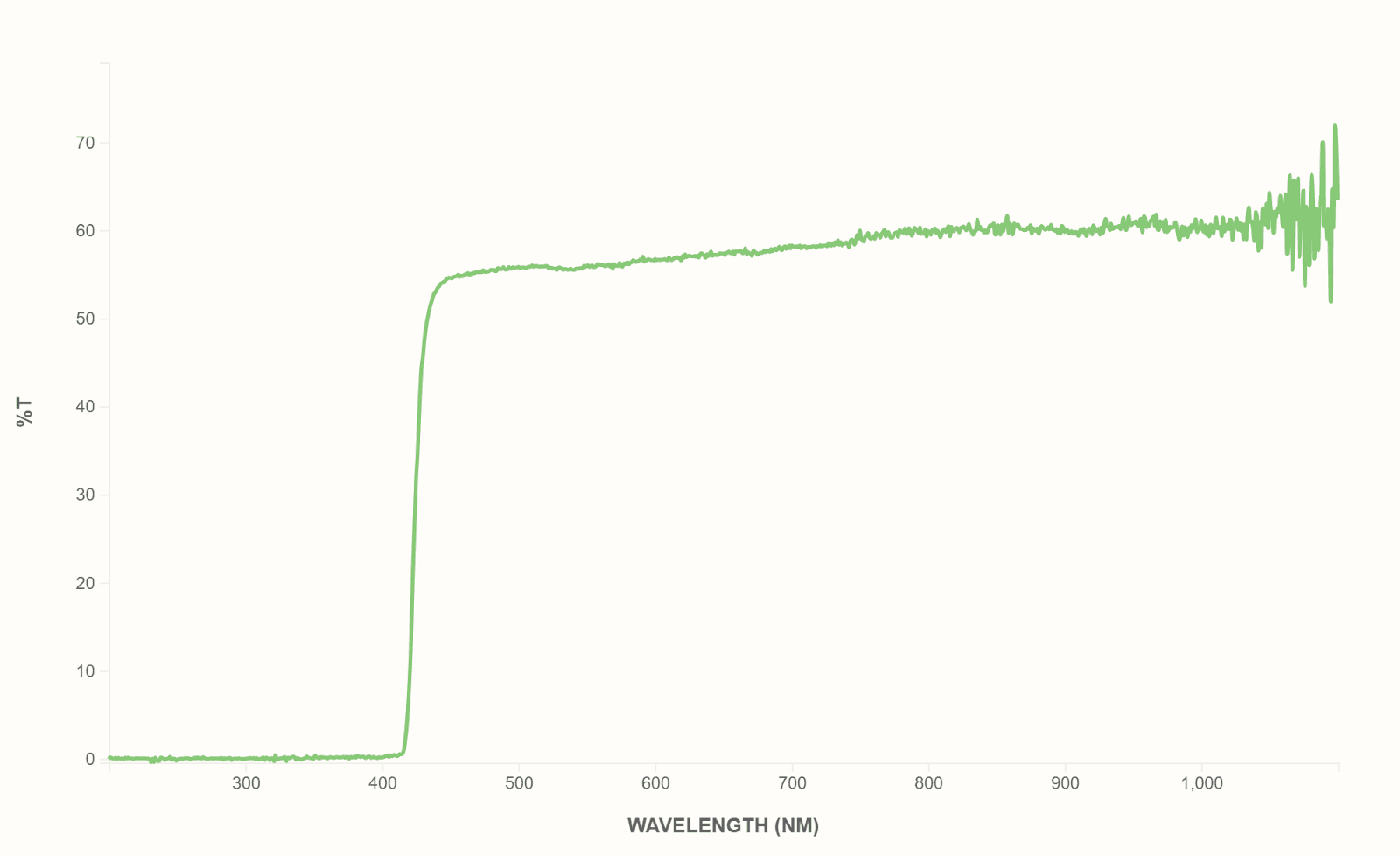
Light Transmission Curve
Transmission spectra were recorded from 200 nm to 1000 nm using a Varian Cary 50 Spectrophotometer. The 3 mm sample was prepared following the Default post-processing workflow. The measured surface was vertical and unpolished.
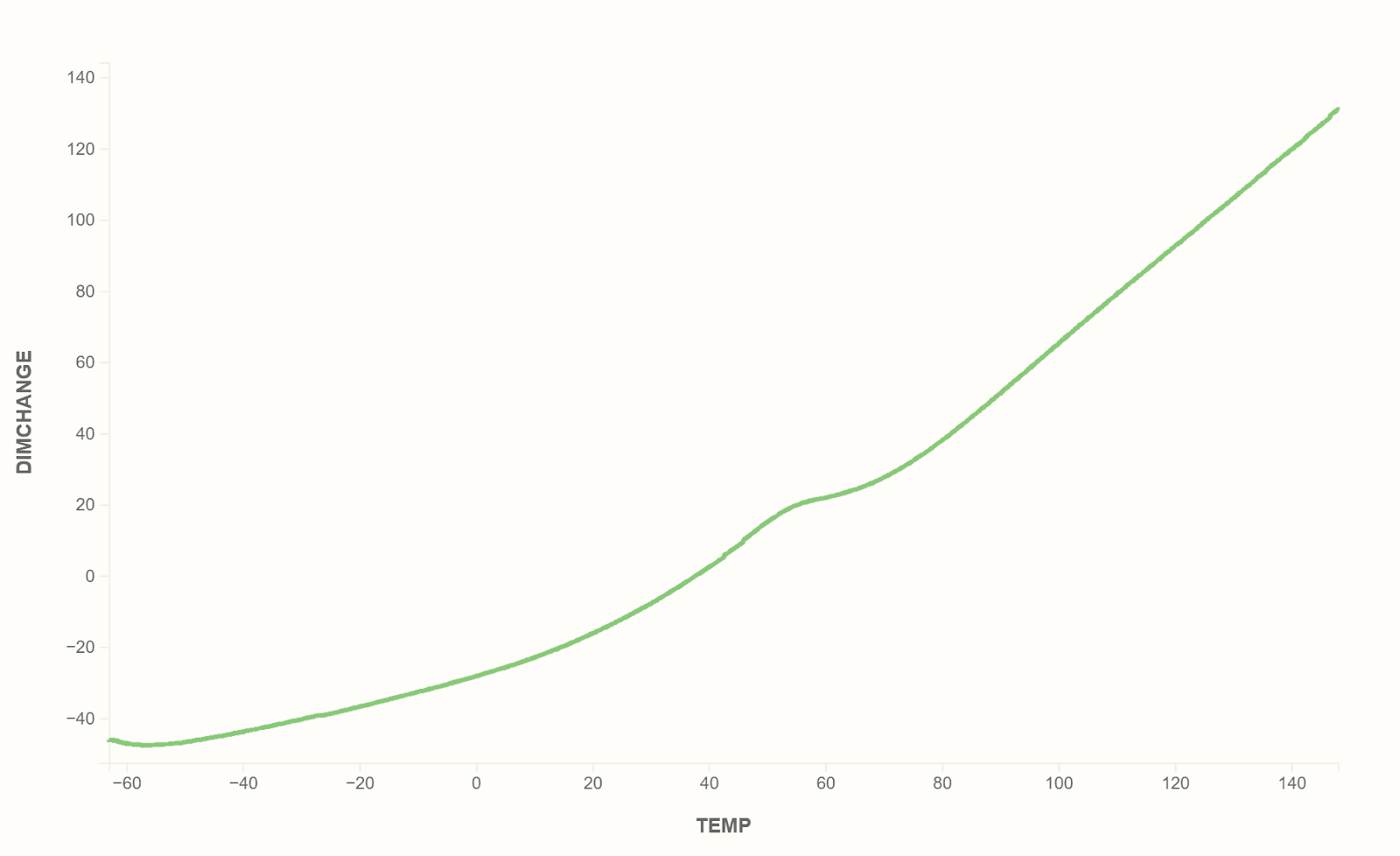
Thermal Expansion by TMA
The Coefficient of Thermal Expansion (CTE) was measured according to ASTM E831. Samples were prepared following the Default post-processing workflow. Testing was performed via TMA with a ramp rate of 5°C/min under a High Purity Nitrogen purge (50 cc/min).
Footnotes
- Material properties may vary based on part geometry, print orientation, print settings, temperature.
- Data was obtained from parts printed on a Form 4 printer with 100 µm Clear Resin V5 settings, washed in a Form Wash for 5 minutes in ≥99% Isopropyl Alcohol, and post-cured at room temperature for 5 minutes in a Form Cure.
- Data was obtained from parts printed on a Form 4 printer with 100 µm Clear Resin V5 settings, washed in a Form Wash for 5 minutes in ≥99% Isopropyl Alcohol, and post-cured at 60 °C for 15 minutes in a Form Cure.
- Data was obtained using Grey Resin V5, and is expected to fall in the same approximate range. Some results may vary. Consult Grey Resin V5 TDS for information on printing and post-processing of samples.
- Transmission refers to the amount of visible light that passes through the part
a* and b* are more commonly associated with the CIELAB color space, where they denote axes for color measurement:
a* axis: Ranges from green to red, with negative values indicating green and positive values indicating red.
b* axis: Ranges from blue to yellow, with negative values indicating blue and positive values indicating yellow." - Data shown was generated using Grey v5. Clear v5 is expected to exhibit similar performance.