
Rapid prototyping
Rapid prototyping
Rapid prototyping is the group of techniques used to quickly fabricate a physical part or assembly from a three-dimensional design. With rapid prototyping, engineers and designers can create a better final product, iterating several times between digital designs and physical prototypes with a quick and cost-effective workflow.
Rapid prototyping helps companies quickly turn ideas into realistic proofs of concept, advances these concepts to high-fidelity prototypes that look and work like final products, and guides products through a series of validation stages toward mass production.
3D printing provides almost unlimited form freedom, doesn’t require tooling, and can produce parts with mechanical properties closely matching various materials made with traditional manufacturing methods. A good model is a 24-hour design cycle: design during work, 3D print prototype parts overnight, clean and test the next day, tweak the design, then repeat.
Formlabs recommended materials
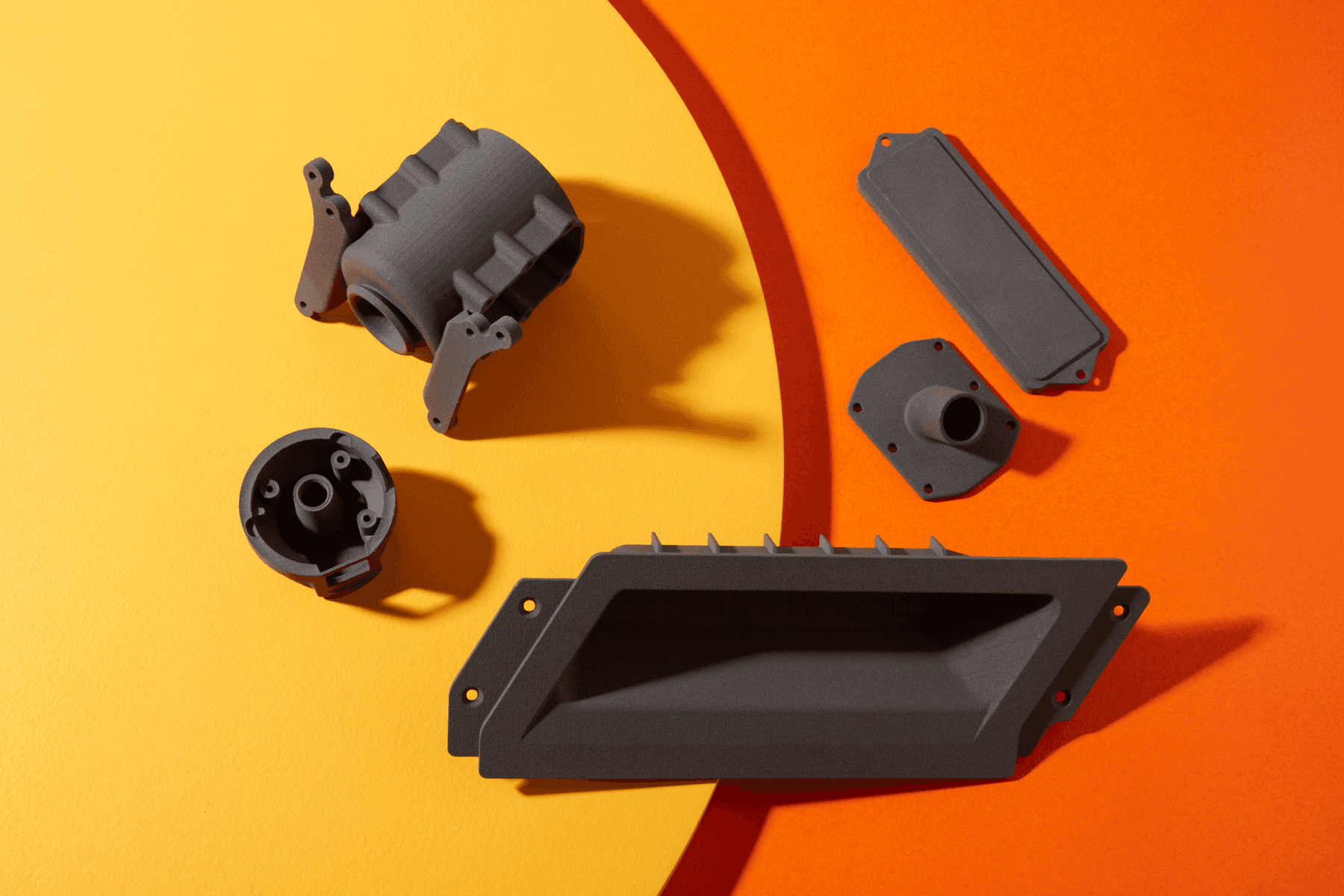
Formlabs offers an expansive materials library that can be used to 3D print a wide variety of rapid prototypes on Formlabs printers. Choosing the right material depends on the application in question.
| Material | Details |
|---|---|
| Draft Resin | Print speed of Draft Resin makes it ideal for same-day design iterations and printing bulky, full-build-volume parts in less than eight hours. |
| Fast Model Resin | Formlabs’ fastest resin, capable of printing at speeds of over 100 mm per hour. Print dental models in minutes or large prototypes in less than two hours. |
| Flexible 80A Resin | Stiff, soft-touch, translucent elastomer with an 80A Shore durometer that is ideal for prototyping rubber-like parts with the flexibility of harder rubber or TPU. |
| Grey Resin | A versatile general purpose material, with a fast print speed, high accuracy, presentation-ready appearance, strong mechanical properties, and an easy, reliable workflow. Create parts that are stiff and strong with a surface finish that rivals injection molding. |
| Rigid 10K Resin | Withstands up to 218 °C @ 0.45 MPa. High stiffness, strength, and resistance to heat and chemicals. Ideal for functional prototypes requiring dimensional accuracy and stability under high temperatures and pressures. |
| Tough 2000 Resin | Similar strength and stiffness to ABS plastics, making it ideal for prototyping strong and sturdy parts that should not bend easily. |
| Nylon 12 Powder (SLS) | General purpose, versatile, and biocompatible material with high detail and great dimensional accuracy. Ideal for both functional prototyping and end-use production of complex assemblies and durable parts with high environmental stability. |
Design considerations
Follow Formlabs best practices when designing a successful 3D model. Take the material type and printer generation into consideration, as they may have specific requirements for print success.
Printing considerations
Follow Formlabs best practices for model orientation.
Orient your parts on the build plate so that critical surfaces are free of support marks.
Maximize packing density for SLS printed parts with 3D Packing.
Post-processing considerations
Follow Formlabs best practices for washing and post-curing prints. Refer to the individual material articles for specific wash and cure instructions.
End-use recommendations and limitations
3D printers are ideal tools to support concept modeling. They provide unmatched turnaround time to convert a computer file into a physical prototype, allowing designers to quickly test additional concepts. It is particularly recommended for:
- Low-risk concept explorations that look like real products in no time
- Communicating ideas effectively
- Cost and time-saving
- Iterative design process
- Finding and fixing design flaws
Some limitations include:
- Printed parts may not have the same long-term UV stability or thermal resistance of final molded plastics.
- Fine features may be lost when using resins like Fast Model Resin.
Additional resources