
Capturing the Data of Sound With Yamaha’s 3D Printed SMARTMOUTHPIECE
In the classical arts, objective metrics can be hard to come by. That hasn’t stopped Yamaha Corporation, the Japanese wind instrument designer and manufacturer, from the relentless pursuit of improvement through technical analysis.
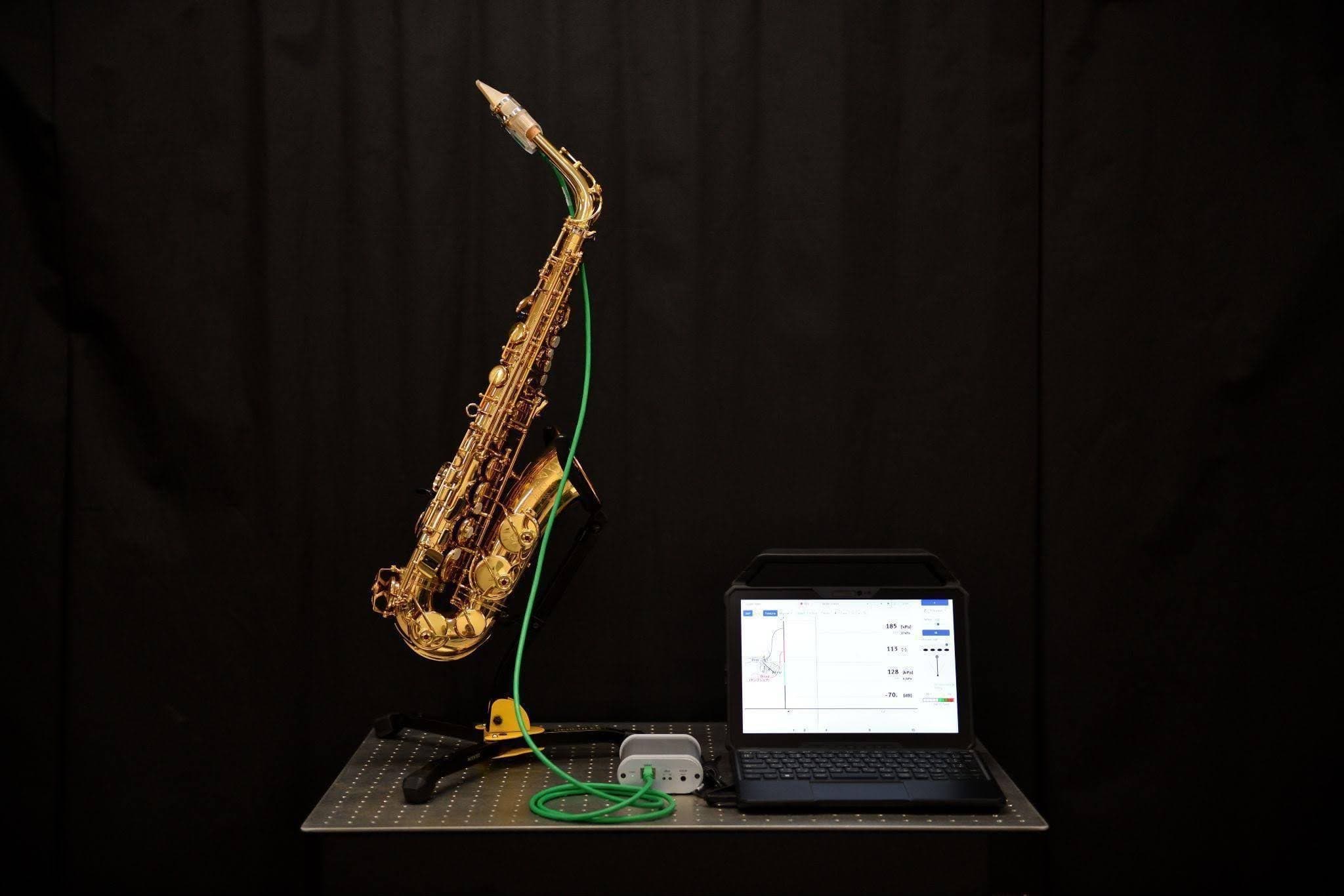
By combining the cutting-edge technology of stereolithography (SLA) 3D printing and biocompatible materials, Yamaha has developed the SMARTMOUTHPIECEⓇ (SMP), a sensor-embedded mouthpiece that measures the player's performance movements as numerical data. Form 4 has drastically shortened Yamaha Corporation’s development timeline: from what they predict would have taken a year with molds or a month with machining to just one week with 3D printing.
The SMP allows Yamaha to analyze the previously undetectable components of a wind player’s performance — mouth shape, air pressure, and more. Tetsuro Shoji, Assistant Manager of the Music Instruments & Audio Group, Advanced Technology Research Department, Research & Development Division, spoke about their efforts combining Form 4 and Expert Material resin, a food-safe resin. Equipment used by the company, including the Form 4, was introduced through BRULE, an authorized Formlabs distributor, via Endo Scientific Instrument.
Capturing the Data of Sound With Yamaha’s 3D Printed SMARTMOUTHPIECE
In the classical arts, objective metrics can be hard to come by. That hasn’t stopped Yamaha Corporation, the Japanese wind instrument designer and manufacturer, from the relentless pursuit of improvement through technical analysis.
By combining the cutting-edge technology of stereolithography (SLA) 3D printing and biocompatible materials, Yamaha has developed the SMARTMOUTHPIECEⓇ (SMP), a sensor-embedded mouthpiece that measures the player's performance movements as numerical data. Form 4 has drastically shortened Yamaha Corporation’s development timeline: from what they predict would have taken a year with molds or a month with machining to just one week with 3D printing.
The SMP allows Yamaha to analyze the previously undetectable components of a wind player’s performance — mouth shape, air pressure, and more. Tetsuro Shoji, Assistant Manager of the Music Instruments & Audio Group, Advanced Technology Research Department, Research & Development Division, spoke about their efforts combining Form 4 and Expert Material resin, a food-safe resin. Equipment used by the company, including the Form 4, was introduced through BRULE, an authorized Formlabs distributor, via Endo Scientific Instrument.

Talk to Our Sales Team
Whether you need to prototype at speed, or are producing end-use parts, we’re here to help. The Formlabs Sales team is composed of dedicated specialists who know exactly how to support you and your company's needs.
Yamaha’s Legacy of Excellence and Innovation

Yamaha Corporation Headquarters’s building, a museum at the entrance and is a facility that handles everything from R&D to experiments for musical instruments and audio equipment.
Since releasing its first saxophone, the YAS-1/YTS-1, in 1967, Yamaha Corporation has been a leader in the wind instrument design and manufacturing field. (the Yamaha engine and vehicle manufacturer is a separate company with shared roots and dedication to precision engineering).
Yamaha Corporation combines traditional prototyping techniques with innovative technology, including Form 4 masked stereolithography (MSLA) 3D printers and Open Material Mode. With OMM, Yamaha can print third-party resins that can be played, enabling direct testing.
With Form 4, Yamaha has developed the SMARTMOUTHPIECEⓇ (SMP), a sensor-embedded mouthpiece that measures the player's performance movements as numerical data. The elongated, curved tunnel shape that connects the inside of the oral cavity to the sensors cannot be produced by either molding or machining. By leveraging the precise printing and rapid speed of the Form 4, they are refining this shape while executing up to five prototype cycles per day.
We spoke to Tetsuro Shoji, Assistant Manager of Musical Instruments & Audio Group, Advanced Technology Research Department, Research & Development Division, about their research and analysis efforts combining the Form 4 and Expert Material, a food-safe resin. Equipment used by the company, including the Form 4, was introduced through BRULE, an authorized Formlabs distributor, via Endo Scientific.
On the Record: Pursuing Data Driven Performance
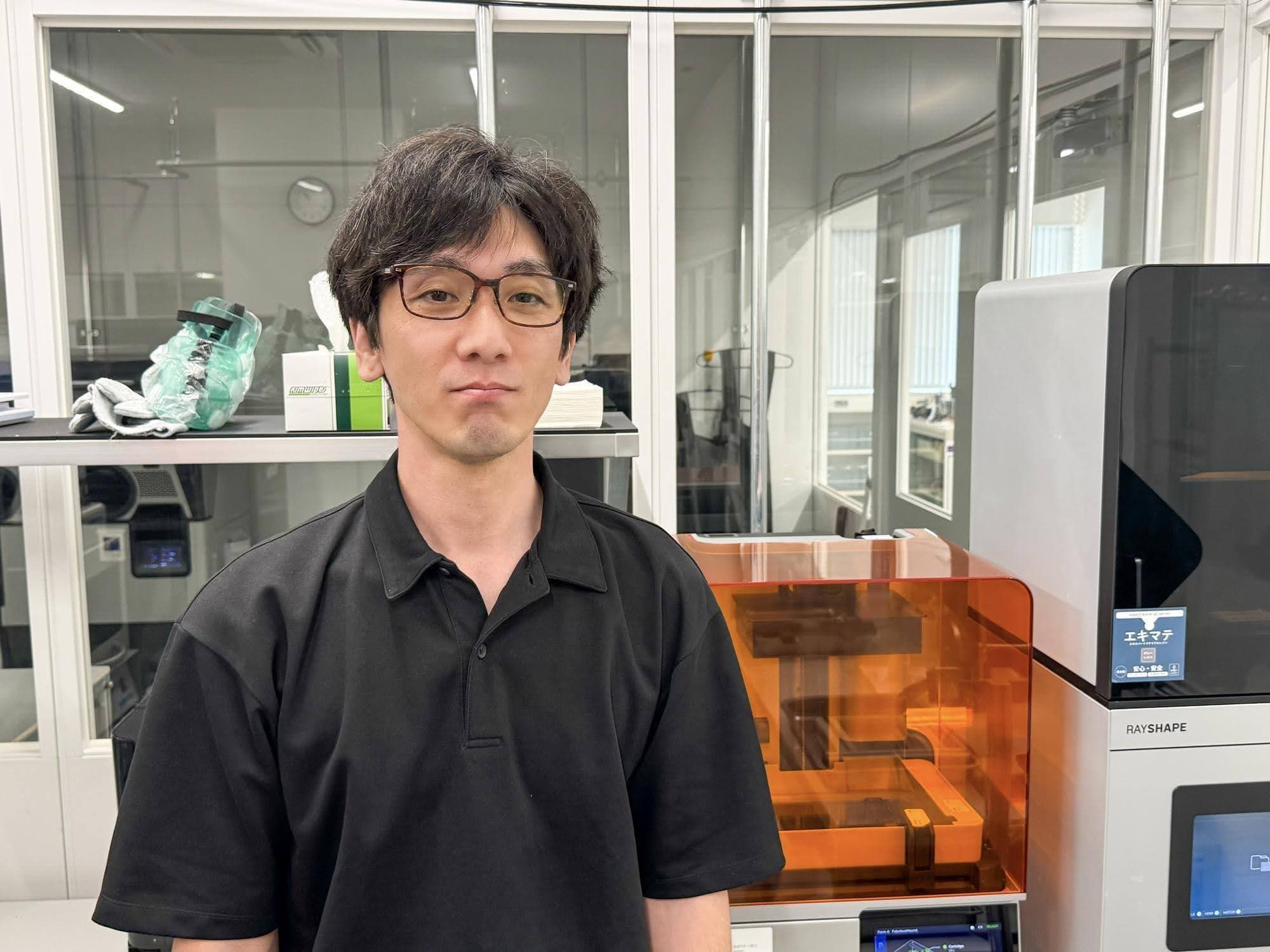
Form 4 enables Shoji to create intricate, biocompatible parts that are impossible to machine or mold. The SMP helps researchers analyze the extremely sensitive (and previously hidden) mechanisms by which wind instruments produce sound.
Yamaha Corporation’s Advanced Technology Development Department’s Music Interaction Group conducts experiments and analyses on woodwind instruments like saxophones and clarinets to identify, quantify, and improve the mechanisms of musical performance — a difficult task in an artistic pursuit where many of the intricacies of performance are difficult to verify visually.
In saxophone performance, the mouthpiece plays a crucial role. The shape of the mouth and the use of muscles around the mouth on the mouthpiece is called an embouchure, which changes the tone and pitch. Shoji was seeking a tool to measure physical metrics during performance, such as how the player blows air and how much pressure is applied to the reed (the thin plate attached to the mouthpiece that vibrates to produce sound).
"In automotive development, you measure exactly how a person is driving. However, in the world of instruments, while sound can be analyzed, it has been difficult to delve into the player's performance movements,” says Shoji.
Even when asked, players often provide only subjective, sensory answers: “I'm blowing hard,” or “I'm loosening my lips.” If these could be verified with data, the scope for analysis and comparison would widen significantly. This realization led to the subsequent development of the SMP.
Capturing Performance as Numerical Data
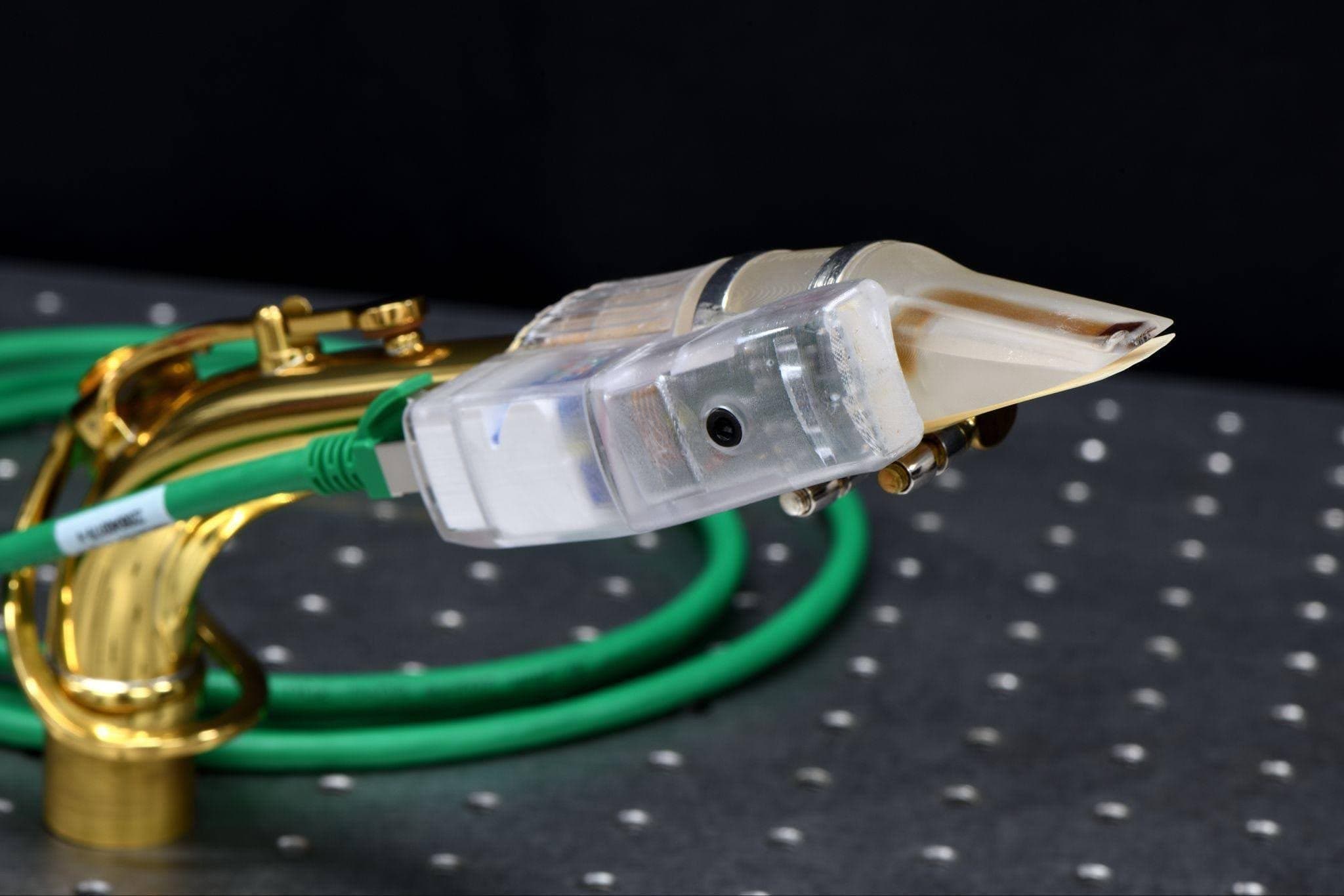
Yamaha Corporation’s SMARTMOUTHPIECEⓇ (SMP) attached to a saxophone neck. It contains a built-in sensor on the side and sends measurement data via an Ethernet cable. The elongated, curved tunnel connecting the oral cavity to the sensors is a shape that cannot be achieved by molding or machining.
To quantify that sensory feedback, Shoji needed to design a device that could integrate seamlessly into the saxophone without any effect on the sound or feel of the instrument. “The key to what we are building is adding sensors without impairing the original function of the mouthpiece,” says Shoji.
Before the SMP, which doubles as a measuring instrument and instrument component, existed, the only option was to insert a tube with a pressure sensor attached to the side of the player's mouth, which interfered too much with performance to allow for accurate measurement.
The SMP simultaneously measures four key mechanisms:
-
Intraoral pressure
-
Reed displacement (or how much the player is biting the reed)
-
Sound inside the mouthpiece
-
Sound radiated externally
These four metrics, recorded as numerical data, provide a complete analytical picture of the performance, giving the player a tangible profile to improve upon and tweak.
Why 3D Printing for the SMP?
The SMP has several features that make it difficult to machine or mold. The core functionality of the device relies on an elongated hole that measures intraoral pressure. This tunnel, which connects the inside of the mouth to the sensors, has an elliptical cross-section of a few millimeters and curves internally.
“It is not just a simple, long, narrow hole; it curves complexly on the inside. This is fundamentally impossible to achieve with molding.”
If one were to attempt to achieve similar functionality with a mold, the structure would need to be divided and glued together, which is impractical. Machining would likewise necessitate dividing and gluing.
Shoji began to 3D print the pressure sensor using fused deposition modeling (FDM) technology, but found that surface roughness became an issue. When playing the saxophone, the player places their front teeth directly on the mouthpiece, and feedback indicated that the rough surface caused discomfort, making natural performance impossible.
Upon trying an inkjet 3D printer with better surface resolution, another problem arose. The material, though smoother than FDM filament, gave off a bitter taste and was not approved for safe intraoral use. Yet another technology — a digital light processing (DLP) printer — used a biocompatible material, but could not deliver on print speed or larger build volumes. And so the search continued.
"While looking for a solution to the constraints of print speed and build size, I arrived at the Form 4, which has a reasonable price and supports Open Material Mode."
Form 4 delivered on several fronts: it was fast, offered easy material management (even for third-party materials), and had a large enough build volume. Shoji brought Form 4 in-house in February 2025 and immediately began iteration on the SMP ."Since we operate tanks exclusively for each material, I can change materials in three minutes. This is a major advantage of the Form 4," says Shoji.
Materials Matter: Selecting "Expert Material" and Clear Resin V5
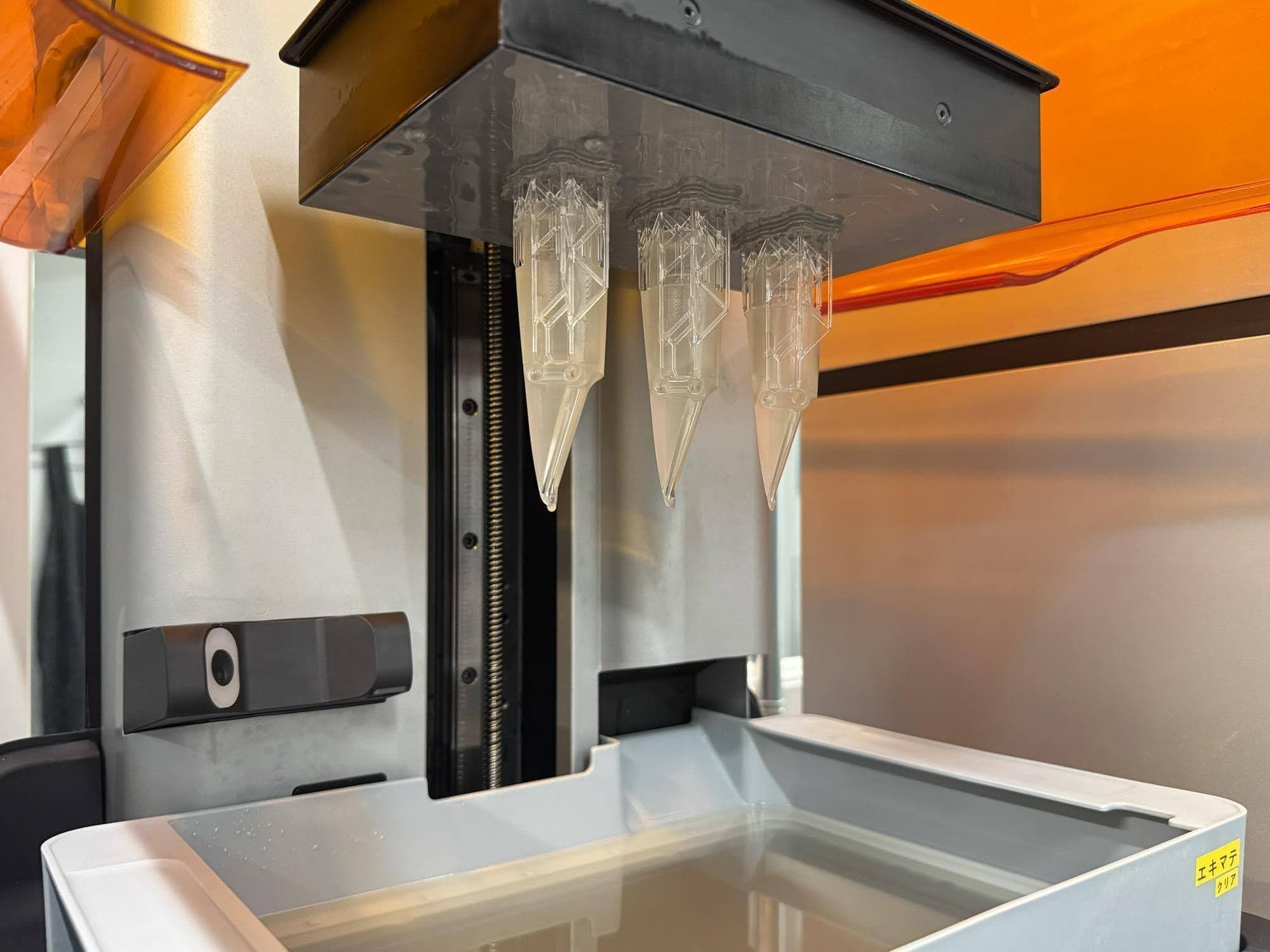
Form 4 enabled faster iterative speed and easy material management, even for third party materials like the biocompatible Expert Material resin.
For an end-use introral device, biocompatibility and extensive safety testing are essential. Shoji tested several different resins and settled on Expert Material, a food-safe resin developed by Expert Material Laboratories.
In addition to the odorless, tasteless, biocompatible characteristics of Expert Material resin, its density proved to be a distinct advantage, as it is extremely close to the density of ebonite, the traditional material for wind instrument mouthpieces. "Players told me the blowing sensation is just like a real ebonite mouthpiece. This was accidental, but it was significant that it fit players with strict material requirements," notes Shoji.
For extra durability, the team settled on a configuration combining two materials: Expert Material resin for the part placed in the mouth, and Formlabs' high-strength Clear Resin V5 for the section housing the Ethernet cable connector that records the real-time data.
Formlabs’ Open Material Mode (OMM), a feature that enables the use of third-party resins, made this unique configuration possible. "The strength of the original Clear V5 and the food-safety compliance of Expert Material. This combination led to the current SMP with the Ethernet connection port," explains Shoji.
OMM makes it possible for the development team to interchange materials seamlessly; they use Expert Material Clear resin for demonstration models that show the inner structure of the mouthpiece, Expert Material Grey resin for durable mouthpieces used by players, Clear Resin V5 for the Ethernet housing, Silicone 40A Resin for vibration-dampening components, and Tough 1500 Resin for strong jig components used during assembly.
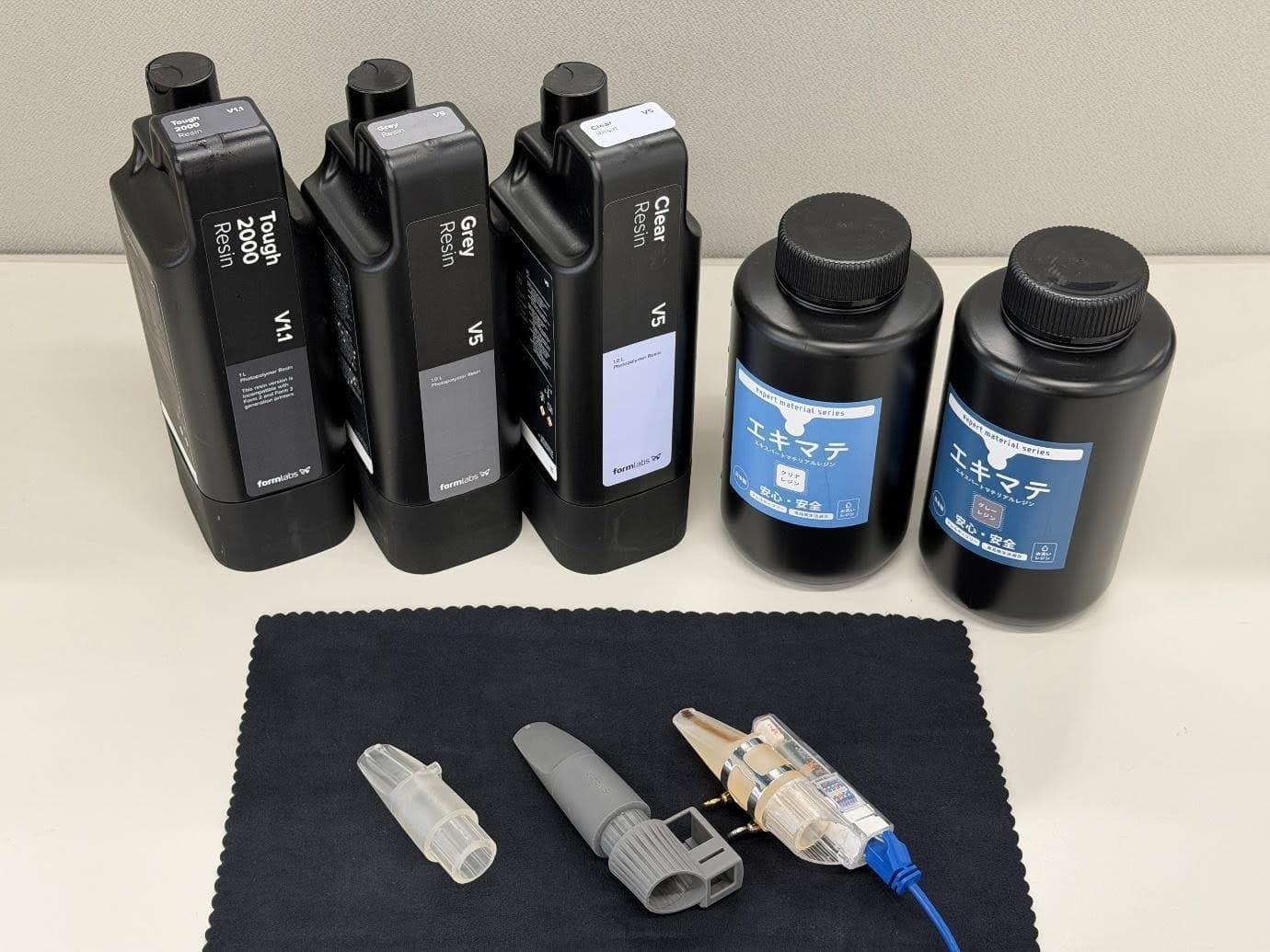
Formlabs’ Open Material Mode (OMM) makes it possible to create a device with multiple third party materials, such as Expert Material resin, food-safe resin (right) as well as Formlabs proprietary resins (left).
Expert Material Laboratories materials have created new possibilities for data-driven development in such a subjective, artistic field. “If Expert Material is helping, even a little, in the effort to study what used to be sensory in a quantitative way, I am happy as a developer. With the addition of the Form 4's high speed and reproducibility, the research cycle itself should be significantly accelerated. I feel that by combining materials, equipment, design, and a research environment, these kinds of efforts are becoming more realistic," says Expert Material Laboratories representative Mr. Noda.
Increasing Iterative Speed: Five Validation Cycles a Day
To ensure the SMP would stay securely attached during a performance, Shoji’s team needed to iterate extensively on the snap-fit closure of the connector piece — they adjusted the fit by sub-millimeter increments in order to reach the final design. Using Clear Resin V5 and Form 4, they printed multiple times a day as their deadline approached.
"The deadline for evaluation by professional players was approaching. Being able to repeat prototypes in a short period and refine the shape and size was extremely significant," Shoji notes.
The print time for the target part was just under two hours, allowing for up to five cycles per day. According to Shoji, at least five prototypes are necessary to refine a shape as intended.
"If I set it up before going home, it's done by the next morning. I run the long print jobs overnight and use the daytime to get in as many tests as possible with shorter print jobs. I make a conscious effort to run up to five cycles a day like this," Shoji explains.
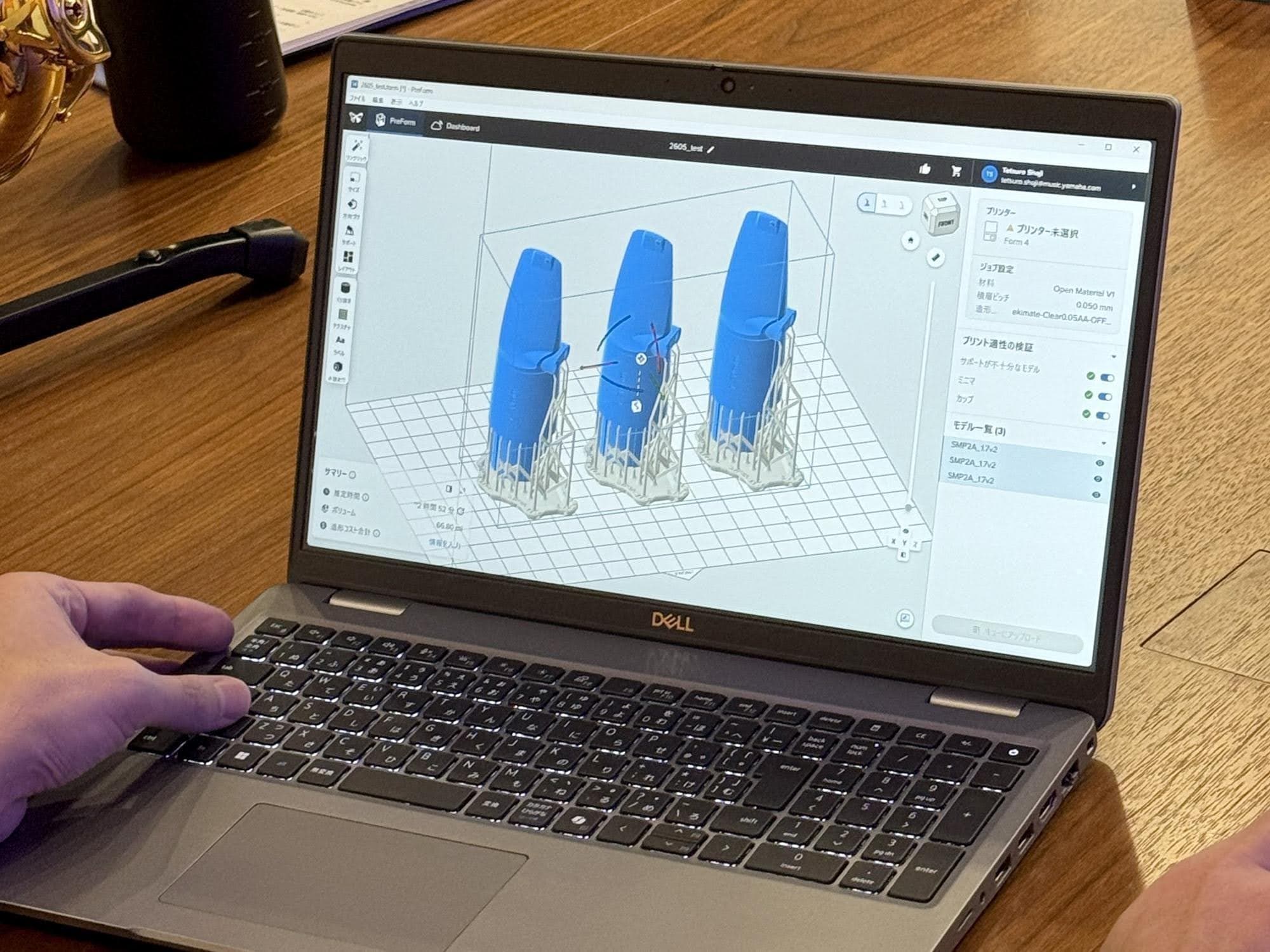
Form 4’s reliability and productivity have led to such a high utilization rate at the company that stopping even for a few moments to take photos of the printer led to inquiries of “how long will it be stopped?”
Expanding Research Possibilities Through Visualization
With the SMP, intraoral pressure in Pa (Pascals) and reed displacement based on infrared reflection intensity can now be visualized in real-time. Performance movements that could previously only be described through subjective anecdotal information can now be captured with waveforms and numerical data.
"We can now see on a graph how much the player is biting and how much the blowing pressure is," says Shoji. Professional players and educators alike see the potential. For teaching new wind-instrument players, educators now have tangible ways to demonstrate the key concepts of ‘biting’ and ‘breath strength.’ For professional players, waveforms and charting are a new way for them to hone their technique.
"Sometimes I notice professional players who are participating in the research study will continue to play on their own for an hour longer. Visualization can also become a tool for players to explore their own performance," Shoji says.
Research Success Opens Doors for Further Applications
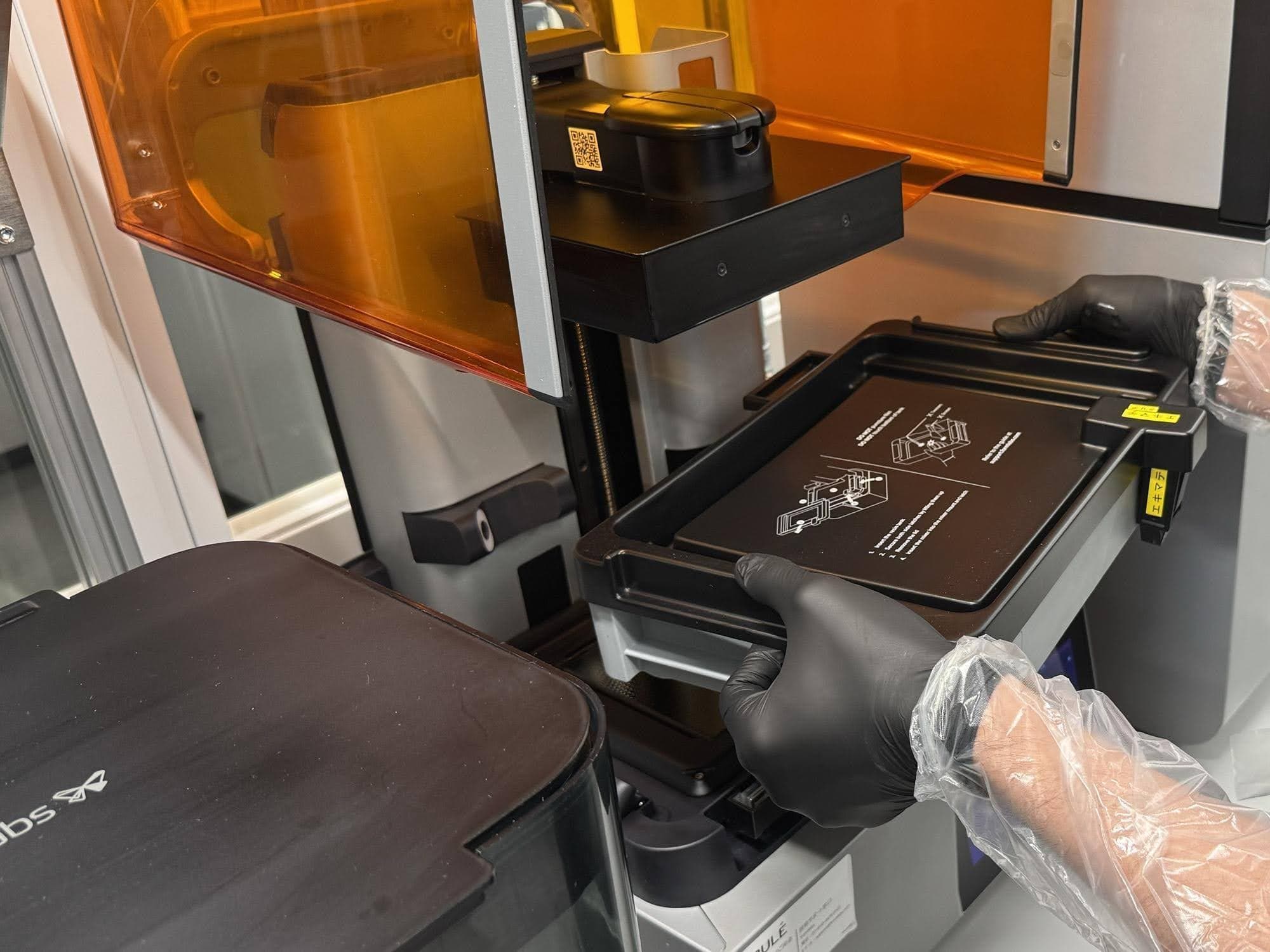
Form 4’s print speed and material management process make it easy for users like Shoji to increase their overall iterative speed and cycle through developments multiple times a day.
The accelerated development of the SMP has created opportunities for new applications, both in music and medicine. New instrument components (including those downstream from the mouthpiece) can be developed using tangible data-driven feedback. For medical conditions related to focal dystonia (a condition that occurs in performers, where specific hand or mouth movements cannot be performed as intended), the team’s research can have a massive impact on treatment and understanding.
Shoji says, "Without a 3D printer, it is highly likely that this research itself would not have been started." Form 4 not only made the development of the SMP possible, it’s also helping open doors for entirely new applications. The team will start to expand to custom mouthpieces for professionals and new designs for other wind instruments soon.
The high utilization rate of Form 4 encouraged the team to bring Form 4L in-house as well, and the large-format machine is currently being used for product examination and jig production in multiple departments.
"We are introducing a new Form 4L to create a two-unit system, and we will roll it out as a model shop that can be used by all of Yamaha, including the Production Technology Department and business divisions," says Shoji.
Though wind instruments have been around for centuries, new developments and understanding are becoming possible with the introduction of cutting-edge technology and the application of data-driven systems.
To see the technology of Form 4, Form 4L, and Open Material Mode for yourself, visit our page to learn more.