
WHITE PAPER
Formlabs Logo

Setting up a compressed air supply for the Fuse Blast

Setting up a compressed air supply for the Fuse Blast

The Fuse Blast is an industrial-grade pneumatic device and its airflow requirements sit at the edge of the performance envelope for many portable compressors.

Below is a set of recommended hardware specifications for different classes of compressors and their respective operating pressure envelopes. Choose the best compressor and fittings for your blasting cycle performance needs.

The presets on the Fuse Blast are guidelines to help you identify the settings that will get parts clean. Formlabs encourages you to experiment to achieve desired results within your air supply and workflow constraints.

The Fuse Blast’s Adaptive Airflow feature pauses and holds the blasting cycle when the Fuse Blast detects low airflow, allowing compatible but not optimal compressors to recharge without interrupting the cycle. The guidance below applies to compressor operation without relying on Adaptive Airflow. There is no impact on cleaning quality when using Adaptive Airflow, only an extended cycle time.

To better understand the settings and how to change them, see the support article Selecting and configuring a blasting cycle (Fuse Blast).

Note:

  • The maximum air supply pressure for the Fuse Blast is 120 psi (8.3 bar). Compressed air sources that supply a pressure of greater than 120 psi (8.3 bar) need to be regulated down before connecting to the Fuse Blast.
  • The Fuse Blast can blast printed parts at a range of pressures. Keep the distinction between air supply and blasting pressure in mind as you read through the recommendations below.
  • Note that the recommended minimum air capacity and the standard preset are designed for effective part cleaning, not to sustain operation across all pressure and time ranges or all presets. If you want to operate the machine at higher or lower pressures for long cycles, your air supply requirements may be different.
Choosing a compressor

Choose an air compressor that can support the minimum pressure and airflow recommended for the Fuse Blast. Scroll compressors tend to have a longer lifetime and run more quietly than other compressor types.

Formlabs recommended air compressor (North America)

Formlabs recommends the Eastwood Elite QST 30/60 air compressor for use with the Fuse Blast in North America. The supplied free air delivery rate is 12.7 SCFM at 90 psi and requires a pressure regulator to lower the output pressure below 120 psi. This option is for users who do not have an existing air compressor or who wish to run their Fuse Blast with a dedicated air compressor separate from their existing setup.

ITEMSUPPLIERNOTES
Eastwood Elite QST 30/60EastwoodAir compressor compatible for use with the Fuse Blast. Requires 220–240 V outlet.
Pressure regulator for Eastwood air compressor

Parker 06R-series regulator w/ 3/8" NPT ports or equivalent, minimum rating 60 SCFM at 120 psi

Supplier: McMaster-Carr

Regulates the compressor output to < 120 psi.
Fittings for Eastwood air compressor
  1. 3/8” NPT female to ¼” industrial quick disconnect hose socket for air (1x)
  2. ½” male to ⅜” female NPT reducer (1x)
  3. EPDM air hose, ⅜ NPT male (1x)

Supplier: McMaster-Carr

For connecting the recommended air compressor to the Fuse Blast.

This configuration allows for blasting at up to 60 psi with the supplied 3 mm blast orifice.

A compressed air filter is only required if your air compressor is not pre-equipped with a filter. Additional hoses are required if using a filter or regulator.

User-supplied compressors

The following information is for users who are not in North America or who would like to connect an existing compressor to a Fuse Blast.

To match the capabilities of the recommended Eastwood compressor, a user-supplied compressor must comply with the following requirements:

  • Free air delivery rate of 12.7 SCFM (360 SLPM) at 90 psi (6.2 bar)
  • 4 hp (3 kW) motor
  • 30 gal (114 L) tank

A compressor with these specifications can support blasting up to 60 psi (4.1 bar) with Adaptive Airflow enabled.

When buying a compressor, it is not always clear if the advertised air flow rates indicate the intake capacity or the output delivery. It may also be difficult to determine whether or not the advertised flow meets standard conditions. When in doubt, check the power rating of the compressor to determine if it is sized appropriately.

The following table indicates the minimum steady-state compressor free air delivery (FAD) and power required to support various blast pressure settings without pausing and recharging with Adaptive Airflow.

Note:

The guidance around compressor power ratings applies to single motor compressors. A 4 hp compressor consisting of two 2 hp compressor motors will not sustain the same airflow as the guidance below specifies.

Blast PressureCompressor free air delivery (FAD)Compressor power***
20 psi (1.4 bar)5.9 SCFM (167 SLPM)2 HP (1.5 kW)
30 psi (2.1 bar)*7.6 SCFM (215 SLPM)4 HP (3.0 kW)
40 psi (2.8 bar)9.0 SCFM (254 SLPM)4 HP (3.0 kW)
50 psi (3.4 bar)11.0 SCFM (311 SLPM)5 HP (3.7 kW)
60 psi (4.1 bar)**12.8 SCFM (362 SLPM)5 HP (3.7 kW)

* Recommended cleaning pressure

** Recommended polishing pressure

The values in this table are based on a Fuse Blast fitted with a 3 mm blast orifice . Fuse Blast now ships with a 3 mm blast orifice installed, but earlier units shipped with a 4 mm blast orifice. Formlabs recommends using the 3 mm orifice by default and has not seen any performance impacts from using the smaller orifice. See the support article Replacing the Fuse Blast blast orifice for details on swapping out the blast orifice.

The Fuse Blast has three different functions which require compressed air:

  • media blasting
  • chamber rinse
  • part rinse

Formlabs recommends a 50–60 psi setpoint for chamber rinse and 40 psi for part rinse. At these setpoints, more air may be required for rinsing than blasting, but for only a short period of time. For this reason, any portable air compressor used with Fuse Blast should have a tank with a volume of at least 30 gal (114 L) to support short bursts of increased airflow.

Note:

The Adaptive Airflow feature allows the machine to run on underpowered air supplies without interrupting a cleaning cycle. If the air compressor’s tank runs out during a cycle, Fuse Blast pauses the blasting cycle and waits for the compressor to recharge before continuing the cycle.

If the cycle is constantly pausing, see the support article Diagnosing low input pressure on the Fuse Blast for more details.

Supply pressure equal or less than 120 psi

If your compressor’s supply pressure shut off switch triggers at less than 120 psi, you do not need an additional regulator between the tank output and the Fuse Blast. Formlabs recommends using a pressure regulator rated to at least 60 SCFM at 100 psi to ensure adequate airflow, and setting the regulator to 90 psi. See the support article Diagnosing low input pressure on the Fuse Blast for more details.

Formlabs recommends plumbing the output of the tank pressure switch to the Fuse Blast directly using a ⅜” ID hose with a ¼” industrial quick-disconnect chuck.

Below are recommendations for an air hose and hose coupling available in North America.

Fuse Blast plumbing connection
ITEMSUPPLIERNOTES
Air hose, 3/8" NPT male to 3/8" NPT male, 15 ftMcMaster-CarrAdditional hoses are required if using a filter or regulator.
3/8" NPT Female to 1/4" Industrial Quick-Disconnect hose couplingMcMaster-Carr

If the air tank output is not a female-threaded ⅜” NPT port, install an appropriate adapter to convert to the correct pipe size.

Supply pressure above 120 psi

If your compressor’s supply pressure shut off switch triggers above 120 psi, there is no risk of damaging the Fuse Blast with overpressure, but you will need an additional regulator between the tank output and the Fuse Blast. Otherwise, you may hear a loud popping sound coming from the Fuse Blast when the pressure relief valve opens. Select a regulator that is capable of supplying more than the minimum airflow in order to guarantee adequate flow into the Fuse Blast’s pressure system.

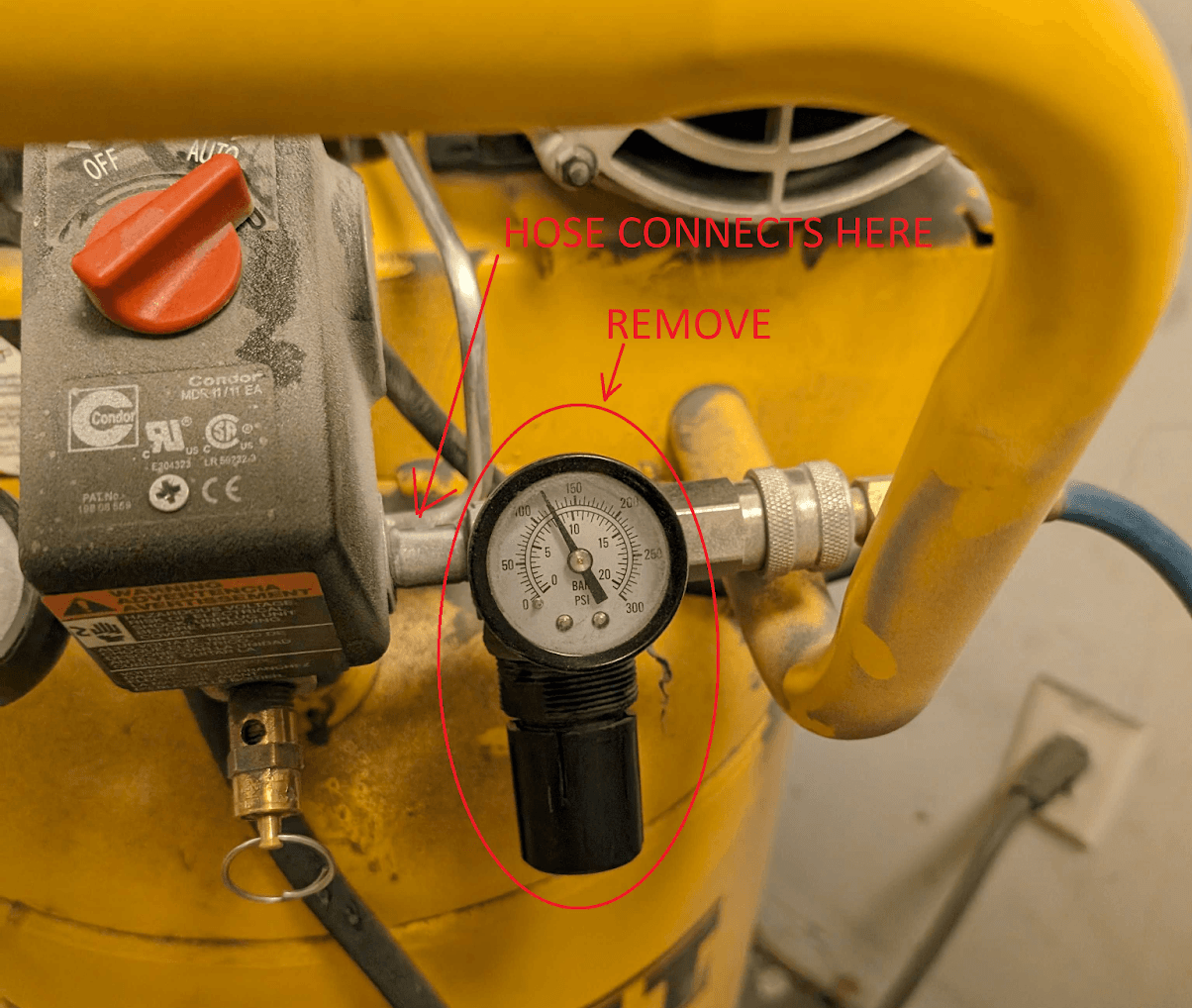
Many of these compressors come with a regulator installed, but it is necessary to check that your regulator is rated to at least 60 SCFM at 100 psi to ensure adequate airflow. If not, replace the regulator with one that has an adequate flow rating.

Below are recommended regulators:

ITEMSUPPLIERNOTE
Parker 06R-series regulator w/ 3/8" NPT ports or equivalent, minimum rating 60 SCFM at 120 psiMcMaster-CarrA pressure regulator is only required if supply is at or over 120 psi.
Air hose, 3/8" NPT male to 3/8" NPT male, 15 ftMcMaster-Carr

Additional hoses are required if using a filter or regulator.

A pressure regulator is only required if supply is at or over 120 psi.

3/8" NPT Female to 1/4" Industrial Quick-Disconnect hose couplingMcMaster-CarrThree air hoses are necessary if you are using an external compressed air filter.

Be sure to install an appropriate adapter to convert the output of the the compressor to ⅜” NPT.

For users who have central compressed air systems and blast above 60 psi

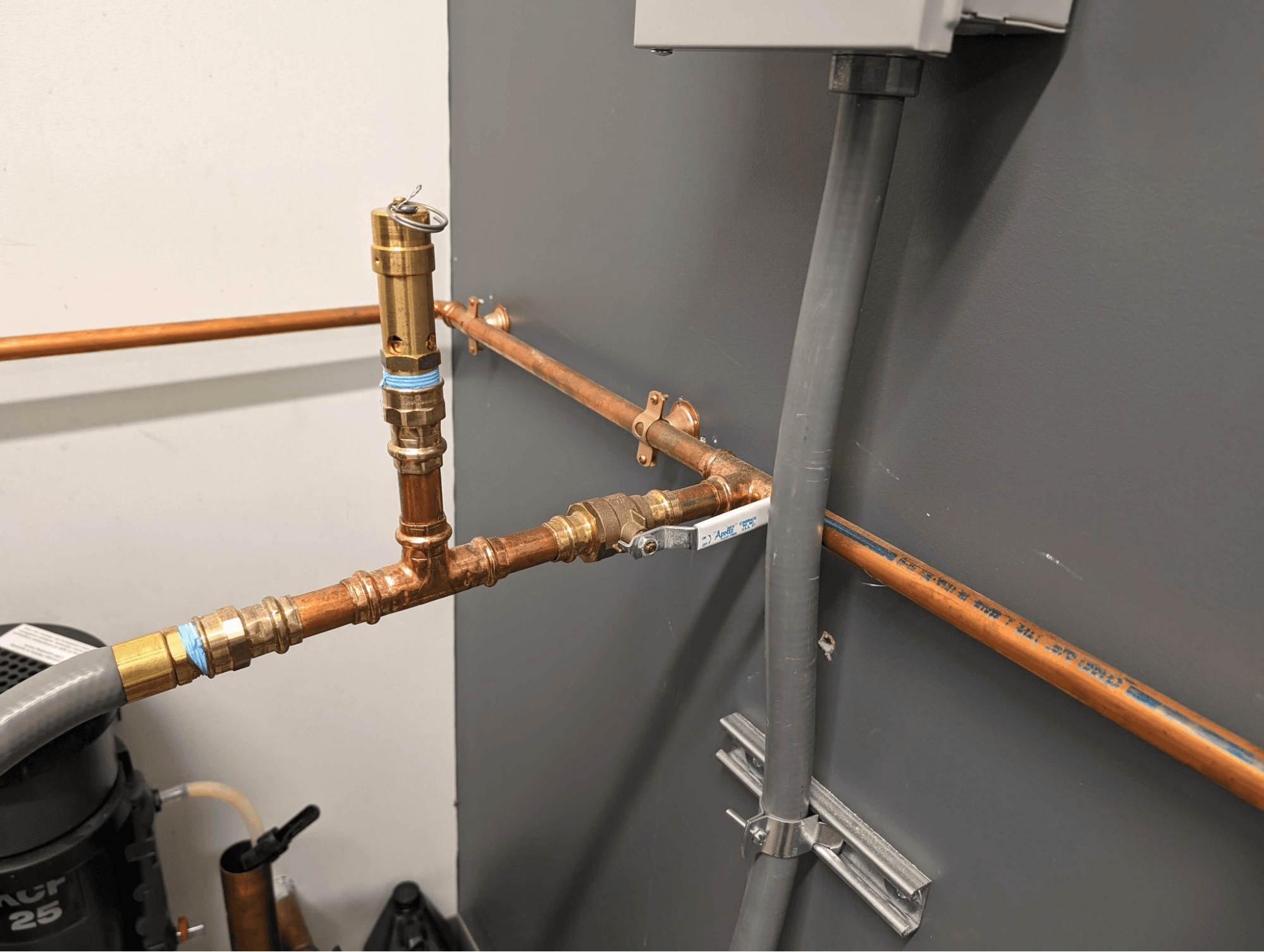
For those with large central compressors wanting to utilize the full pressure range of their Fuse Blast, the airflow requirements increase significantly. Since these compressors are often located in separate rooms from the Fuse Blast, Formlabs recommends running a minimum ¾” ID hard pipe from the compressor to the wall behind the Fuse Blast in order to minimize pressure drop through the line. From there, run a ⅜” hose from a distribution manifold to the Fuse Blast unit. Regulate the supply pressure down to 120 psi at most.

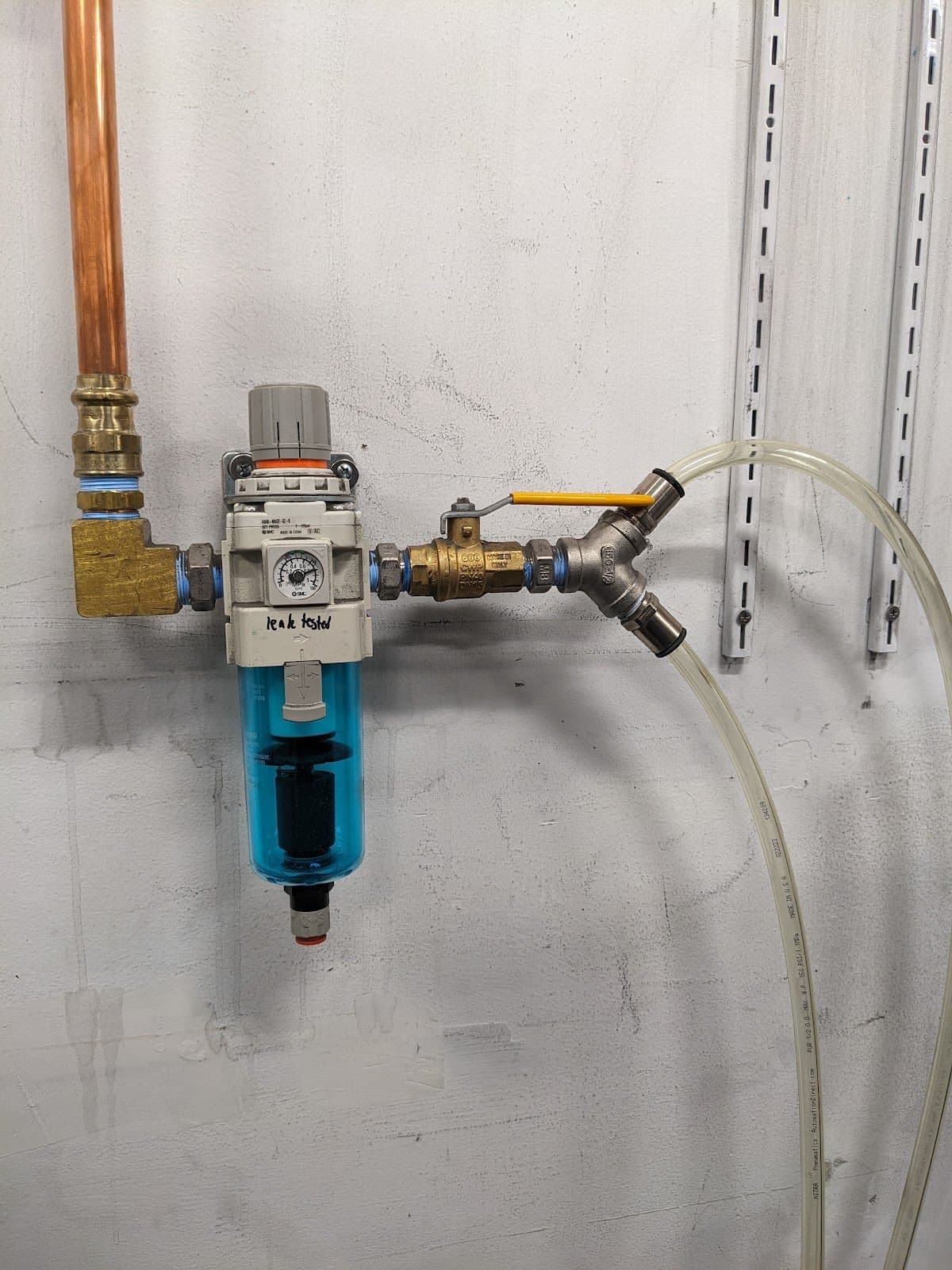
Central air compressor set up.
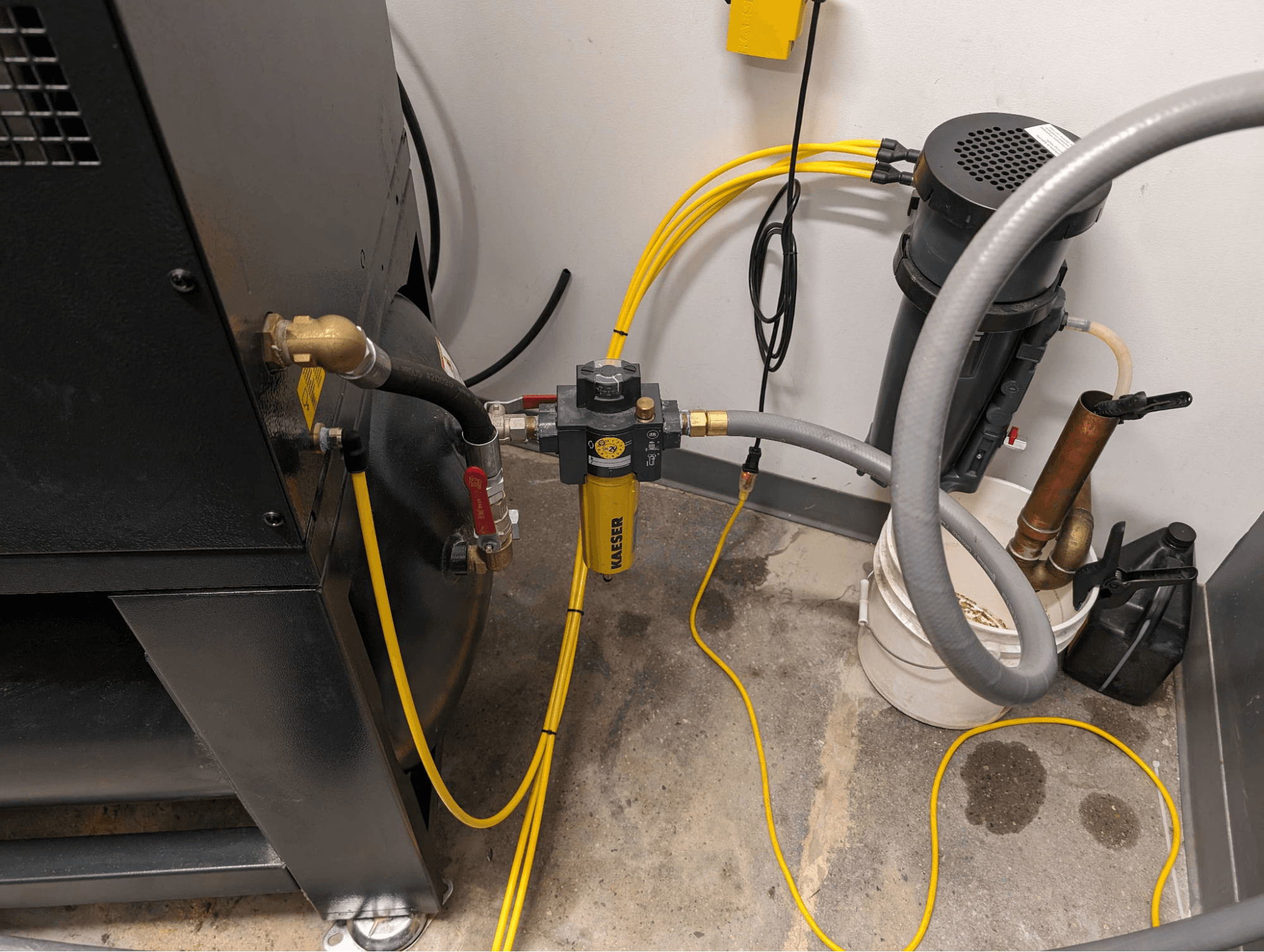
Central air compressor set up
Central air compressor systems require additional hardware to minimize pressure drops.
Run a minimum ¾” ID hard pipe from the compressor to the wall behind the Fuse Blast.
Central air compressor distribution manifold
Central air compressor hose
Minimize pressure drop with a ⅜” hose connected to a distribution manifold.
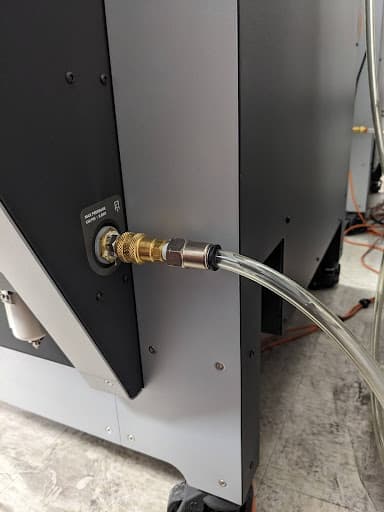
Use a ⅜” inch hose to connect the Fuse Blast to compressed air.

Below is a list of recommended supplies for connecting the Fuse Blast to a central air system:

ITEMSUPPLIER
SMC AR40-series regulator w/ 3/4" NPT ports or equivalent, minimum rating 80 SCFM at 120 psiMcMaster-Carr
Air hose, 3/8" NPT male to 3/8" NPT male, 15 ftMcMaster-Carr
3/8" NPT Female to 1/4" Industrial Quick-Disconnect hose couplingMcMaster-Carr

Selecting a blast orifice

With the standard profile, clean parts can be achieved with a blasting pressure of 30 psi. The Fuse Blast ships with two blast orifice sizes: a 3 mm orifice and a 4 mm orifice. Early Fuse Blast units shipped with the 4 mm blast orifice preinstalled. All subsequent units shipped with the 3 mm blast orifice preinstalled. When using the 4 mm nozzle orifice, a 4 hp compressor is sufficient. The 3 mm nozzle orifice lowers the required air consumption.

USA3 mm nozzle orifice4 mm nozzle orifice
Pressure (psi)Air consumption (SFCM)Compressor powerAir consumption (SFCM)Compressor power
205.92 hp8.74 hp
30*7.64 hp11.34 hp
409.04 hp14.05 hp
5011.05 hp16.55 hp
60**12.85 hp19.15 hp

* Recommended cleaning pressure

** Recommended polishing pressure

Metric3 mm nozzle orifice4 mm nozzle orifice
Pressure (Bar)Air consumption (SLPM)Compressor power (kW)Air consumption (SLPM)Compressor power (kW)
0.68113At least 1,5 kW172At least 1,5 kW
1.37167At least 1,5 kW2463 kW
2.06*2153 kW3193.0-3.7 kW
2.752543 kW3963.7 kW
3.443113.7 kW4673.7 kW
4.13**3623.7 kW5403.7 kW

* Recommended cleaning pressure

** Recommended polishing pressure

Additional considerations

Compressed air fed into a Fuse Blast must be filtered to remove moisture. If your air compressor is pre-equipped with a filter, you do not need an additional external filter.

Fittings: A compressor alone may be rated to deliver enough air, but other factors can limit the air flow:

Hose/pipe length:

  • Long hoses/pipes cause pressures to drop due to internal friction.
  • Keep the piped distance between the compressor and device as short as possible. For a portable compressor, Formlabs recommends a maximum of 15 ft (4.6 m).

Hose/pipe diameter:

  • Use the largest diameter that is feasible to minimize flow restriction. Formlabs recommends a minimum inner diameter of ⅜” (9.5 mm).
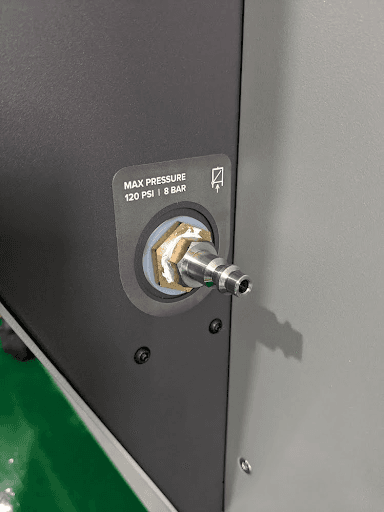
  • The Fuse Blast comes with a ¼” industrial quick disconnect coupling preinstalled, which is compatible with most air systems in North America.
Fuse Blast industrial quick disconnect coupling
  • This may be replaced with a region-specific fitting with a ⅜” BSPP external thread. Ensure that any user-supplied fitting has the largest inner diameter possible. Anything that changes the shape or direction of the flow causes the pressure to drop. The smoother the transition, the less the pressure drops.
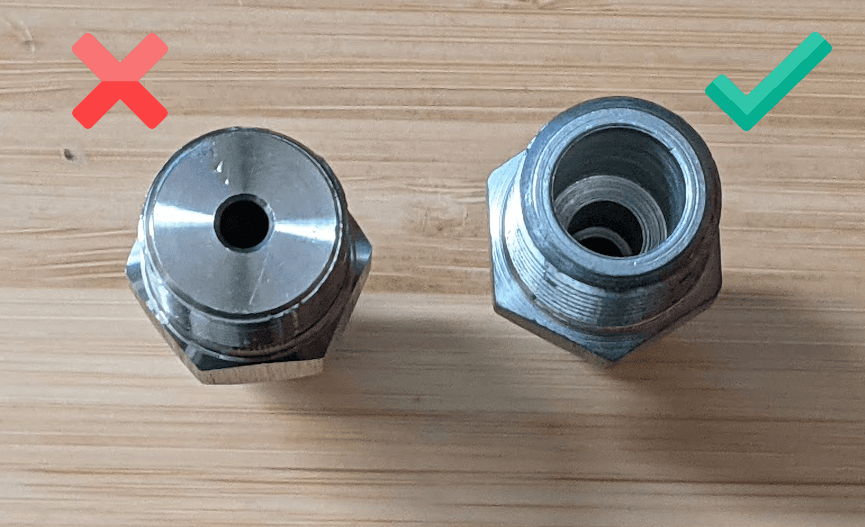
Fittings for the air compressor