Determine during which blasting cycle stage the issue occurs
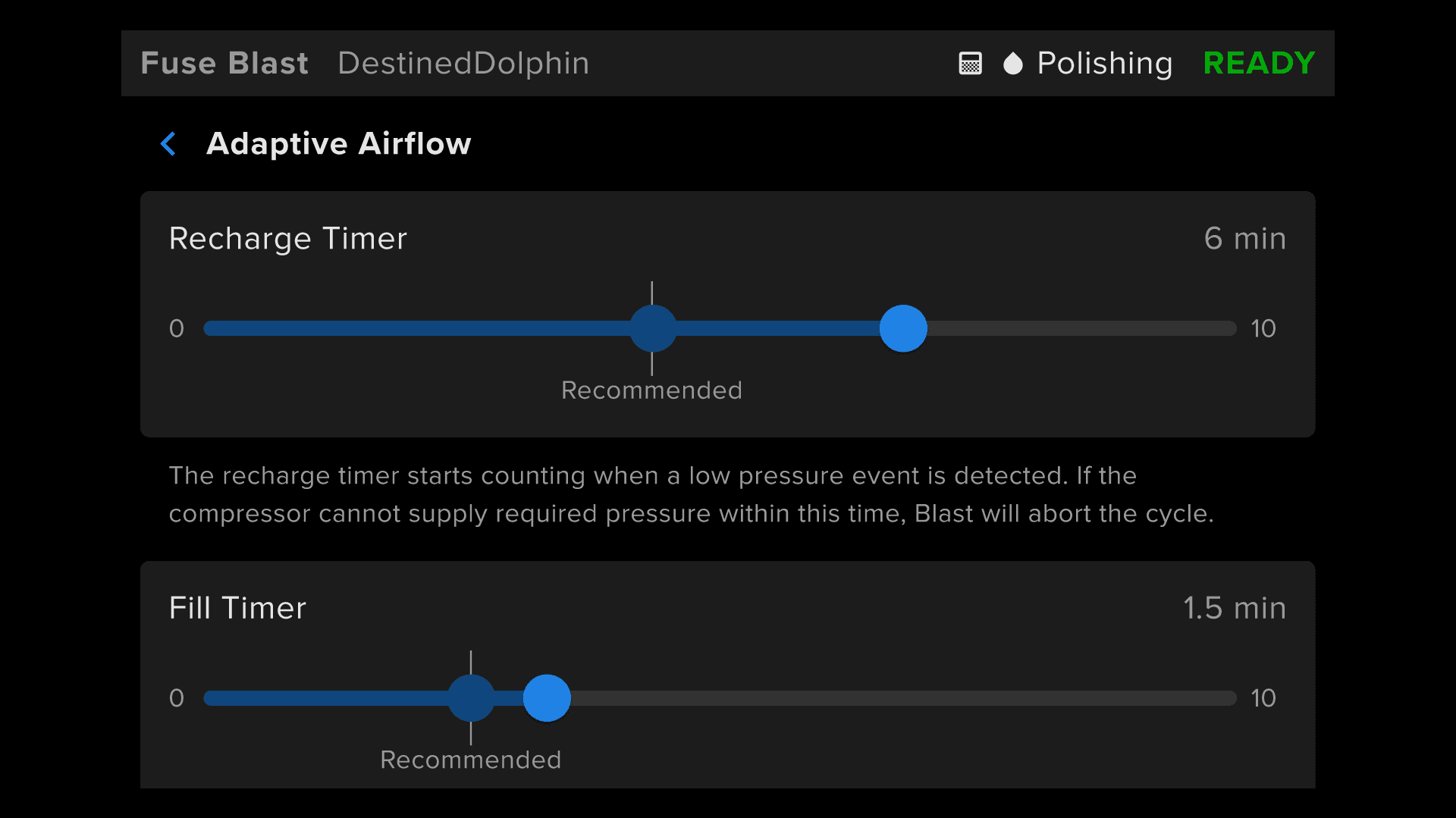
A normal blasting cycle has three stages: blasting, chamber rinse, and part rinse, in that order. Using the standard blasting preset settings, part rinse demands the most air, as at least 13.4 SCFM (379.4 SLPM) must be supplied for at least three minutes.
- Using the manual Fuse Blast pedals, run the blast gun at the desired pressure and time settings (30 psi for 10 minutes is recommended for a standard blast cycle). Note any drop in pressure readings at the compressor or error messages on the Fuse Blast.
- Using the manual Fuse Blast pedals, run the part rinse at the desired pressure and time settings (40 psi for 3 minutes is recommended for a standard blast cycle). Note any drop in pressure readings at the compressor or error messages on the Fuse Blast.
- If the Fuse Blast did not display an error message during the previous steps, run a rinse-only cycle and note any drop in pressure readings at the compressor or error messages on the Fuse Blast during the chamber rinse cycle. The chamber rinse can be identified by the movement of the thin air whip tubes around the periphery of the blasting chamber.
Determine the maximum pressure that can be sustained by your compressed air supply
- Once you have determined when the low pressure issue occurs, gradually decrease the pressure setting for each cycle until the compressed air supply can meet the demand for the time required. Note that as air pressure is decreased, the cycle time may need to be increased to achieve equivalent part finish.
- If the error occurs during the blast stage, consider installing the provided 3 mm blast orifice to achieve greater pressure values with less air consumption.
- Once you have found a set of effective blast cycle settings, save them as a Custom preset.
- Using the Custom cycle preset, run an automatic blast cycle and adjust further as needed.
Evaluate the compressed air supply
- Ensure your air compressor meets the requirements for the settings being used. If the air compressor does not meet the minimum requirements, follow the instructions above to minimize air consumption or source a more powerful compressor. Formlabs’ recommendations can be found here.
- If your compressor meets the minimum requirements for your blast cycle settings, there may be loss introduced between the compressor and the Fuse Blast:
- Check the length of the tubing. An excessively long supply tube will introduce pressure loss. For the most efficient use of your compressor, keep the supply tubing between the Fuse Blast and the air compressor as short as possible.
- Check the inner diameter of the tubing. Narrow tubing may not be able to supply enough air to the Fuse Blast. Formlabs recommends using tubing with at least a ⅜” (10 mm) internal diameter.
- Check the fittings in the air supply. Any fittings, such as elbows, tees, valves, and adaptors, will introduce pressure loss. Remove unnecessary fittings to reduce that pressure loss.
- Check any other tools drawing from your air supply. Any other tools using compressed air will draw down from your air compressor when used at the same time as your Fuse Blast.
Replace the blast orifice
The Fuse Blast ships with two blast orifice sizes: a 3 mm orifice and a 4 mm orifice. Early Fuse Blast units shipped with the 4 mm blast orifice preinstalled. All subsequent units shipped with the 3 mm blast orifice preinstalled. Formlabs recommends replacing the 4 mm blast orifice and installing the 3 mm blast orifice if you have an air compressor that does not supply enough pressure to adequately clean parts. Measure the inner diameter of the spare blast orifice that came with your Fuse Blast to determine which is currently installed.
Check for leaks
If your compressed air supply is sufficient, there may be leaks in your supply tubing or inside the Fuse Blast unit.
- Run a blast cycle and listen for any air escaping. If there are leaks in your air supply tubing, resolve these and retest the system.
- If there are no leaks in the air supply tubing or if leaking air can be heard from inside the Fuse Blast, there may be a leak in your internal pneumatic tubing. Contact Formlabs Support for assistance inspect the internal tubing of your Fuse Blast unit.