Notice:
To avoid damage to equipment, check the resin tank compatibility table in Choosing the right material to confirm you are using a resin tank that is compatible with this material.

Notice:
To avoid damage to equipment, check the resin tank compatibility table in Choosing the right material to confirm you are using a resin tank that is compatible with this material.
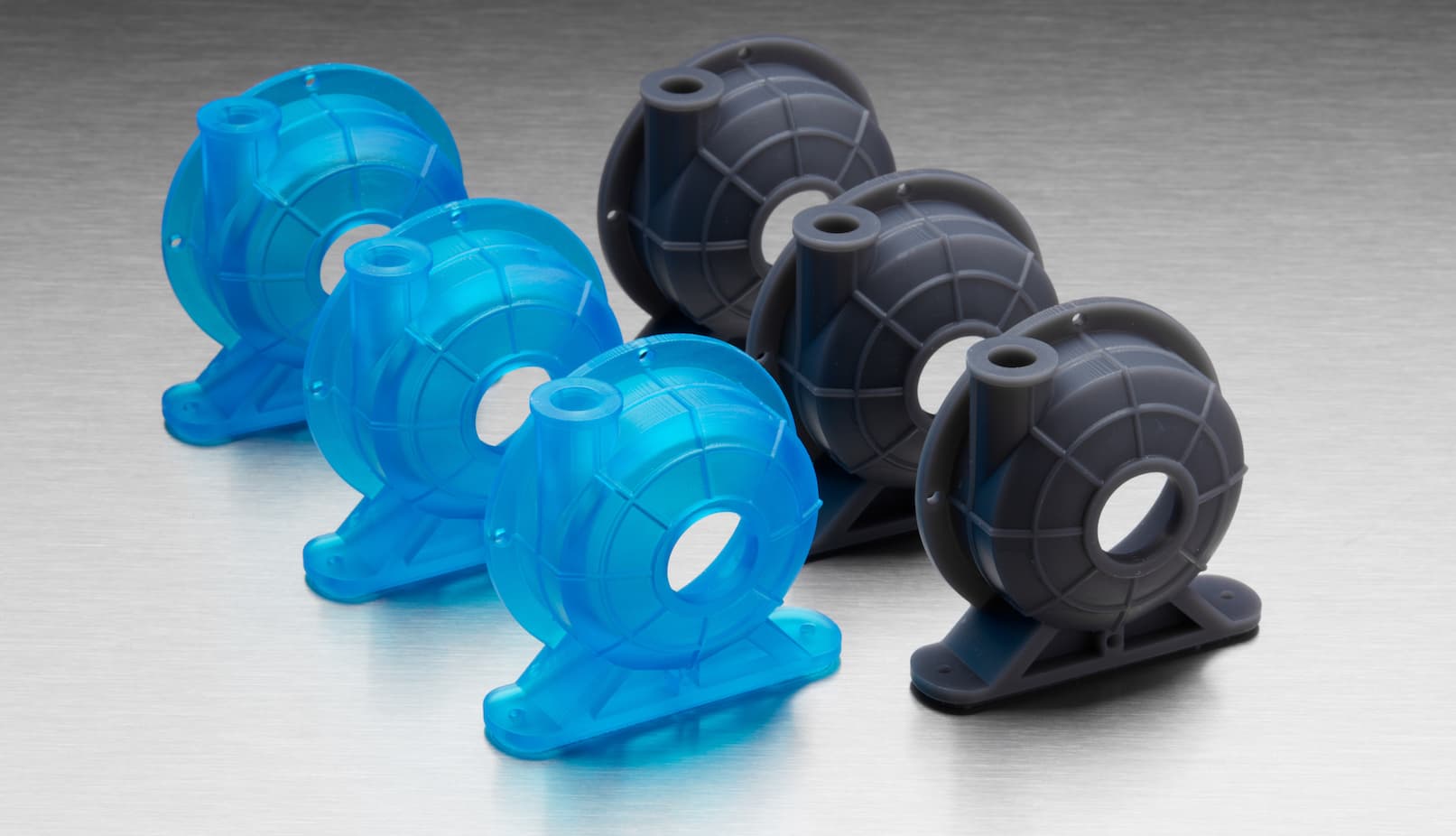
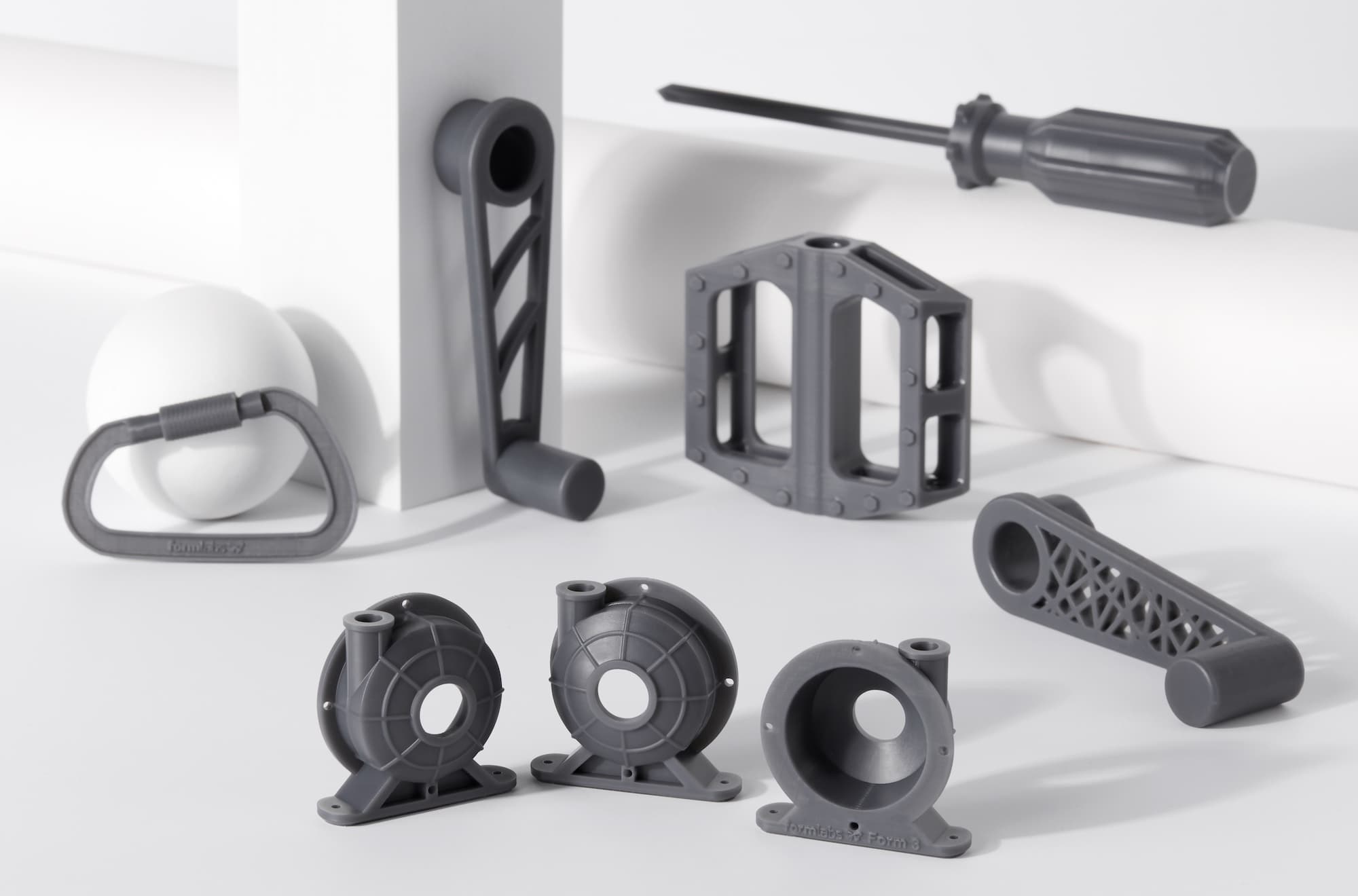
Tough 2000 Resin simulates both the feel and important mechanical properties of Acrylonitrile Butadiene Styrene (ABS) plastic. ABS is a very common thermoplastic that provides a good balance of strength and flexibility. Tough 2000 Resin creates strong engineering prototypes and has been developed to withstand high stress and strain. For further finishing, Tough 2000 Resin can also be machined once printed.
Tough 2000 Resin also has a higher Heat Deflection Temperature (HDT) than other materials in the family of Tough Resin and Durable Resin, such as Tough 1500 Resin and Durable Resin.
Tough 2000 Resin prints at 50 microns and 100 microns.
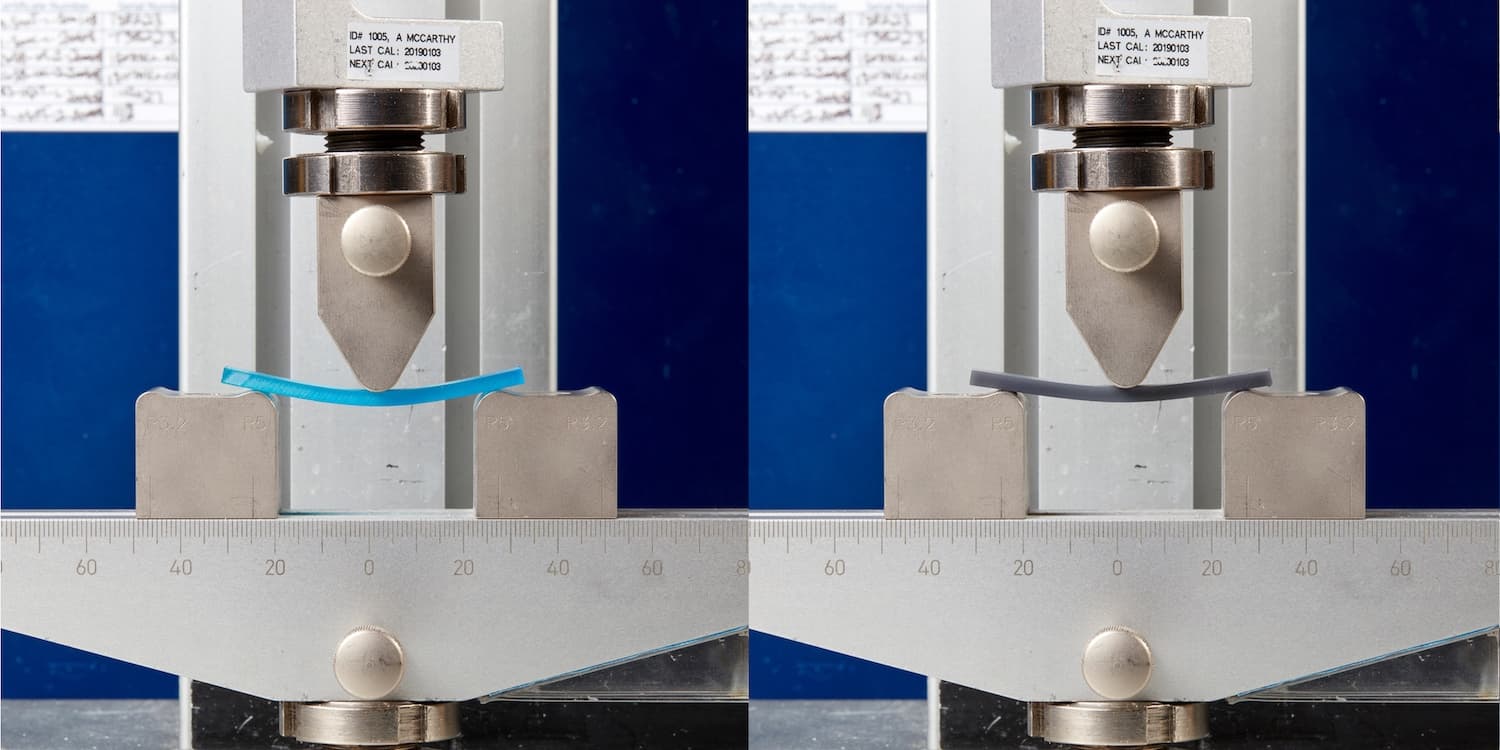
Toughness refers to a material’s ability to absorb energy before fracturing. When a tough material yields, it undergoes deformation rather than simply shattering. In other words, tough materials have a little more “give” than brittle ones.
Toughness is also defined as the area under a stress-strain curve. Tough materials generally have a good balance of "strength" (the amount of stress a material can withstand) and "ductility" (the elongation or percentage strain). Because of this, the area under a tough material's stress-strain curve is much larger than that of a very strong and stiff material with low elongation. Tough 2000 Resin has lower stiffness and withstands more elongation than standard resins, meaning it can absorb more energy before failure.
Recommended for:
Not recommended for:
Note:
To learn more about the performance or specific material properties of Tough 2000 Resin, please refer to the Safety Data Sheet (SDS) and Technical Data Sheet (TDS). Always consult the SDS as the primary source of information to understand safety and handling of Formlabs materials.
Comparison with other materials
| Durable Resin V2, post-cured (60 °C) | Tough 1500 Resin, post-cured (70 °C) | Tough 2000 Resin, post-cured (80 °C) | |
|---|---|---|---|
| Ultimate Tensile Strength (MPa) | 31.8 | 33 | 46 |
| Tensile Modulus (GPa) | 1.26 | 1.50 | 2.20 |
| Elongation at Break (%) | 49.0 | 51.0 | 48.0 |
| Flexural Modulus (GPa) | 0.82 | 1.40 | 1.90 |
| Izod Impact Strength (J/m) | 109 | 67 | 40 |
| HDT @ 1.8 MPa (°C) | -- | 45 | 53 |
| HDT @ 0.45 MPa (°C) | 43.3 | 52.0 | 63 |
To learn more about the performance properties of each Formlabs resin, refer to the library of material properties datasheets.
Printing with Tough 2000 Resin
Notice:
To avoid damage to equipment, check the resin tank compatibility table in Choosing the right material to confirm you are using a resin tank that is compatible with this material.
Install or update PreForm, then set up the next print job.
To prepare a model for printing in PreForm:
Print Tough 2000 Resin with supports, and avoid printing directly on the build platform due to the high likelihood that the print will be difficult to remove from the build platform. For very bulky parts, increase the support touchpoint size to prevent print failures.
Parts printed with Tough 2000 Resin may be more difficult to remove from the build platform than parts printed with standard resins. To improve part removal, warm the build platform with heated air.
Finishing
The Form Wash agitates the solvent bath and removes parts from the bath after a set time. Wash parts according to the support article Form Wash time settings. Pay particular attention to information that affects mechanical properties or biocompatibility requirements.
Notice:
Allow parts to fully dry before post-curing. Post-curing parts that are not completely dried may adversely affect mechanical properties.
Post-curing requirements
Tough 2000 Resin requires post-curing to reach its optimal mechanical properties.
Refer to the Form Cure time and temperature settings for post-curing recommendations.