Technical Data Sheet
Nylon 12 Powder
Material Code : FLP12G01 | Datasheet Version : V2 | Revision Date : October 4, 2026 | Category : General Purpose Powder | Safety Datasheet
Material Properties | Thermal Properties | Electrical Properties | Other Properties | Biocompatibility | Workflow | Environmental Stability
| Mechanical Properties | Value | Method 1,2 |
|---|---|---|
| Tensile Properties | ||
| Ultimate Tensile Strength | 50 MPa [7300 psi] | ASTM D638-14 |
| Tensile Modulus | 1900 MPa [270 ksi] | ASTM D638-14 |
| Elongation at Break (X/Y) | 8% | ASTM D638-14 |
| Elongation at Break (Z) | 5% | ASTM D638-14 |
| Flexural Properties | ||
| Flexural Strength | 66 MPa [9600 psi] | ASTM D790-15 |
| Flexural Modulus | 1600 MPa [230 ksi] | ASTM D790-15 |
| Toughness Properties | ||
| Izod Impact Strength (Unnotched) | 150 J/m [2.8 (ft·lb)/in] | ASTM D4812-11 |
| Izod Impact Strength (Notched) | 32 J/m [0.60 (ft·lb)/in] | ASTM D256-10 |
| Surface Roughness | ||
| Rz (X/Y) | 33 μm [1300 μin] | ISO 21920 |
| Rz (Z) | 44 μm [1700 μin] | ISO 21920 |
| Ra (X/Y) | 6.6 μm [260 μin] | ISO 21920 |
| Ra (Z) | 8.6 μm [340 μin] | ISO 21920 |
Read more about these surface roughness measurements in the whitepaper.
| Thermal Properties | Value | Method 1,2 |
|---|---|---|
| Heat Deflection Temp. at 1.8 MPa | 87 °C [189 °F] | ASTM D648-16 |
| Heat Deflection Temp. at 0.45 MPa | 171 °C [340 °F] | ASTM D648-16 |
| Vicat Softening Temperature | 175 °C [347 °F] | ASTM D1525 |
| Coefficient of Thermal Expansion (-30-140 °C) | 118 (μm/m)/°C [66 (μin/in)/°F] | ASTM E 831-19 |
| Flammability | HB (3.0 mm) | UL 94 Section 7 |
| Electrical Properties | Value | Method 1,2 |
|---|---|---|
| Surface Resistivity | 1x10¹¹ Ω/sq | ASTM D257 |
| Comparative Tracking Index | 600 V | ASTM D3638 |
| Dielectric Strength | 8.8 kV/mm [220 V/mil] | ASTM D149-20 |
| Dielectric Constant (k') at 7 MHz | 2.9 | ASTM D150-22 |
| Dielectric Constant (k') at 27 MHz | 2.7 | ASTM D150-22 |
| Value | Method 1,2 | |
|---|---|---|
| General Properties | ||
| Density (printed part) | 0.99 g/cm3 [0.0358 lb/in3] | ASTM D792 |
| Shore Hardness | 75D | ASTM D2240-15 |
| Moisture Content (powder) | 0.25% | ISO 15512 Method D |
| Water Absorption (printed part) | 0.66% | ASTM D570 |
| Outgassing Properties | ||
| TML | 0.38% | ASTM E595 |
| CVCM | < 0.01% | ASTM E595 |
| WVR | 0.14% | ASTM E595 |
Biocompatibility
Parts printed with Nylon 12 have been evaluated in accordance with ISO 10993-1:2018 and have passed the requirements for the following biocompatibility risks. 2
| ISO Standard | Result |
|---|---|
| EN ISO 10993-5:2009 | Not Cytotoxic |
| ISO 10993-10:2010/(R)2014 | Non Irritant |
| ISO 10993-10:2010/(R)2014 | Not a sensitizer |
| ISO 10993-11:2017 | No Evidence of Systemic Toxicity |
| ISO 10993-11:2017 | Non-Pyrogenic |
Workflow
Printer Compatibility
| Platform | Printer | Compatibility | Nitrogen Required? |
|---|---|---|---|
| Fuse 1 | Fuse 1 Fuse 1+ 30W |
Supported | No |
| Fuse X1 | Fuse X1 | Supported | Yes |
Supported: Validated on this printer, with print settings available in PreForm.
Incompatible: Not validated on this printer; no print settings are available in PreForm. Open Material Mode required.
Storage and Handling
| Recommended Refresh Rate | 30% |
| Shelf-life | 2 years |
| Storage temperature | 0 - 45 °C |
Environmental Stability
Chemical Compatibility (ASTM D543)
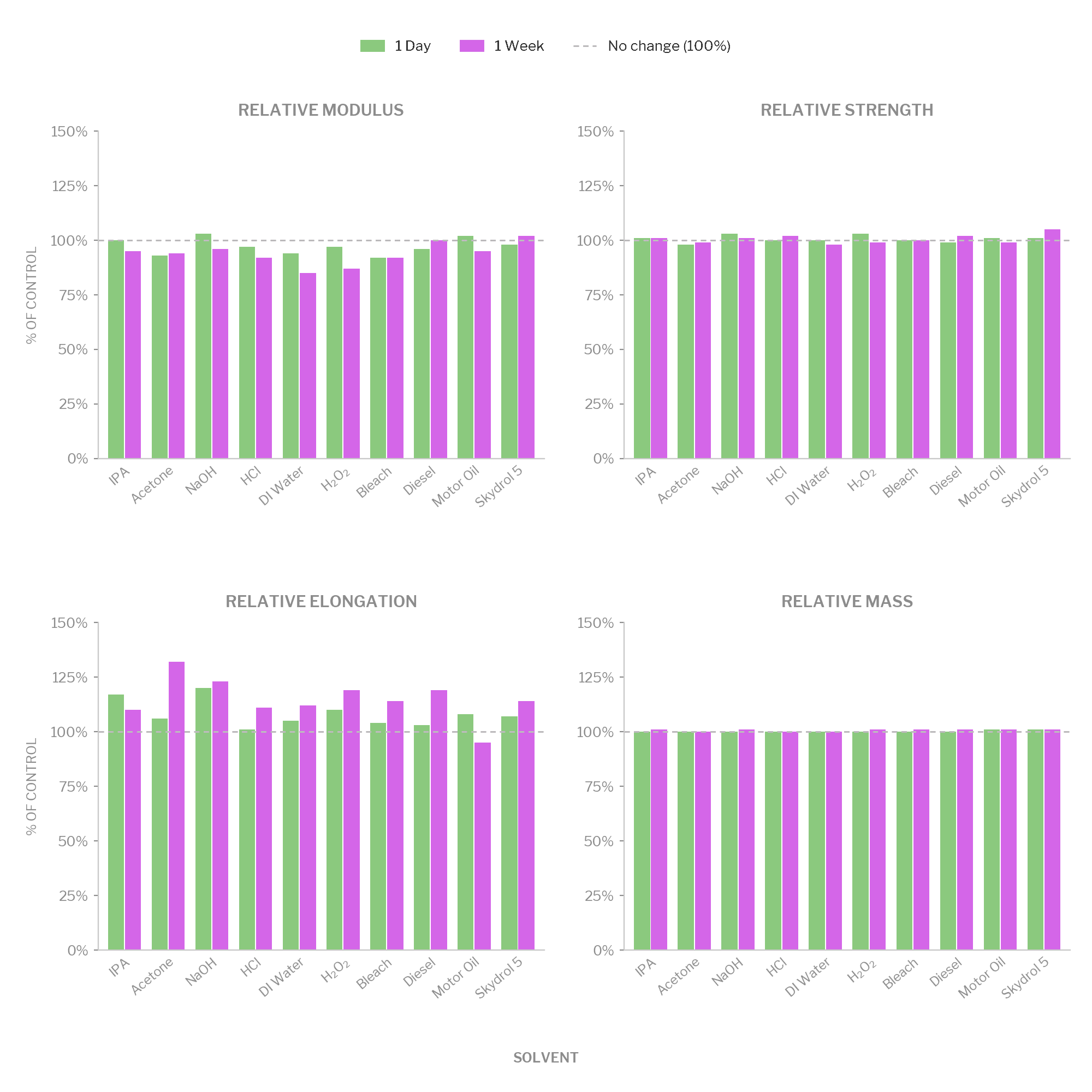
Chemical resistance was evaluated according to ASTM D543. Samples were fully immersed in test chemicals for durations of 1 day and 1 week. Following exposure, samples were manually wiped off and conditioned at 23°C and 50% RH for 24 hours. Mechanical testing was conducted per ASTM D638 (Type IV). Results are reported as the percentage change from non-exposed control samples. 3
Outdoor Aging (ASTM D4329)
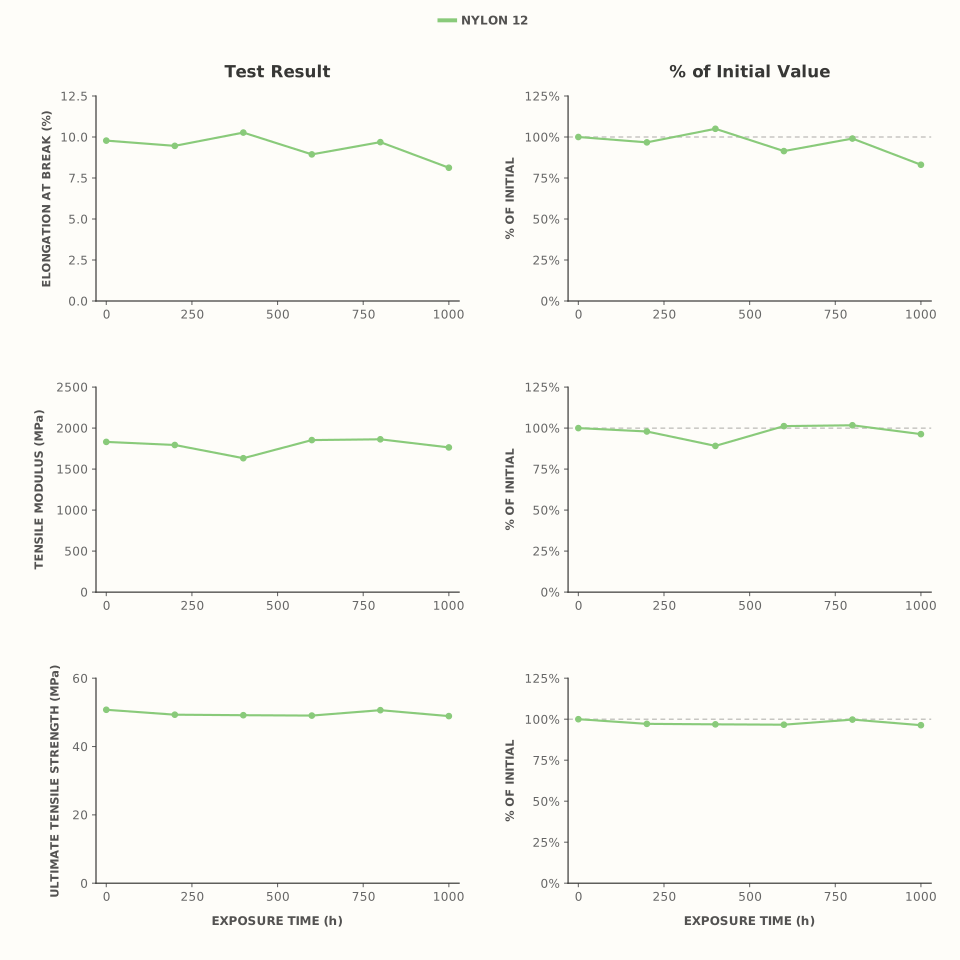
Nylon 12 samples were aged using ASTM D4329-21, Cycle A. This standard outlines procedures for accelerated weathering of plastics using a Xenon arc light source, which simulates the full spectrum of sunlight (UV, visible, and infrared) and includes moisture cycles via water spray. The aged samples were then tested at Formlabs by a calibrated automatic tensile tester, as well as measured and analyzed with a spectrophotometer for color changes.
Read more about the results in the whitepaper.
Footnotes
- Material properties may vary with part geometry, print orientation and temperature.
- Parts were printed using Fuse 1, with Nylon 12 powder. Parts were conditioned at 50% relative humidity and 23 °C for 48 hours before testing.
- Chemical compatibility results are reported relative to non-exposed control samples; a value of 100% indicates no change from control.