
技術白書
Formlabs Logo

熱成形

熱成形

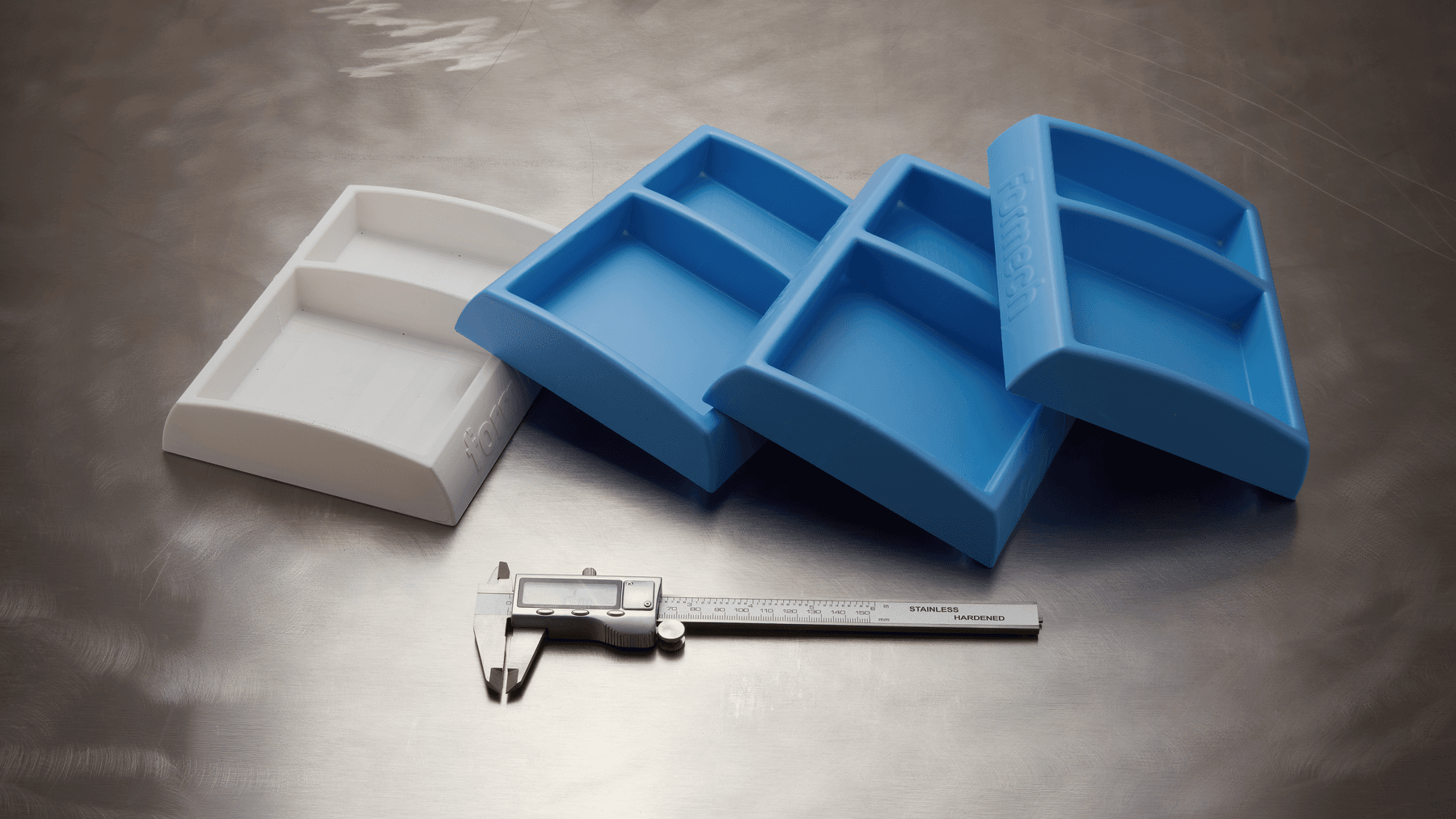
Thermoforming is a manufacturing process where sheets of plastic are heated and layered atop a mold to create an end product. It is used extensively to produce disposable food and medical packaging, consumer goods and appliances, but also for heavy-duty applications such as automotive components and train interior parts. Thermoforming can be employed from one-off parts to batch production with low to moderate unit costs.

Traditionally, thermoforming tools—also referred to as molds, forms, or bucks—are fabricated by CNC machined metal for large production, or wood or composite board (foam or fiberglass) for smaller batches. Producing limited quantities of thermoformed parts for prototypes or low-volume batches is usually not a viable option. Rapid tooling with 3D printed parts is a cost-effective and quick way to produce parts in limited quantities.

熱成形

Formlabs推奨材料

Formlabs typically recommends three materials for thermoforming: Draft Resin, Grey Resin, or Rigid 10K Resin.

  • Draft Resin is best for individual or small batches of tools for rapid prototyping. The low resolution is not ideal for fine details, but the print speed is ideal for large parts, simple designs, initial prototypes, and rapid iterations.
  • Grey Resin is best for individual or small batches with high surface finish quality and fine detail. Grey Resin’s accuracy, consistency, and simple support removal makes it preferable for small parts if speed is not a concern.
  • Rigid 10K Resin is best for tools exposed to more challenging forming conditions. It is an industrial-grade, highly glass-filled material capable of forming a limited series of dozens of parts with cycle times close to production. Rigid 10K Resin has an HDT of 218 °C @ 0.45 MPa and a tensile modulus of 10,000 MPa, making it a strong, extremely stiff, and thermally stable molding material that will maintain its shape under pressure and temperature to produce accurate parts.

The table below offers a summary of our recommendations. More dots indicate better performance under certain conditions:

CriteriaDraft ResinGray ResinRigid 10K Resin
Shorter print times* * ***
Lower material costs* * ** * **
Facilitates support removal** * ** *
Improved surface finish** * ** *
Increased sheet thickness*** * *
Increased forming time*** * *
Decreased cooling time*** * *
Increased number of cycles*** * *

設計上の注意点

When designing a printed part for thermoforming, follow Formlabs’ best practices for additive manufacturing as well as for thermoforming.

To improve the vacuum and the surface finish:

  • Hollow the mold to circulate the air and reduce the volume of resin to save on material costs and printing time.
  • Formlabs recommends 1–2 mm minimum wall thickness.
  • Include air vents respective to the suggested diameter associated with your sheet thickness. Incorporate small vent features on the outside of the mold for a more complete draw and an even distribution of the vacuum across the surfaces to improve part quality.
    • For part printed in Grey Resin: use air vents as small as 0.5 mm in diameter.
    • For parts printed in Draft Resin or Rigid 10K: use air vents with 1 mm in diameter.
  • Avoid sharp edges to reduce the chances of material webbing.
  • Avoid supports on molding surfaces.

To extend the lifetime of the tool:

  • Add a network of ribs following the topology of the part to reinforce the mechanical support and prevent warping.
  • Include notches on the ribs to circulate the air.
  • Increase draft angles of 2–3° minimum to facilitate the demolding.
  • Build assembly features in order to fix the tool to the baseboard of the thermoformer.
    • Integrate tapped holes into the model.
    • In case of dimensional variations, groom with a drill after printing.
    • Plan enough assembly components to prevent breakage during the ejection of the part.
    • Add flat strips at the base of the model in order to fix the tool with double-sided foam tape. Take care as the foam may compress under heat during the process and restrict the vacuum flow.
  • For large molds and higher volumes, include cooling channels to regulate the temperature of the tool.
  • If undercuts or other geometries that are difficult to demold can not be avoided: design the tool in multiple parts. Facilitate part ejection with collapsing bucks can facilitate the part ejection and add magnets to hold parts together.
  • Incorporate a cutline into the CAD design of your tool for trimming the excess material after molding. Elevate your part during the vacuum forming process to mitigate errors at the machine level.

造形時の注意点

Follow Formlabs best practices for model orientation.

Avoid printing supports on molding surfaces. If the geometry allows it, print the mold flat on the edge directly on the build platform, in order to reduce warpage. Printing without supports also saves printing time, labor, and resin. Select a base surface that will minimize overhangs.

後処理の注意点

Once the tools are printed, wash the air vents and cooling channels carefully with IPA following Formlabs best practices and dry the part using an air gun to remove any resin excess that could harden inside the holes. Post-cure the prints according to the Formlabs guidelines. Refer to the individual material articles for specific wash and cure instructions.

  • Groom the tool with sanding, desktop milling, or drilling to meet critical dimensions.
  • Wipe parts printed in Rigid 10K with mineral oil to remove any excess powder from the surface.
  • Consider threading the printed tool to a plate that can be installed on the thermoformer.
  • Use mold releases like Slide or Sprayon to facilitate the demolding and silicone mold releases.
  • Use good cutoff tools to trim your final part; tin snips for thin sheets and Dremel cutoff wheels for over 1.5 mm thick sheets.

最終用途の推奨事項と制限

3D printed thermoforming molds can be used on both benchtop and industrial machines to efficiently and affordably produce dozens of functional prototypes, parts for pilot production, and end-use parts. It is particularly recommended for:

  • Low to medium term manufacturing needs
  • Production runs of 20–50 cycles
  • 3x–7x shorter lead times than traditional tooling

Some limitations include:

  • Degradation of molds printed in Draft Resin or Grey Resin over time
  • For very thin sheets (0.5 mm) at a short cycle time (80s), the quality of the vacuum forming decreases after about 10 iterations and the part is harder to demold.
  • Avoid forming highly abrasive or thick-gauge plastics without testing.

その他資料